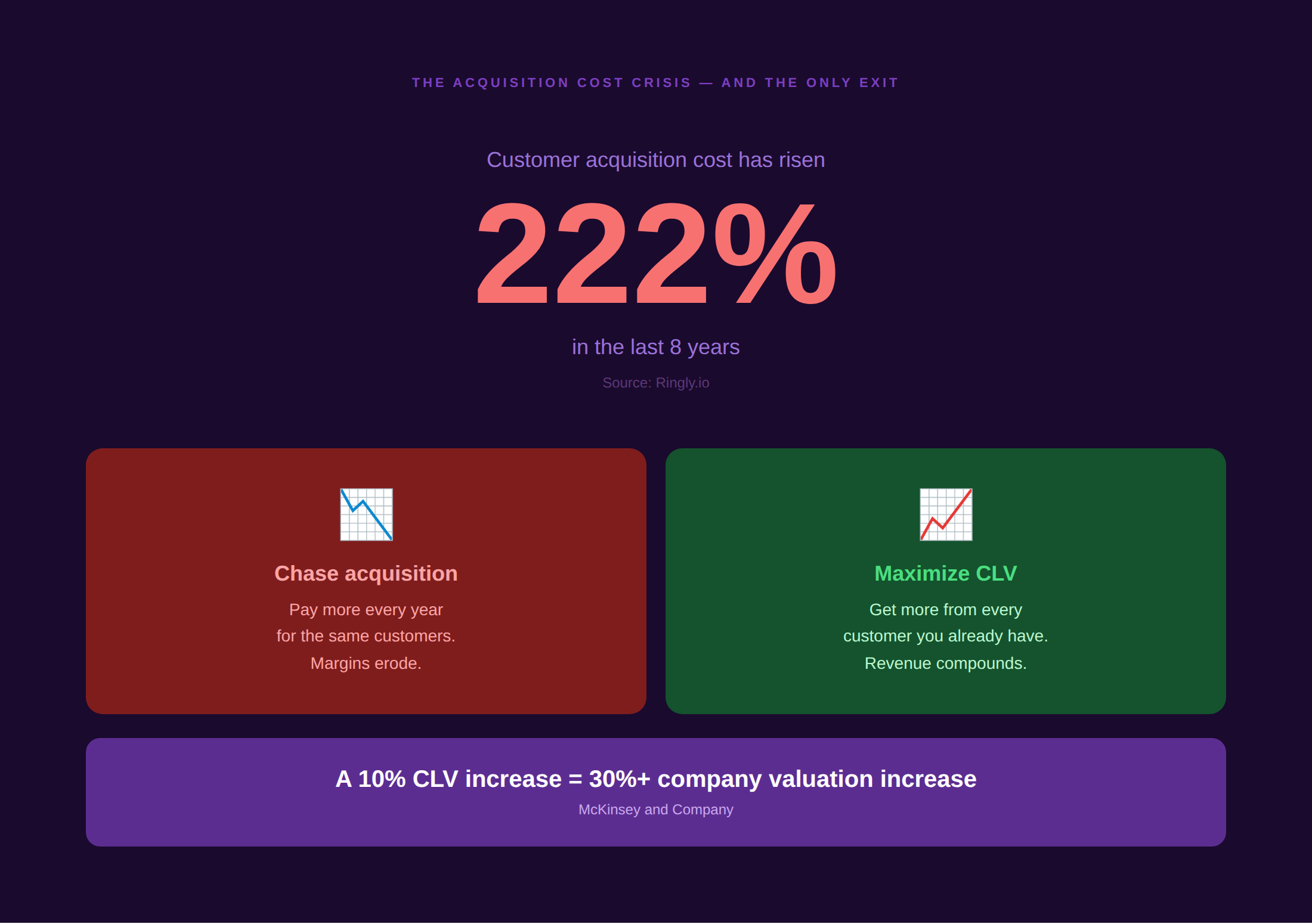
Customer acquisition cost has risen 222% over the past eight years (Ringly.io). That compounding inflation in acquisition economics is why Customer Lifetime Value (CLV) has become the metric every growth leader, CFO, and investor now insists on seeing. When acquiring new customers costs more every quarter, the only sustainable path to profitability is extracting more value from the customers you already have.
CLV answers the question that CAC alone cannot: how much is a customer actually worth over their full relationship with your business, not just on the day they signed up? This guide covers the definition, both formulas, the benchmarks that matter in 2026, how CLV changes across business models, what drives it, and the concrete levers that move it.
What Is Customer Lifetime Value (CLV)?
Customer Lifetime Value (CLV) — also written as CLTV or simply LTV — measures the total net revenue a business can expect from a single customer account over the entire duration of the relationship. All three acronyms refer to the same metric; CLV and CLTV are interchangeable, and LTV is the shorthand most commonly used in investor conversations.
CLV comes in two flavors:
- Historic CLV looks backward. It sums the actual revenue generated by a customer or cohort over a completed period. It is simple, auditable, and useful for understanding segments you already have data on. The weakness is that it cannot capture future value and is prone to survivor bias: the cohort you are measuring includes only customers who stayed.
- Predictive CLV looks forward. It uses statistical or machine learning models to estimate the expected value of a customer or segment over a future time horizon. Predictive CLV is more powerful for resource allocation and acquisition strategy decisions but requires quality historical data and careful model selection to avoid systematic error.
Increasing CLV by 10% can increase company valuation by 30% or more (McKinsey, cited in GrowSurf). That asymmetric relationship between the operating metric and the financial outcome is why CLV has moved from the finance department to the board agenda. In 2026, companies that focus on maximizing lifetime value consistently outperform competitors on profitability, growth rate, and market capitalization.
The Customer Lifetime Value Formula and How to Calculate It
The standard e-commerce formula
CLV = Average Order Value x Purchase Frequency x Customer Lifespan
Where:
- Average Order Value (AOV) is total revenue divided by the total number of orders in a defined period
- Purchase Frequency is total orders divided by total unique customers in the same period
- Customer Lifespan is the average number of years a customer continues purchasing
E-commerce worked example
Average Order Value: $80
Purchase Frequency: 4 orders per year
Customer Lifespan: 3 years
CLV = $80 x 4 x 3 = $960
To get net CLV, multiply by your gross margin percentage.
At 50% gross margin: Net CLV = $960 x 0.50 = $480
The SaaS formula
CLV = ARPU x Gross Margin Rate / Monthly Churn Rate
Where:
- ARPU is Average Revenue Per User (or account) per month
- Gross Margin Rate is (Revenue minus COGS) divided by Revenue, expressed as a decimal
- Monthly Churn Rate is the percentage of MRR lost to cancellations each month
SaaS worked example
ARPU: $500 per month
Gross Margin: 75% (0.75)
Monthly Churn Rate: 2% (0.02)
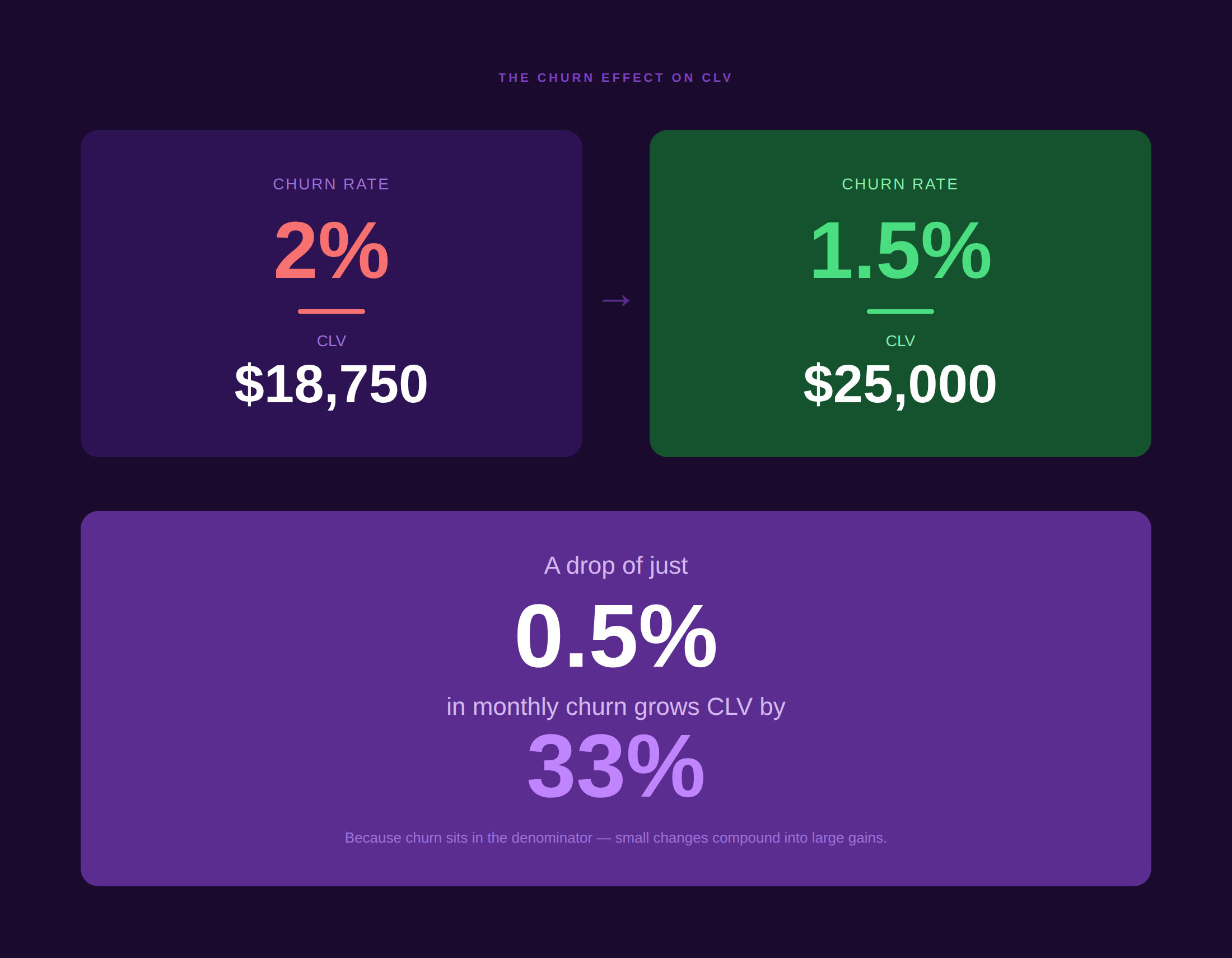
CLV = $500 x 0.75 / 0.02 = $18,750
If churn drops from 2% to 1.5%: CLV = $500 x 0.75 / 0.015 = $25,000
A 0.5 percentage point churn reduction increases CLV by 33%.
The SaaS formula highlights why churn is a CLV lever of exceptional leverage: the churn rate is in the denominator, so small improvements compound into large CLV gains. Use Kayako’s CSAT calculator to track the interaction-level satisfaction data that predicts churn before it appears in your MRR numbers.
Historic vs. Predictive CLV: Which Model Fits Your Business
Most businesses start with historic CLV because the data is already there. You calculate the actual revenue from a defined cohort over a defined period, apply a margin, and you have an auditable CLV figure. The problem with historic CLV is that it only tells you what happened, and because it excludes churned customers by definition, it overstates the expected value of future cohorts unless you correct for survivor bias.
Predictive CLV uses probabilistic models to forecast future purchasing behavior before it occurs. The most widely used framework for non-contractual (e-commerce) customers is the BG/NBD model (Beta-Geometric/Negative Binomial Distribution) for purchase frequency, combined with the Gamma-Gamma model for monetary value. For contractual (SaaS/subscription) businesses, survival analysis and churn-rate-based discounting work better because the renewal decision is the key behavioral event to model.
The practical decision rule: if you have fewer than 500 customers or less than 24 months of behavioral data, use historic CLV with cohort segmentation. If you have sufficient data and need CLV for acquisition targeting, budget allocation, or retention prioritization, move to a predictive model. The accuracy improvement from predictive models, at 25 to 40% better forecast accuracy over traditional approaches (Genesys Growth), only materializes when the underlying data is clean and representative.
The CLV: CAC Ratio — The Most-Watched Unit Economics Metric
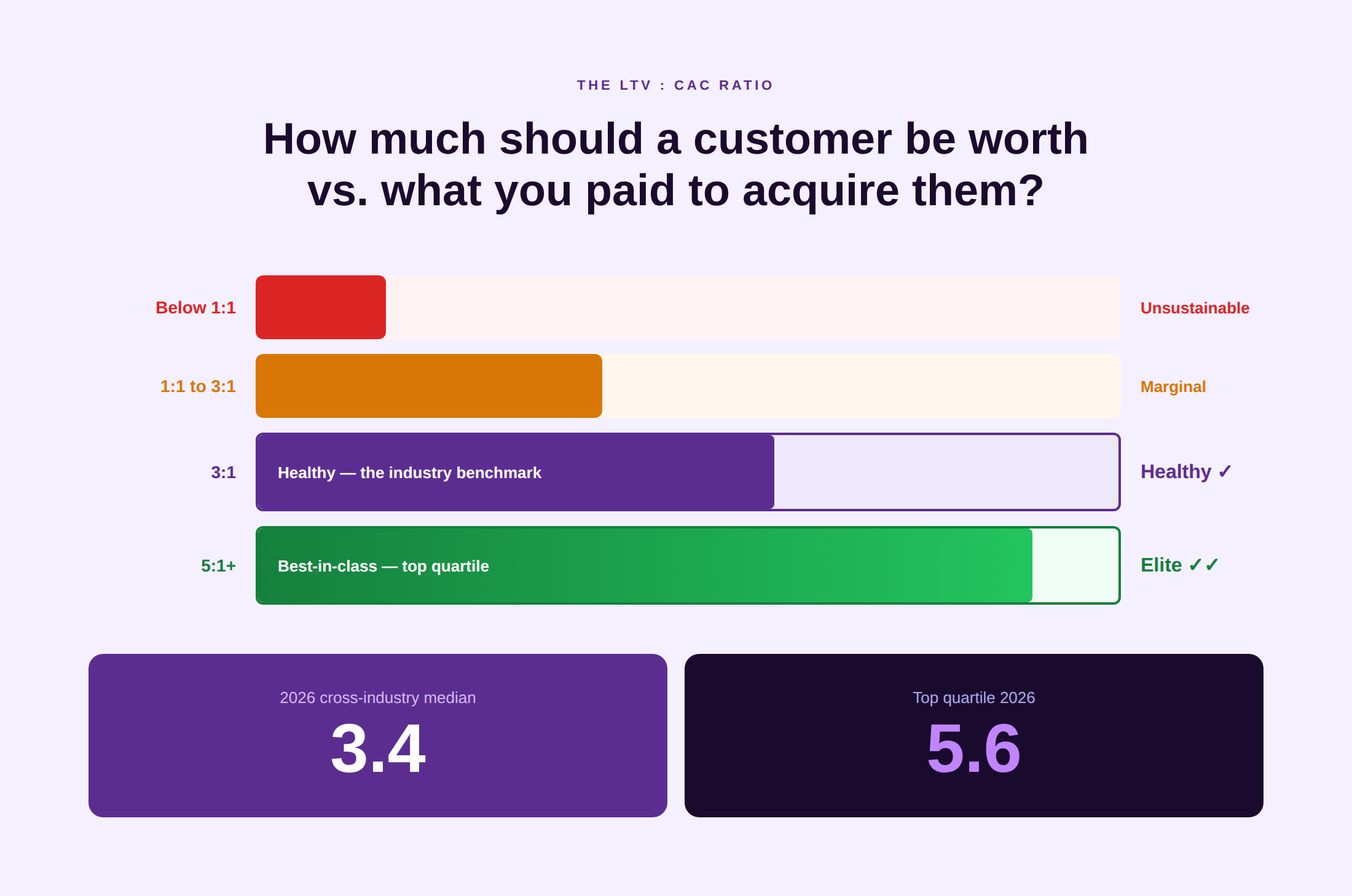
The CLV:CAC ratio divides Customer Lifetime Value by Customer Acquisition Cost. It tells you how much value you generate for every dollar spent acquiring a customer.
- Below 1:1 — You are spending more to acquire customers than they are worth. This is not a growth stage; it is structural unsustainability.
- 1:1 to 3:1 — Marginal. Acquisition costs are consuming too much of the value generated.
- 3:1 — The widely cited healthy benchmark. For every dollar spent on acquisition, three dollars of CLV is generated.
- 5:1 and above — Best-in-class. The business compounds: low acquisition cost relative to long-term customer value creates significant margin for growth investment.
The 2026 cross-industry LTV: CAC median is 3.4, with the top quartile at 5.6 (Digital Applied). The gap between the median and top quartile has widened every year since 2023 as best-in-class operators compound their NRR advantages while lower-quartile companies absorb continued CAC inflation.
Alongside the ratio, track the CAC Payback Period: the number of months it takes to recover the cost of acquiring a customer through gross profit. A payback period below 12 months is healthy for most SMB SaaS; below 18 months is acceptable for mid-market; enterprise SaaS can sustain 24 months given the contract sizes involved. The payback period gives investors and operators a cash-flow perspective that the CLV: CAC ratio, being a long-run metric, cannot.
Kayako’s support platform helps reduce the ticket volume and resolution friction that quietly erodes CLV at the interaction level. See How It Works
What Is a Good Customer Lifetime Value? Benchmarks by Industry
CLV varies so dramatically by business model and segment that universal benchmarks are nearly meaningless. The most useful benchmark is your own CLV: CAC ratio, not an external absolute number. That said, industry context provides useful calibration.
| Industry | Typical CLV range | Key driver |
| Professional services (architecture) | $500K to $1.13M+ | Repeat engagements, high ACV |
| SaaS/subscription (mid-market) | $43,200 median LTV | NRR, expansion revenue, low churn |
| Banking and financial services | $2,000 to $5,000 | Product depth, switching costs |
| Pet products and subscriptions | $380 to $720 | Consumable repeat cycles, loyalty |
| Beauty and cosmetics (e-commerce) | $220 to $450 | Replenishment cycles, AOV |
| Fashion and apparel | $180 to $340 | Purchase frequency, seasonal loyalty |
| General e-commerce (cross-industry) | $100 to $300 | Repeat purchase rate |
| SaaS/subscription (SMB-focused) | $9,850 median LTV | Retention quality, pricing model |
Sources: Digital Applied 2026, Genesys Growth 2026, Dollarpocket 2026, GrowSurf 2026
The 80/20 rule applies sharply to CLV: roughly 80% of a business’s total customer lifetime value comes from approximately 20% of its customers (SAP Emarsys). This concentration means that identifying, retaining, and expanding your highest-value segments has a disproportionate impact on overall profitability.
CLV Across Business Models: SaaS vs. E-commerce vs. B2B
SaaS: churn is the CLV denominator
In subscription SaaS, CLV is dominated by the churn rate. Because the SaaS CLV formula places churn in the denominator, a 0.5 percentage point improvement in monthly churn produces a larger CLV increase than a 10% improvement in ARPU. SaaS Month-12 paid retention currently averages 71%, flattening to 64% by Month 24 (Digital Applied, 2026). The implication: the first-year retention window is where CLV is made or lost for most SaaS businesses.
Expansion revenue (upsells, seat growth, additional modules) is the variable that allows SaaS CLV to exceed initial contract value. Mid-market SaaS median LTV of $43,200 is 4.4 times higher than SMB median LTV of $9,850, and the difference is explained primarily by net revenue retention, not initial pricing.
E-commerce: repeat purchase rate is the driver
E-commerce repeat purchase rates collapse rapidly: 52% by Month 3, 28% by Month 12 (Digital Applied, 2026). This non-contractual behavior makes CLV more volatile and harder to model than subscription SaaS. The levers that matter most in e-commerce CLV are: first-purchase experience (a poor first experience kills repeat behavior), email and SMS retention sequences, and loyalty programs that give customers a financial incentive to return.
Omnichannel customers — those who engage both online and in-store — carry a 30% higher CLV than single-channel customers (Amra and Elma). The behavior that drives that premium is higher purchase frequency, not higher AOV.
B2B: account expansion is the primary CLV engine
In B2B, CLV is driven by account expansion at renewal: additional users, additional products, additional business units, and annual price escalators. Initial contract value is less predictive of total CLV than the expansion rate in years two and three. A B2B account that starts at $50,000 ARR but grows to $200,000 over five years has a higher CLV than one that starts at $80,000 and stays flat. This is why B2B customer success teams treat land-and-expand as a CLV strategy, not just a sales motion.
What Drives Customer Lifetime Value
Retention rate: the foundation
Every other CLV lever operates on top of retention. A customer who leaves cannot be upsold. A 5% increase in retention can boost profits by 25 to 95% (Bain and Company). That range is wide because the impact of retention compounds differently depending on margin structure and expansion potential, but the direction is always the same: the single best investment for CLV improvement is keeping customers longer.
Average order or contract value
Higher AOV or ACV increases CLV arithmetically. The levers are premium product tiers, bundling, and price-tier engineering that create natural upgrade paths. In e-commerce, existing customers spend 67% more than new ones (Amra and Elma), which means the AOV of your retention cohort is already structurally higher than your new-customer cohort.
Purchase frequency and usage depth
In e-commerce, how often a customer buys is as important as how much they spend per transaction. In SaaS, usage depth (feature adoption, seats active, integrations deployed) predicts renewal probability better than contract value alone. The customers who use your product most deeply are the customers who are hardest to replace and most likely to expand.
Gross margin
CLV calculated on revenue rather than gross profit overstates value for low-margin businesses. A $500 CLV with 20% gross margin is worth $100; a $300 CLV with 70% gross margin is worth $210. Always calculate CLV on gross margin, not revenue, when making acquisition or retention investment decisions.
Expansion revenue
For SaaS and subscription businesses, expansion revenue from the existing base is the component that separates 100% NRR from 120% NRR, and that difference is what turns a sustainable business into a compounding one. See how customer success metrics track the signals that precede expansion decisions, giving teams the lead time to act on expansion opportunities before renewal conversations.
How to Improve Customer Lifetime Value
Invest in onboarding above all else
23% of customer churn is caused by ineffective onboarding (Tipsonblogging). Customers who do not reach their first value milestone within 30 days are disproportionately likely to churn before renewal. A structured onboarding program, tracked with milestone-triggered CSAT surveys, is the highest-return CLV investment available because it reduces early-stage churn — the stage where CLV is most fragile.
Build a customer success program before you need one
Proactive customer success outreach at key milestones increases CLV by 20% (Totango, cited in GrowSurf). The word “proactive” is the critical one: reactive CS, which responds to cancellation requests, recovers a fraction of what proactive CS prevents. Teams that monitor login frequency, feature adoption, and customer service satisfaction metrics can identify at-risk accounts 60 to 90 days before they churn, while there is still time to intervene.
Reduce customer effort at every support touchpoint
Harvard Business Review research on the Customer Effort Score establishes that low-effort service experiences are one of the strongest predictors of customer loyalty and CLV. Every ticket that requires the customer to repeat themselves, re-explain their issue, or wait through multiple transfers increases effort and decreases the probability of renewal. Kayako’s SingleView technology gives agents the full customer context before they respond, removing the effort that compounds over a customer’s lifetime into churn.
See how omnichannel customer service eliminates context loss between channels, keeping effort low across every customer interaction.
Engineer pricing tiers for natural expansion
Annual billing reduces churn by 15 to 20% compared to monthly billing (ProfitWell, cited in GrowSurf), because the renewal decision happens once a year rather than twelve times. Beyond billing frequency, pricing tiers that align with natural customer growth, seat-based, usage-based, or feature-tiered, create expansion revenue without a sales conversation. When the customer’s business grows, their spend grows automatically.
Deploy loyalty and referral programs strategically
Community-driven brands see 19% higher CLV from community-engaged customers (CMX Community Industry Report, cited in GrowSurf). Referral programs increase CLV for both sides: referrers become more engaged (and thus less likely to churn), while referred customers demonstrate consistently higher lifetime values because they entered the relationship with pre-existing trust.
Personalize at scale with data
Companies implementing sophisticated personalization strategies regularly achieve 2 to 3 times e-commerce CLV benchmarks. Email nurture campaigns increase CLV by 10 to 15% through improved engagement and repurchase rates. The underlying mechanism is the same in every case: customers who feel known, served according to their specific behavior and preferences, experience lower friction and higher satisfaction, both of which extend the customer lifetime.
Kayako connects your support interactions, ticket history, and customer context into one view so every agent starts from the right place. See Kayako
Common Mistakes When Calculating CLV
- Using revenue instead of gross margin. CLV calculated on revenue includes costs. A $1,000 CLV with 30% gross margin is worth $300 in actual value. Always apply your gross margin rate to convert revenue CLV into profit CLV before using it in acquisition or investment decisions.
- Ignoring discount rates. A dollar received three years from now is worth less than a dollar today. Long-horizon CLV calculations should apply a discount rate (typically the cost of capital, often 8 to 12%) to future revenue streams. Omitting the discount rate overstates CLV for businesses with long customer lifespans.
- Using the mean behavior instead of the median. CLV distributions are typically right-skewed: a small number of very high-value customers pulls the mean up significantly above what a typical customer is worth. The mean CLV includes your top 1% of customers, who are worth 18 times the average in e-commerce. Use median CLV for resource allocation decisions to avoid building a business around atypical customers.
- Survivor bias in historic CLV. Historic CLV calculated on your existing customer base excludes everyone who churned. This systematically overstates the expected CLV of future customers, who will include people who churn early. Correct for this by calculating CLV on full cohorts, including churned members, not just the survivors.
- Mixing gross and net revenue retention without labeling. NRR-based CLV and GRR-based CLV can look identical in format but differ significantly in value. Be explicit about which revenue basis the CLV figure uses, especially when presenting to investors who will apply different multiples to each.
- Not segmenting cohorts before reporting. A company-level average CLV obscures the wide variance between customer segments. Your top 10% of customers likely generate 3 to 5 times the CLV of your median customer. CLV reported without segment context misleads both internal planning and external investor conversations.
Best Tools and Software for Measuring CLV
ChartMogul
Best for: SaaS and subscription businesses wanting the most comprehensive subscription analytics available. Cohort CLV analysis, MRR movement tracking, and NRR reporting built for recurring-revenue businesses.
Baremetrics
Best for: Early-stage SaaS teams wanting fast deployment and clean dashboards. Direct Stripe integration, real-time LTV tracking, and cohort reporting with minimal configuration.
Maxio (formerly SaaSOptics)
Best for: Mid-market SaaS companies needing revenue recognition compliance alongside CLV and NRR analytics in one platform.
Klaviyo
Best for: E-commerce businesses on Shopify and similar platforms. Native predictive CLV modeling is built into the email and SMS marketing platform. Segment by predicted value to direct marketing spend toward high-CLV cohorts.
Optimove
Best for: E-commerce and subscription companies wanting customer-level CLV prediction connected to marketing automation. Strong in retail, gaming, and financial services verticals.
Gainsight
Best for: B2B SaaS customer success teams wanting CLV tied to account health scores, success plans, and expansion playbook triggers. Connects usage data to renewal and expansion probability
Mixpanel / Amplitude
Best for: Product teams wanting to connect in-product behavior (feature adoption, usage frequency, session depth) to CLV outcomes. The data layer that feeds predictive CLV models.
HubSpot CRM
Best for: SMB teams that want CLV tracked within their existing CRM without a dedicated analytics platform. Native deal value and customer lifetime tracking for contacts and companies.
Real-World CLV Case Studies
Amazon Prime: turning CLV into a product
Amazon Prime is the most cited CLV case study in business literature for a specific reason: the $139 annual fee is not primarily a revenue stream; it is a customer behavior modification instrument. Prime members spend an average of $1,400 per year on Amazon; non-Prime customers spend $600. The membership fee turns occasional shoppers into habitual ones, increasing purchase frequency, the core CLV driver in e-commerce, without requiring any additional acquisition spend. Prime is a CLV improvement program structured as a product.
Starbucks Rewards: loyalty driving frequency
Starbucks Rewards members visit Starbucks twice as often as non-members and account for over 40% of US revenue. The program’s CLV impact comes primarily from purchase frequency rather than AOV: reward points create a behavioral commitment to return before the next reward expires. The program demonstrates that loyalty mechanics do not need to offer large discounts to increase CLV; they need to create a behavioral pattern of return.
Snowflake and Datadog: NRR-driven CLV at scale
Both Snowflake and Datadog have demonstrated that the highest CLV in enterprise SaaS comes from usage-based pricing models where customer spend grows automatically as their operational scale increases. Snowflake’s consumption model produced a peak NRR above 158%, meaning each cohort’s CLV was growing by 58% annually purely from expanded usage. This is the ultimate expression of expansion-driven CLV: the product design makes CLV growth the natural consequence of customer success, requiring no intervention from a sales or CS team to realize it.
Acquiring a customer and then getting regular business out of them is a tightrope that very few companies are able to ace. It demands a perfect blend of pricing, services, value, and most importantly, longevity and requirements from the customer’s perspective. Giants like Amazon, Uber, and even Netflix have somewhat cracked the code of making themselves constantly relevant in people’s lives. After all, each business would love to have a repeat customer that guarantees a strong bottom-line revenue in these tough times.
FAQs
What is Customer Lifetime Value?
Customer Lifetime Value (CLV) — also written as CLTV or LTV — is the total net revenue a business can expect from a single customer account over the entire duration of the relationship. It can be calculated historically (looking back at actual revenue from a cohort) or predictively (using models to forecast future value). CLV is the fundamental metric for understanding whether customer acquisition and retention investments are generating sustainable returns.
What is the formula for Customer Lifetime Value?
There are two main formulas. For e-commerce: CLV = Average Order Value x Purchase Frequency x Customer Lifespan, then multiply by gross margin to get net CLV. For SaaS: CLV = ARPU x Gross Margin Rate / Monthly Churn Rate. Both should be calculated on gross margin, not revenue, to reflect actual value. Segment your customer base before calculating to avoid mean-skewing from outlier accounts.
What is a good Customer Lifetime Value?
There is no universal good CLV; it depends entirely on your business model, industry, and acquisition cost. The most useful benchmark is your CLV: CAC ratio, not an absolute CLV figure. A 3:1 ratio is the widely cited healthy minimum; 5:1 or above is best-in-class. The 2026 cross-industry median is 3.4, with the top quartile at 5.6. In e-commerce, average CLV typically runs $100 to $300; in mid-market SaaS, median LTV is $43,200.
What is a good LTV: CAC ratio?
3:1 is the widely cited minimum for a healthy SaaS or subscription business. Below 1:1 is structurally unsustainable. Above 5:1 is best-in-class and indicates either exceptionally high CLV or very efficient acquisition, both of which are positives that investors reward with premium valuation multiples. The 2026 cross-industry median sits at 3.4, with the gap between median and top quartile continuing to widen.
How is CLV different in SaaS vs. e-commerce?
In SaaS, CLV is determined primarily by the churn rate (which sits in the denominator of the formula) and expansion revenue (upsells, seat growth). A small churn improvement produces a large CLV gain because of the denominator effect. In e-commerce, CLV is determined by repeat purchase rate and AOV; the relationship is linear rather than denominator-driven. SaaS Month-12 retention averages 71%, while e-commerce repeat purchase rates fall to 28% by Month 12, making the two models fundamentally different even when the headline CLV numbers look similar.
How do I increase Customer Lifetime Value?
The five highest-leverage levers in order of typical impact: (1) fix onboarding to reduce early-stage churn, which accounts for 23% of all churn; (2) implement proactive CS outreach at usage milestones, which increases CLV by 20%; (3) reduce customer effort at every support touchpoint to prevent the friction that quietly drives non-renewal; (4) switch to annual billing to reduce churn by 15 to 20%; (5) engineer pricing tiers for natural expansion so that customer growth automatically increases their spend. See how first contact resolution improvement protects CLV at the interaction level.
Why is CLV more important than CAC?
CAC tells you what you paid to acquire a customer. CLV tells you what that customer is actually worth. CAC without CLV is like knowing the price of an asset without knowing its return. A $500 CAC that produces a $1,500 CLV is a better investment than a $200 CAC that produces a $400 CLV. CAC has risen 222% in eight years and will likely continue rising; the only sustainable response is maximizing what you extract from each customer acquired. That is the CLV imperative for 2026 and beyond.