Drift is the conversational marketing platform that invented the category. A chat widget goes on your website, playbooks decide who sees which conversation based on account, page, and behavior, a bot qualifies the visitor, and a meeting lands on the right sales rep’s calendar without a form in sight. Around that sit visitor tracking, a prospector dashboard showing which companies are browsing, video messaging, and Salesforce and Marketo integrations that were genuinely best in class. It was sold to mid-market and enterprise B2B revenue teams, and the entry plan was listed at $2,500 a month.
This review is written by Colin Guilfoyle, SVP of Customer Support at Trilogy, who has spent roughly a decade leading support functions and buying the platforms that run them. He has not run Drift in production, and nothing here is bench testing. What follows is built from primary security and regulatory reporting, from vendor and marketplace listings read firsthand and dated, and from a close read of what practitioners describe across four review platforms. Where there is an opinion, it comes from that experience of operating customer-facing systems. Where the evidence disagrees with the opinion, the evidence wins.
I need to lead with something the review sites will not tell you. Drift is being retired. Clari and Salesloft announced a gradual sunset on 6 March 2026, named a successor product, and closed Drift to new customers, and that followed a security incident in August 2025 that reached more than seven hundred organizations. Neither fact appears on the listings currently ranking for this search. What follows explains what happened, reads the ratings honestly given that context, grades the product feature by feature for the teams still running it, and names the alternatives worth moving to.
How I evaluated Drift
Software gets judged over a renewal cycle, and in this case over a wind-down. Six criteria, in the order they matter.
Hands-on use. I did not run Drift and will not claim otherwise. What I examined directly are the current marketplace listings, the published plan structure and entry price, and the primary incident advisories, all read on 8 August 2026.
User reviews, at volume and in depth. G2, Capterra, Trustpilot and Reddit, read for what people describe and, critically here, for when they wrote it. Review age turned out to matter more than review content.
Depth and breadth of features. Whether the product covers a real support and engagement surface. Drift was always narrow by design, and that design choice is the whole story of what happened to it.
Scalability. Seat model, routing, CRM object mapping, and behavior across territories and brands.
Pricing and forecastability. The bill you cannot predict, and in this case the contract you may not be able to exit cleanly.
Support the vendor gives you. Measured before and after the acquisition, because the two are not the same product experience.
Two standing exclusions. Employer-review content from Glassdoor and AmbitionBox is dropped, because it measures the company as a workplace rather than as a vendor. And this one needs stating plainly: nearly every article ranking for Drift searches right now is published by a company selling a Drift replacement, several with migration offers attached. I have used those for orientation only and grounded every factual claim in primary reporting.
What you are actually buying in 2026
The short answer is a migration project.
Drift launched in 2015 and defined conversational marketing. Salesloft acquired it in February 2024 for a reported $500 million. Clari and Salesloft then merged in December 2025, and on 6 March 2026 the combined company announced Drift’s gradual sunset, naming 1mind as the successor for existing customers. No hard end-of-life date has been published, and active development has ended.
Between those two events came the incident that matters most to anyone holding customer data. In August 2025, a threat actor tracked as UNC6395 used compromised OAuth tokens from the Drift application to reach connected systems. According to Google Threat Intelligence Group’s advisory, the activity ran from at least 8 to 18 August 2025 and systematically exported large volumes of data from corporate Salesforce instances, with credential harvesting assessed as the primary intent.
The detail support leaders should sit with is what was taken. The exfiltrated material was largely support case text, contact records, and account information. Support cases are where customers paste API keys, tokens, and connection strings, which is precisely why credential harvesting was the goal. A chat and lead capture tool became a route into the credential store of more than seven hundred companies, among them Cloudflare, Palo Alto Networks, Zscaler, Proofpoint and Google itself.
Salesloft and Salesforce revoked all Drift tokens on 20 August 2025, Salesforce removed the application from its marketplace, and the scope later widened beyond Salesforce to the Drift Email integration in Google Workspace. FINRA issued a member alert telling regulated firms to disconnect Salesloft integrations and rotate credentials. When a securities regulator writes to its members about your chat widget, the category of problem has changed.
The ratings disagree, and every one of them is out of date
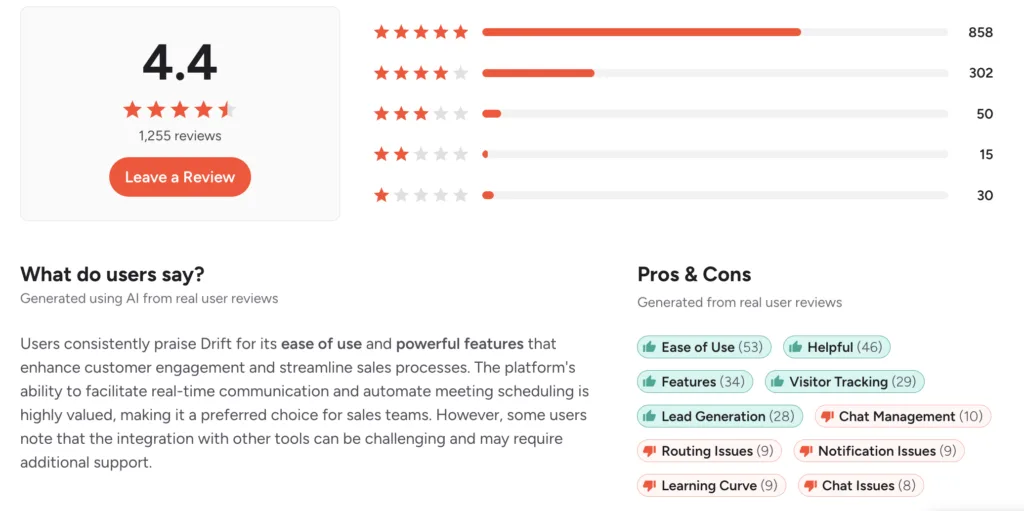
Here is where Drift sits across the four platforms as of August 2026.
|
Platform |
Score |
Reviews |
What the audience is |
|---|---|---|---|
|
G2 |
4.4 / 5 |
1,255 |
Mostly SDRs and reps, weighted to 2024 |
|
Capterra |
4.5 / 5 |
199 |
Corpus concentrated in 2019 and 2020 |
|
Trustpilot |
No usable corpus |
None |
Profile conflated, vendor page thin |
|
|
No score |
Security threads |
Incident responders, not marketers |
Three things undercut those numbers, and together they matter more than the scores themselves.
The first is who wrote them. Read the G2 corpus and the reviewers are overwhelmingly sales development representatives, account development executives, and business development reps. Those are end users who did not sign the contract and never saw the invoice. They loved it, and their enthusiasm is real, but a 4.4 built from people who do not pay is not a buying signal.
The second is when. The bulk of the five-star G2 entries cluster in the first eight months of 2024, immediately after the acquisition. The Capterra corpus skews older still, with much of the most-helpful content dating from 2019 and 2020. Both aggregates describe a product and a company that no longer exist in that form.
The third is what is missing. The G2 listing was last modified in July 2026 and still presents Drift as a live product with three pricing plans and no sunset notice. Trustpilot offers nothing usable either: the drift.com profile carries reviews about one-time purchases converting to subscriptions, which points to a different company, and the Salesloft vendor profile holds only nineteen reviews, far too few to read as a signal. I am reporting that as a gap rather than filling it with a number that would look authoritative and mean nothing.
On Reddit, the pattern is its own finding. Search Drift across the past year, and the substantial threads are in r/cybersecurity and r/sysadmin, tracking victim disclosures and remediation. The conversation moved from marketing subreddits to incident response.
That is the last score in this review. Everything after this comes from what people described.
What users actually say about Drift
Five themes recur, ordered by how often they came up.
Speed to meeting was genuinely excellent
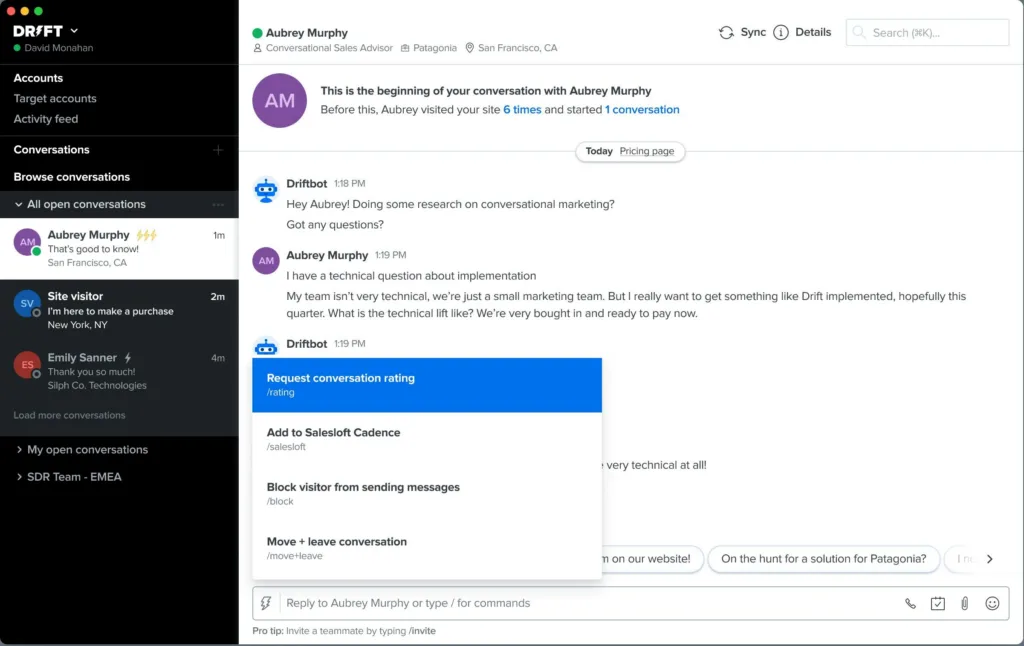
The praise is consistent and specific. Reps describe prospects booking directly into their calendar while still browsing, bot qualification handling the first questions so the conversation starts warm, and the prospector dashboard showing which accounts were on the site and what they read. Several describe it as their highest-contributing source of meetings. Whatever else is true, this part worked.
Routing sent conversations to the wrong people
The most common operational complaint by a distance. Reps across territories describe receiving leads outside their patch, meetings booked with them for accounts they do not cover, and bots scheduling with prospects using personal email addresses. Others describe meetings landing outside their configured working hours. None of this is fatal; all of it is friction, and it recurs across years.
Notifications were unreliable in both directions
Reviewers describe delays that meant the visitor had already left by the time the alert arrived, blank screens on the mobile app, and floods during busy periods that made the queue unmanageable. For a product whose entire value is responding within seconds, this is the criticism that most undercuts the pitch.
The Salesforce integration was the best in the category, until it was not enough
Praise for the CRM sync is genuine and repeated. The ceiling is specific. Glorianna S., running an in-house implementation at a staffing agency, described Drift attributes only being mappable to native Salesforce Leads and Contacts objects rather than custom objects, which forced everything into a single crowded view as her team built more playbooks. She also flagged an inability to test reusable blocks before publishing them into live playbooks.
After the acquisition, the commercial relationship deteriorated
This is where the recent reviews concentrate. One reviewer in October 2025 described support quality dropping sharply following the acquisition, the service being disrupted for around ten days during the August incident, and then attempting to cancel the renewal while Salesloft continued calling for payment. That reviewer reported the charge eventually being processed against an American Express card that had expired the previous year. Javier B., writing at greater length, described support as generally responsive but slow on complex issues, with follow-up on tickets taking longer than expected.
A note on sourcing. Capterra’s Drift entries are old enough that several carry vendor responses from staff who no longer work there. The wider web is worse: search results for this keyword are dominated by competitors offering contract buyouts and free migrations to Drift customers, some with named deadlines. Treat any Drift recommendation or condemnation you find on a vendor blog as commercially motivated in both directions.
Drift pros and cons
|
Pros |
Cons |
|---|---|
|
Best-in-class speed from visit to booked meeting |
Product is being retired with no end-of-life date |
|
Playbook targeting by account and behavior |
Routing misassigns leads across territories |
|
Prospector dashboard genuinely useful for reps |
Notification delays undercut real-time promise |
|
Salesforce sync reps trusted daily |
Maps only to native CRM objects, not custom |
|
Fast for non-technical teams to launch |
Entry pricing started at $2,500 a month |
|
Video and email tools bundled in |
Support declined sharply after acquisition |
|
Strong onboarding and training reputation |
OAuth integration was the breach vector |
What Drift did better than anyone
Compressing the distance between interest and conversation. A buyer reading your pricing page could be talking to the right rep within seconds, and no form stood in the way. That idea reshaped B2B websites, and the reason so many reviewers sound genuinely fond of it is that it worked. The category exists because Drift built it.
What you will be living with
An unsupported product on an undeclared clock, a vendor whose attention is elsewhere, and an integration surface that has already been demonstrated as a supply chain risk. None of that is a criticism of the software as it was. It is a description of what owning it means now.
Feature by feature, based on the reviews
Pricing and contract structure
Pricing was never public. The entry plan was listed at $2,500 a month with an annual commitment; higher tiers were quote-only, and there was no free or starter option, so every customer was paying enterprise rates from day one with no meaningful way to trial first.
The structural problem practitioners named was seat coverage. To route conversations properly, you needed a seat for everyone who might receive one, which in practice meant the whole sales team. One reviewer put it plainly: to be effective, you buy for everyone, and that gets expensive fast. So the tool’s core value, getting the right rep into the conversation instantly, was also the mechanism that multiplied the license count.
Renewal is now the live issue rather than list price. Reports of cancellation attempts being met with continued collection calls, and of a charge processed against a card that had already expired, describe an exit that was harder than the entry. If you are still on contract, I would put your notice period and your renewal date in writing this week, and confirm what happens to your data at termination before anything else.
The chat widget, playbooks and routing
Playbooks were the good part, and they hold up. Targeting by account, page, referral source, and firmographic data let teams show different conversations to different buyers, and reviewers describe launching a working bot from a template in hours rather than weeks.
Routing is where the operational complaints concentrate, and they are consistent across four years. Leads arriving outside a rep’s territory, meetings booked with the wrong coverage owner, and bots accepting personal email addresses that then consume a rep’s calendar slot. Reviewers also describe availability being tied to calendar state, so blocking focus time removed you from the live chat pool whether you meant it or not.
Maintenance had rough edges too. Editing large playbooks was described as awkward enough that one practitioner resorted to exporting and reformatting raw data, and reusable blocks could not be tested before being published into live flows. For a system sitting on your pricing page, publishing untested changes is a real risk.
AI and conversational qualification
The AI did one job well, and it was qualification rather than resolution. Bots asked predefined questions, scored the answer, and either booked or routed. Reviewers describe that as reliable and genuinely time-saving for sales development teams.
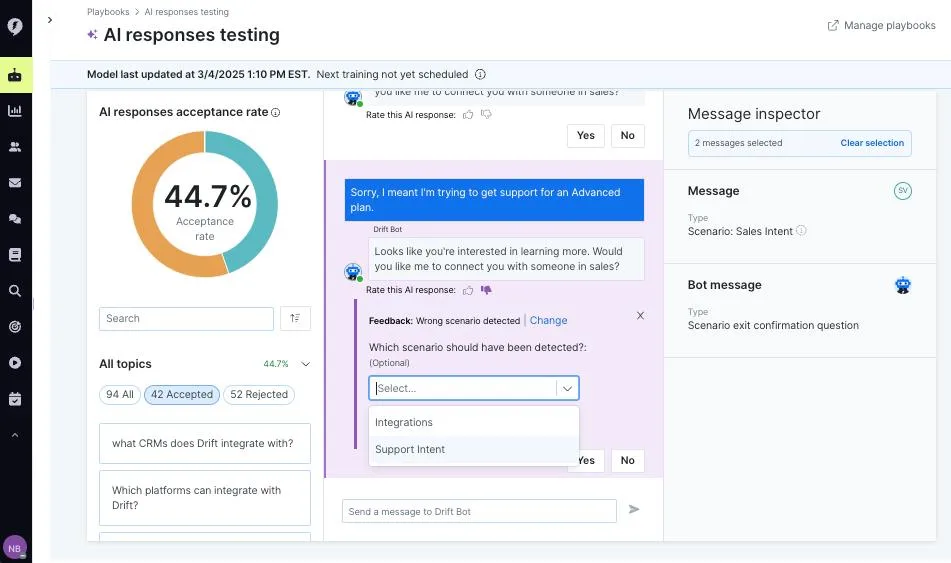
The limits are worth naming for anyone considering it as a support tool, which it never was. Reviewers describe bots failing to parse answers that did not match the expected format, with one giving the example of a UK mobile number entered without an international prefix, after which the visitor simply left. Others describe a high volume of low-quality conversations requiring continuous tuning to filter. There is no resolution concept, no knowledge base grounding of the kind support teams need, and reporting on conversation performance rather than on outcomes.
Integrations, data flow and the OAuth surface
This section reads differently after August 2025, and it should.
Functionally, the Salesforce integration was the strongest in the category, and the Marketo, Slack, Teams, and calendar connections were solid. The constraint reviewers hit was object mapping, with attributes pushing only to native Leads and Contacts rather than custom objects, which limited how far teams could model their own processes.
The security lesson is broader than Drift and worth carrying to whatever you buy next. The tokens that made the integration convenient were also standing, broadly scoped credentials into the systems holding your customer conversations. When they were compromised, multi-factor authentication did not help, because the attacker was not authenticating as a user. Reporting on the campaign describes the actor deleting query jobs afterward to obscure the activity.
I would ask any chat or support vendor three questions now that I would not have thought to ask two years ago. What scopes does your integration request, can they be narrowed, and how quickly can every token be revoked by me rather than by you?
Vendor support and account management
Before the acquisition, support was a selling point. Reviewers describe named account teams making proactive playbook recommendations, trainers working across time zones, and responsive help during setup. That reputation is one of the most consistent positives in the whole corpus.
After it, the picture inverts. Recent reviewers describe support quality dropping noticeably, complex issues taking longer than expected to resolve, and account contacts changing. The service disruption during the August incident lasted around ten days for one customer’s account, during which the widget was down.
Set the two halves side by side, and you get the clearest possible illustration of acquisition risk. The vendor you evaluated is not necessarily the vendor you renew with, and nothing in a feature comparison captures that.
Product direction and what happens to your data
Development has ended. The successor named by Clari and Salesloft is a different kind of product, built around AI video presenters rather than text chat, and it does not carry across the visitor de-anonymization and intent capabilities Drift customers relied on. Migration to it is a re-platform, not an upgrade.
The absence of a published end-of-life date is the part I would treat as urgent rather than reassuring. A gradual sunset with no fixed date gives you no planning anchor, while feature degradation, integration breakage and support delays all tend to arrive well before the formal cutoff. Export your conversation history, your playbook logic and your attribution data now, while there is still someone to raise a ticket with.
Drift alternatives, by what you are solving for
You want conversations that resolve questions, not just book meetings
Most teams discovered during the wind-down that a large share of their Drift chats were support questions rather than sales inquiries. Kayako is built for that half, grounding answers in your own help content and reporting on what actually got resolved. You give up Drift’s account-based targeting and prospector dashboard. Test it by tagging a fortnight of chat transcripts and counting how many were buying questions.
You need the whole conversation surface in one place
If Drift was one of three or four tools handling customer messages, consolidating is the cheaper move. Kayako’s omnichannel setup brings website chat, email and social into a single queue with routing you control. You give up specialist marketing playbook depth. Test it by listing every inbox a customer message can currently land in.
You want a like-for-like replacement for the sales chat use case
Drift alternatives built for pipeline generation cover the same ground, with visitor identification and meeting booking. Be wary of the migration offers circulating with deadlines attached, since a rushed re-platform under time pressure is how configuration debt gets baked in. Test any of them by rebuilding your single highest-converting playbook first.
You are a product-led company, and chat sits inside the product
Intercom covers in-product messaging with per-resolution AI pricing and a mature support workflow underneath. You give up ABM-style targeting, which Drift did better. Test it by checking what share of conversations start inside your product rather than on your marketing site.
You want something lighter and cheaper on the website
Tidio handles website chat and basic automation at a fraction of the cost, and suits teams whose volume never justified enterprise pricing. You give up routing sophistication and CRM depth. Test it by pricing your actual monthly conversation volume rather than your seat count.
You have outgrown point tools and need a service desk
Zendesk or a comparable platform brings SLAs, entitlements, and audit trails, none of which Drift attempted. You take on configuration overhead. Test it by asking whether anyone has asked you for an audit trail you could not produce.
Three questions decide this for any option: what it costs per resolved conversation at your real volume, what integration scopes it requests and whether you can revoke them yourself, and what the exit looks like in writing.
Verdict
Drift deserves its reputation and does not deserve a recommendation. It invented conversational marketing; it compressed the path from a visitor reading your pricing page to a meeting on the right rep’s calendar better than anything before it, and the fondness in the reviews is earned rather than manufactured. Nobody who bought it in 2021 made a mistake.
Buying it in 2026 is a different question, and the honest answer is that you cannot. Development has stopped, the product is closed to new customers, the successor is a different category of tool, and the integration that made it valuable was the vector for a supply chain attack that reached more than seven hundred organizations and prompted a regulatory alert. On Monday, if you still run it, I would do two things. Pull your notice period and renewal date and get your exit terms confirmed in writing, because the cancellation stories in the recent reviews are the most consistent recent theme. Then export your conversation history, playbook logic, and attribution data while support still exists to help, and start the replacement evaluation on your timetable rather than on a migration offer’s deadline.
Drift FAQs
Is Drift shutting down?
Yes, gradually. Clari and Salesloft announced the sunset on 6 March 2026 and named 1mind as the successor. No hard end-of-life date has been published, and existing instances still run, but active development has ended, and the product is closed to new customers.
Was Drift hacked?
In August 2025, a threat actor used compromised OAuth tokens from the Drift application to export data from Salesforce instances at more than seven hundred organizations. The material taken was largely support case text and contact records, and credential harvesting was assessed as the goal. All Drift tokens were revoked on 20 August 2025.
Should I still be using Drift?
If you are mid-contract, it will keep working for now. I would treat it as a system to exit rather than invest in, confirm every integration token has been rotated since August 2025, and narrow any remaining connection scopes.
What did Drift cost?
The entry plan was listed at $2,500 a month on annual billing, with higher tiers quoted privately. There was no free or trial tier, and effective use generally meant buying seats for the whole sales team.
What should I replace Drift with?
It depends on which half of your Drift traffic mattered. If most conversations were support questions, move to a support platform with resolution reporting. If they were genuinely sales inquiries, look at pipeline-focused tools. Tag two weeks of transcripts before choosing, because most teams are surprised by the split.