Freshdesk Pricing 2026: Plans, Costs, Features, and Is It Worth It?
Pricing tells you what Freshdesk costs. Use cases tell you whether it is worth paying for. This guide covers both.
|
Quick answer. Freshdesk pricing in 2026 runs per agent per month: Growth $19, Pro $55, and Enterprise $89 on annual billing, after Freshworks raised every tier in 2026. The omnichannel suite costs more, and the headline seat price is not the real one: Freddy AI Copilot adds $29 per agent and is gated to Pro and above, while the Freddy AI Agent bills per session once a one-time pool runs out. So the real question behind Freshdesk pricing is whether the plan and AI you need are worth it for your team. Key takeaways
|
Freshdesk pricing looks simple: three ticketing tiers, but the real cost depends on how many agents you have, which features you need, and how much AI you turn on. Freshworks raised every tier in 2026, and the sticker seat price leaves out the two things that move the bill most: the AI add-ons and the omnichannel upgrade.
This guide covers what each plan is built for, what really drives the bill once Freddy AI is in the picture, and when Freshdesk is worth it against when a simpler, resolution-priced tool would do the same job. It ends with a decision tree and a scenario table so you can place your own team.
1. Freshdesk pricing at a glance
Here is the Freshdesk ticketing ladder on annual billing. Treat it as the entry point, because the AI add-ons and the omnichannel suite sit on top.
|
Plan |
Price per agent (annual) |
Built for |
|---|---|---|
|
Free |
$0 (time-limited) |
A tiny team trialing basic ticketing |
|
Growth |
$19 / month |
Small teams wanting core email and ticketing |
|
Pro |
$55 / month |
Growing teams needing routing, SLAs, and AI assist |
|
Enterprise |
$89 / month |
Large or regulated operations needing controls |
Note. These are ticketing prices on annual billing, and Freshworks raised every tier in 2026. The omnichannel suite, which adds chat, messaging and phone as first-class channels, runs $29, $79 and $119 per agent. The free tier is now a time-limited program for one or two agents rather than a standing plan.
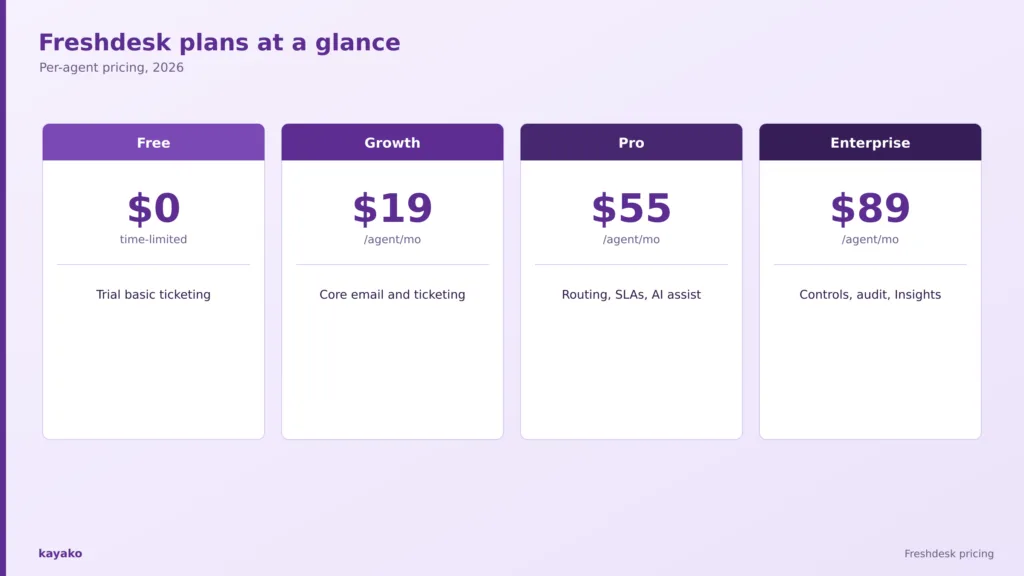
The Freshdesk ticketing tiers. Freddy AI add-ons and the omnichannel suite sit on top of these per-agent prices.
That table is the easy part. Before breaking down what moves the number, it helps to hear from the teams already paying it.
2. What people say about Freshdesk on G2, Capterra, and Reddit
Freshdesk holds strong ratings, around 4.4 out of 5 on G2 from roughly 3,800 reviews and 4.5 on Capterra from about 3,500. The standout themes behind the scores tell the buying story.
What people praise
- Intuitive UI and a short learning curve. The most repeated point: teams report new agents onboarding in a couple of days.
- True omnichannel consolidation. Email, chat, WhatsApp, social, and web forms collapse into one ticket thread.
- Affordable versus Zendesk. Switchers repeatedly cite Freshdesk as the better-priced option, especially the omnichannel bundle.
- Automation that offloads work. Routing, SLA management, and canned responses cut repetitive effort.
- Often-praised support team. Many reviewers single out Freshdesk’s own support as fast and helpful.
What people flag
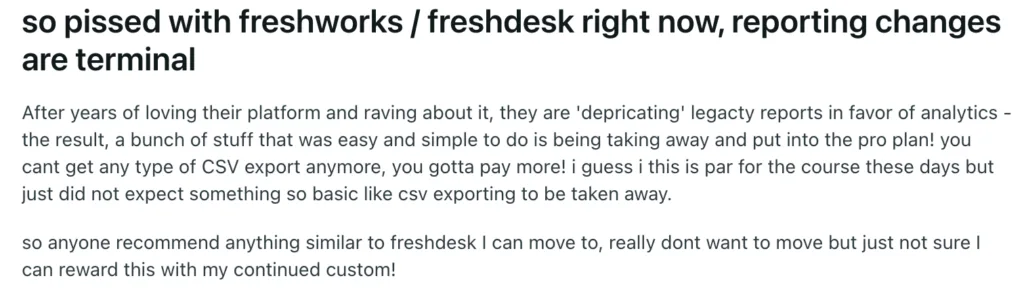
- Features gate to higher tiers. Skills-based routing, deeper analytics, and the better AI sit on Pro and Enterprise, so cost climbs fast for growing teams.
- Native reporting is basic. Several users export tickets and rebuild reports elsewhere because the built-in analytics are limited.
- Freddy AI cost is hard to forecast. The per-session meter and expiring packs make spend unpredictable, and on Reddit, users warn that usage-based AI support pricing looks cheap up front but produces surprise bills as volume climbs.
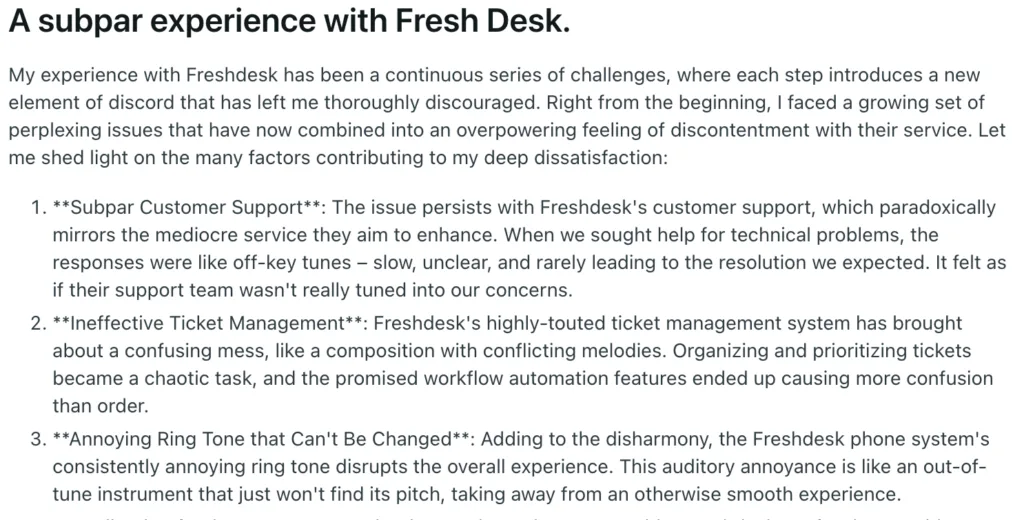
- Contracts and seat lock-in draw complaints. One reviewer described paying for far more seats than used over the long term, and a 2026 price rise that removed a loyalty discount.
- Performance can lag under load. Rate-limit errors and slow loading appear at high volume, along with a recurring mailbox bug that creates duplicate tickets.
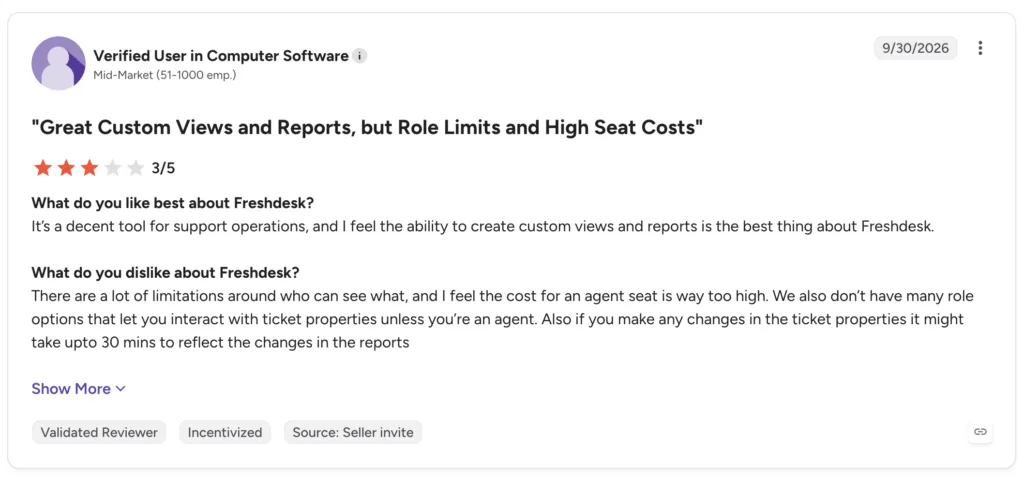
None of these are vague grumbles. They trace back to how the Freshdesk bill is assembled once AI is on, which is worth breaking down next.
|
3. What actually determines your Freshdesk cost?
Freshdesk is billed per agent, so headcount is the first lever: Pro at $55 across twenty agents is $13,200 a year, and the omnichannel suite raises that again. The seat price, though, is only the start once you want the AI.
The gate that catches growing teams is Freddy AI Copilot, the agent-assist AI. It costs $29 per agent and is sold only on Pro and above, so a Growth team that wants AI must first move to Pro and then add Copilot, roughly $84 an agent all in rather than $19. The customer-facing Freddy AI Agent is billed differently, per session: a one-time pool of 500 sessions is included, and beyond it you pay about $49 per hundred sessions, where a session covers all interactions in a day for chat or three days for email. Those packs expire at renewal, so unused sessions do not roll over.
Add in day-pass agents, connector tasks, and telephony usage, and Freshdesk with the AI actually turned on runs well above the headline seat price, commonly cited as roughly double the sticker for a small team and genuinely volatile for a high-volume one, because the AI Agent meter tracks ticket spikes. That is why the next question matters more than the price list: which plan does your team genuinely need?
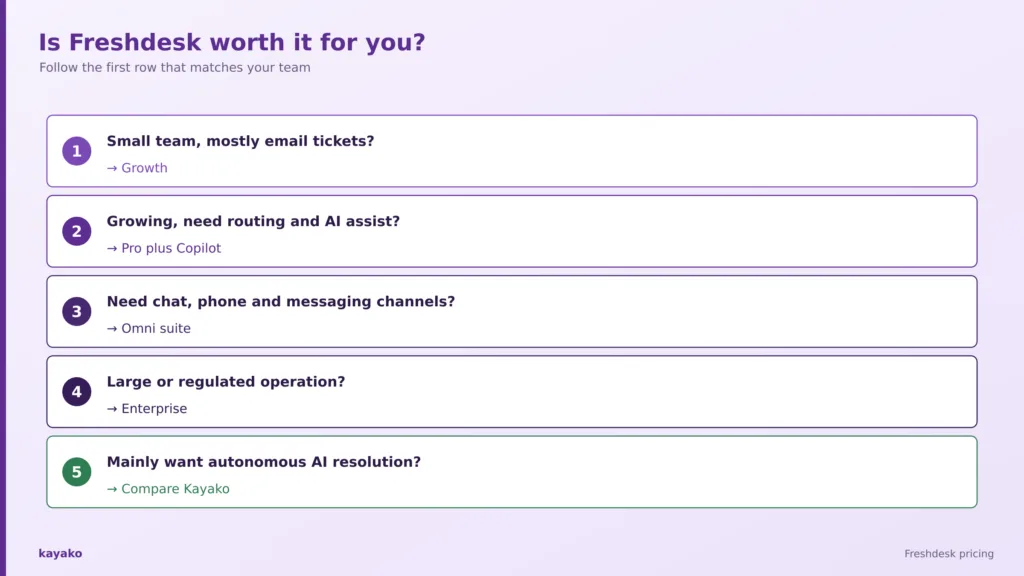
Four layers decide the real Freshdesk bill: seats, the Copilot gate, per-session AI, and add-ons.
|
4. Which Freshdesk plan makes sense for you?
The right plan follows the shape of your support work, not the length of the feature list. Three patterns cover most teams.
A small team on email: consider Growth
Growth covers core ticketing, a shared inbox, a knowledge base, and basic automation. If you have a handful of agents and most tickets arrive by email, it is enough, as long as you do not yet need routing depth or AI.
- Scenario. A six-agent team answering product and account questions, almost all by email.
A growing team needing routing and AI: consider Pro
Pro adds multilingual support, custom dashboards, round-robin routing and multiple SLA policies, and it is the entry point for Freddy Copilot. Remember that adding Copilot brings the real per-agent cost to about $84.
- Scenario. A twenty-agent team that needs routing, SLAs, and agent-assist AI across more than one channel.
A large or regulated operation: consider Enterprise
Enterprise adds skills-based routing, a sandbox, audit logs, approval workflows, and Freddy Insights for larger or regulated teams. The value appears when you genuinely need the controls.
- Scenario. A regulated operation needing audit trails, approvals, and skills-based routing at scale.
If you are comparing the category more broadly, our guides to the best ticketing systems and the best shared inbox tools put Freshdesk in context, and CSAT is worth tracking whichever you choose.
Knowing which plan fits is half the decision. The other half is knowing when the spend is justified.
5. When does Freshdesk pricing actually make sense?
Freshdesk earns its price when several of these are true at once.
- You want affordable, easy omnichannel support. The short learning curve and bundled channels are genuine strengths.
- Your team fits Growth or Pro. You do not need every Enterprise control, so the mid-tiers deliver value.
- You want fast onboarding. Teams report being live in days rather than weeks.
- You will use Freddy Copilot selectively. Assigning it only to frontline agents keeps the add-on cost in check.
- You are moving off a pricier suite. Freshdesk is frequently the cheaper switch from a more expensive help desk.
Put plainly, Freshdesk is affordable and capable for straightforward support. The reverse case matters too, because the AI economics change the picture for resolution-focused teams.
|
6. When might Freshdesk be more than you need?
The better test is what you want the AI to do. Freshdesk may cost more than it should when several of these hold true.
- You mainly need ticketing and do not need the higher tiers’ features.
- Your priority is AI resolution, and the per-session meter is hard to budget.
- You dislike long contracts and seat lock-in.
- You would pay for Pro plus Copilot just to get usable AI.
- Your volume spikes, so the AI Agent meter becomes unpredictable.
When most of your volume is repetitive, and your goal is resolution, paying for seats plus a gated Copilot plus a per-session meter is a roundabout way to buy AI. A platform built around AI agents rather than basic chatbots and priced on resolved tickets charges for the outcome directly, which reframes the buying question by scenario.
7. Freshdesk pricing by company scenario
Find the row that sounds most like your team, then read across. The last row is the one most pricing pages leave out.
|
Company scenario |
What you probably need |
Freshdesk fit |
|---|---|---|
|
Small team on email |
Core ticketing and knowledge base |
Growth |
|
Growing support team |
Routing, SLAs and AI assist |
Pro plus Copilot |
|
Large or regulated ops |
Skills routing, audit, Insights |
Enterprise |
|
Omnichannel team |
Chat, phone and messaging |
Omni suite |
|
AI-first resolution |
Autonomous ticket resolution |
Compare alternatives |
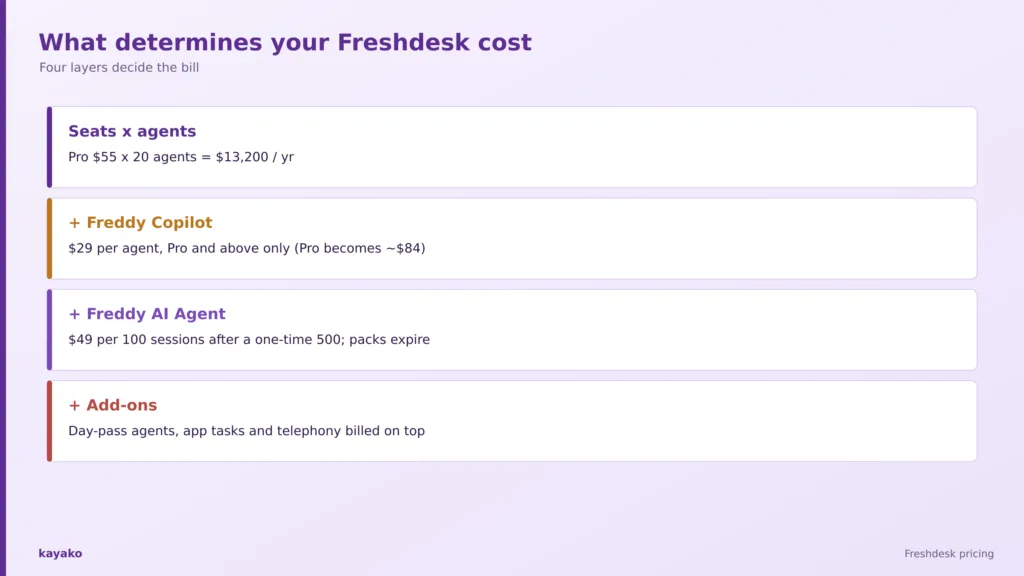
Match your scenario to the plan. AI-first teams are the ones who should price alternatives.
Seeing yourself in a row is useful, but a buying decision usually comes down to a direct comparison with a leaner, AI-first option.
8. Freshdesk vs Kayako
This is not a full feature teardown, just the short version of where each platform fits.
Freshdesk
Freshdesk is an affordable, easy omnichannel help desk: a short learning curve, email, chat, social and web in one thread, solid automation and a lower seat price than most suites. It fits teams that want straightforward support without heavy setup.
Kayako
Kayako is an AI-first support platform. Agent Kay resolves tickets autonomously, SingleView gives agents one screen of context, and pricing is one dollar per resolved ticket rather than per agent plus AI add-ons, so the AI that does the work is the thing you pay for, not a seat upgrade and a separate meter.
Freshdesk’s model is seats plus a gated AI add-on plus a per-session meter; Kayako’s is per resolved ticket, which rewards automation directly and keeps the bill predictable.
A head-to-head helps, but the final call comes down to your own numbers. For a wider view, our guide to Freshdesk alternatives lays out the options by use case, and a short checklist turns the pricing question into a decision.
|
9. What should you actually consider before buying Freshdesk?
Swap the question of which tier is cheapest for a short set of questions about your own operation.
- How many agents need seats?
- How many tickets do we handle a month?
- Which features do we need, and which tier gates them?
- Will we need Freddy Copilot, and for how many agents?
- How volatile is our volume for the AI Agent meter?
- What is the contract term, and can we reduce seats?
- What will Pro plus AI cost at double the team?
That last question is the one that catches teams out. Pricing today is not the same as cost at scale. It is also worth weighing how much of your volume is automatable, since research from Gartner found only 14 percent of customer service issues are fully resolved in self-service, which shows how much room modern AI resolution still has to take load off paid seats.
With those answers in hand, the decision becomes straightforward. The tree below turns them into a single recommendation.
Is Freshdesk worth it for you? A quick decision tree
- Small team, mostly email tickets? Growth.
- Growing, and need routing and AI assist? Pro plus Copilot.
- Need chat, phone and messaging as channels? Omni suite.
- Large or regulated operation? Enterprise.
- Mainly want autonomous AI resolution? Compare Kayako.
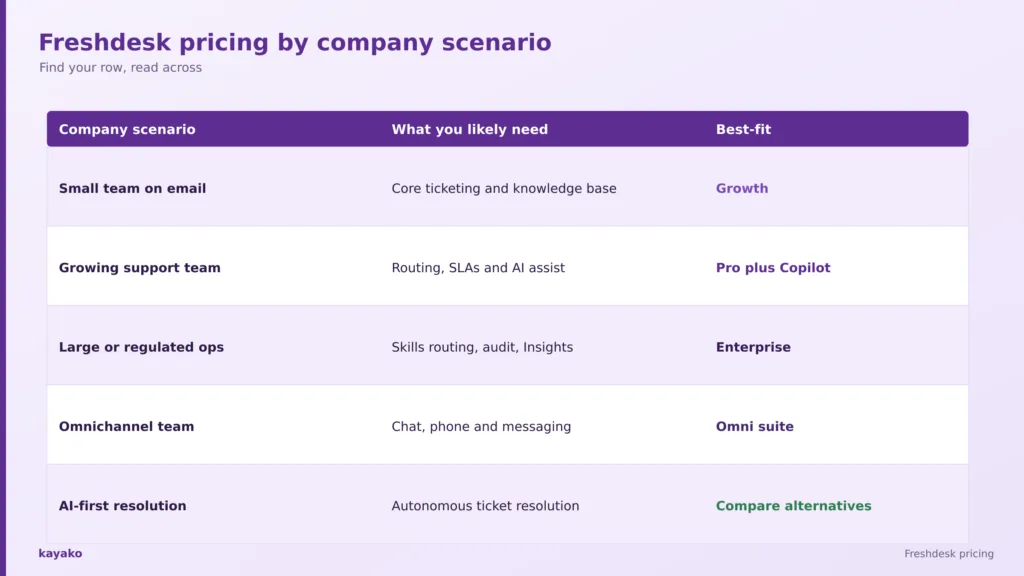
Follow the first row that matches your team to land on the right plan, or a leaner alternative.
A tree like this is more useful than another long pricing table, because it moves you from what Freshdesk costs to whether it is worth paying for.
How Kayako helps
Kayako is an AI customer support platform built around autonomous resolution. Agent Kay resolves repetitive tickets end to end, and SingleView gives agents the full history of every customer on one screen for the conversations that still need a human. Because pricing is one dollar per resolved ticket rather than per agent plus an AI meter, cost rises only when the platform does the work.
Case study: Aurea. Aurea saved about $20,000 per agent with Kayako across a phased rollout spanning more than fourteen products, by letting AI resolve the repetitive volume rather than adding seats and add-ons to manage it.
|
Conclusion
Freshdesk pricing in 2026 is clear enough on paper: Growth $19, Pro $55, and Enterprise $89 per agent, with the omnichannel suite higher. The harder question is the AI. Once you add Freddy Copilot on Pro and the per-session AI Agent meter, the real cost climbs well past the sticker, and it gets harder to predict as volume grows. For straightforward support, Freshdesk is affordable and easy. For resolution-focused teams, the AI economics are the thing to model.
So read the price list, then read your own operation. Pricing tells you what Freshdesk costs. Your use case tells you whether it is worth it, and whether a simpler, outcome-based platform would get you more resolution for less.
Frequently asked questions
How much does Freshdesk cost?
Freshdesk ticketing costs $19 per agent per month for Growth, $55 for Pro, and $89 for Enterprise on annual billing, after a 2026 price rise. The omnichannel suite is higher at $29, $79, and $119. Freddy AI Copilot and the per-session AI Agent are billed on top.
What is the cheapest Freshdesk plan?
Freshdesk’s free tier is now a time-limited program for one or two agents rather than a standing plan. Among paid plans, Growth at $19 per agent per month is the cheapest, covering core ticketing, a shared inbox, and basic automation for small teams.
Is Freshdesk priced per agent?
Yes. Freshdesk ticketing and omnichannel plans are billed per agent per month, so cost scales with team size. Freddy AI Copilot is an additional per-agent charge on Pro and above, while the Freddy AI Agent is billed by conversation session rather than per agent.
How much does Freddy AI cost?
Freddy AI Copilot, the agent-assist feature, is $29 per agent per month and only on Pro and Enterprise. The customer-facing Freddy AI Agent includes a one-time pool of 500 sessions, then costs about $49 per hundred sessions, and unused sessions expire at renewal rather than rolling over.
Is Freshdesk cheaper than Zendesk?
Freshdesk is frequently cited as the cheaper option, especially for the omnichannel bundle, and switchers often move from Zendesk for that reason. The gap narrows once AI is added, since Copilot and the per-session AI Agent raise the real cost on both platforms.
Is Freshdesk worth the cost?
Freshdesk is worth it for teams wanting affordable, easy omnichannel support without heavy setup. For teams whose priority is AI resolution, the gated Copilot and the per-session AI Agent meter make the real cost higher and less predictable, so a resolution-priced platform may deliver more for less.
Is Freshdesk good for small teams?
Yes, small teams often start well on Growth for core ticketing. The thing to watch is the step up to Pro plus Copilot if you want usable AI, which brings the real per-agent cost to about $84, so model the AI economics before committing.
What is the best Freshdesk alternative?
The best alternative depends on your use case. For teams focused on AI-first autonomous resolution without per-agent AI add-ons, Kayako is a strong fit, charging per resolved ticket. Our guide to Freshdesk alternatives compares options by scenario.
Is Kayako cheaper than Freshdesk?
It depends on your volume and how much AI you need. Kayako charges one dollar per resolved ticket plus a fixed onboarding fee rather than per agent plus AI add-ons, so teams with repetitive volume that automates well often pay less than Pro plus Copilot plus the per-session meter.