Your helpdesk choice will either turn support into a profit center or a cost center—there's no middle ground.
I've watched brands triple their support-driven revenue by picking the right platform, and I've seen others hemorrhage money because they chose based on features instead of philosophy. The Freshdesk vs Gorgias decision matters more than most people realize because these platforms approach ecommerce support from completely different angles.
Gorgias is commerce-native and optimizes for fast, revenue-linked resolutions inside the helpdesk where agents can actually take action. Freshdesk is an enterprise-grade platform that excels at governance, orchestration across systems, and analytics that span beyond the checkout to measure real business impact.
This breakdown compares them head-to-head across voice, omnichannel, self-service, SLAs, automation, reporting, pricing, scalability, and more—without losing the nuance that matters when you're running support at scale for one or many brands.
Research Methodology
To write the most honest Freshdesk vs Gorgias comparison possible, we combined:
Hands-on evaluation: Setting up trial accounts for both platforms, building standard workflows WISMO, returns, refunds, replacements, and testing channel connectivity across email, chat, SMS, voice, Instagram/Facebook, and WhatsApp.
Documentation analysis: Reviewing help centers, developer docs, marketplace apps, and product update logs to understand native capabilities versus connectors that break down under pressure.
User feedback mining: Scouring user reviews and practitioner commentary across G2, Capterra, Reddit, industry Slack groups, and CX communities for real-world pain points and wins that matter.
Pricing analysis: Comparing seat vs ticket-based economics, add-ons, and module requirements for channels/features across typical team sizes and multi-brand scenarios.
Use case benchmarking: Mapping workflows like order edits/cancellations, IVR routing, self-service, intent-based automation, and CRM revenue attribution to see how each platform handles depth and edge cases.
Measurement evaluation: Testing what each tool captures and reports by default and how easy it is to drill into which action, by whom, on which order without stitching data externally.
Pricing: The Economics That Determine Everything
Let's cut straight to what shapes most Freshdesk vs Gorgias decisions—the pricing model that will either support your growth or strangle it.
Gorgias's approach: Ticket-based economics that map better to pooled, shared-service teams running multiple brands. You pay for resolved volume, not idle licenses across shifts or geographies. Channels like email, chat, and social are native, so you aren't stacking extra modules. Seasonal spikes become a variable cost while steady periods don't lock you into unused capacity.
Freshdesk's model: Seat-based pricing that's predictable for high-volume merchants, avoiding ticket-cap overages. Enterprise controls—SSO, audit logs, data retention policies—come standard for brands that need governance across regions.
The reality check: Gorgias wins for variable volume and multi-brand efficiency. Freshdesk wins for predictable enterprise scaling and governance requirements.
Kayako alternative: Before committing to either pricing structure, consider platforms that deliver comprehensive ecommerce support capabilities without the complexity tax or usage-based surprises that kill budgets.
Main Platform Comparison
Gorgias wins at integrated voice for ecommerce helpdesk
Gorgias' voice is built into the helpdesk, not bolted on like an afterthought. That matters operationally in ways that affect your bottom line:
Calls, voicemails, and transcripts live in the same ticket thread as email, chat, and SMS. Agents click-to-call from the ticket, see live order and subscription data on screen, and can launch refunds or replacements mid-call—no tool switching that kills productivity.
As one Capterra user put it plainly:
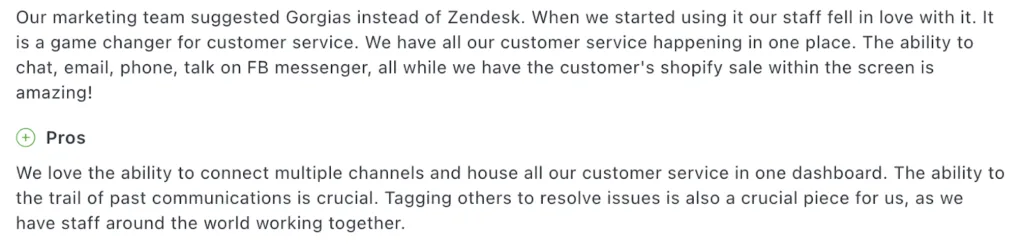
IVR, skills routing, and auto-tagging run on customer and order attributes, so VIPs or high-value carts route to the right queue by design. Missed calls deflect to SMS in the same ticket, and macros can include order lookups and shipping links.
Try Kayako for integrated voice without the markup.
By contrast, Freshdesk splits voice into a separate product and reporting plane. The result is extra setup, context loss between systems, and duplicated rules for routing, SLAs, and analytics that create operational nightmares.
Freshdesk wins at governed Shopify order actions and approvals
Freshdesk turns Shopify order actions into governed, auditable workflows rather than ad‑hoc agent clicks that create compliance risks:
Granular roles separate view from refund/cancel/edit permissions. Add approval steps based on order value or fraud risk, with full audit logs tied to the ticket, agent, and Shopify order/line item.
Consider Kayako for Shopify governance without enterprise complexity.
Workflow Automator can block a refund until a manager approves, require a reason code, then push the refund and capture the Shopify refund ID into custom fields. Gorgias is fast for one‑click actions, but Freshdesk's native approvals and auditability reduce leakage and chargeback exposure.
Gorgias wins at omnichannel automation in one workspace
Gorgias covers the rest of the journey in one automation layer that actually makes sense:
Instagram DMs and comments, Facebook, Twitter/X, WhatsApp, SMS, live chat, and email all inherit the same rules, intents, macros, and SLAs. Commerce events drive automation across channels: create tickets on failed deliveries, escalate when a preorder is delayed, or suppress promos when an order is in fraud review.
A G2 review highlights this point:
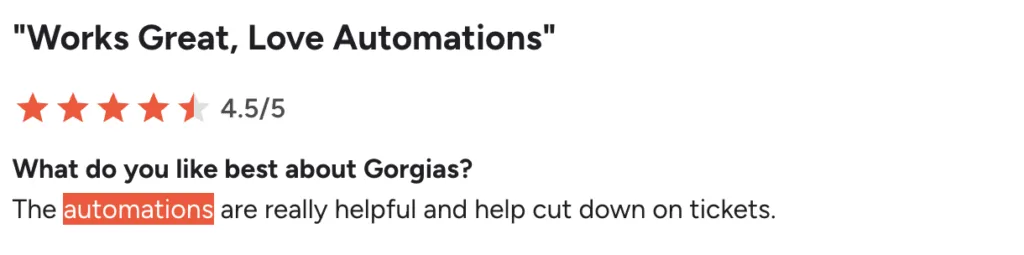
Agents can reply to ad comments as easily as emails, convert DMs to tickets with full customer history, and attribute revenue from assisted conversions. Reporting rolls up contact reason, resolution, and revenue across channels for one version of the truth.
In Freshdesk, social and messaging rely on connectors with uneven metadata, separate limits, and rule drift. That fragments context and inflates handle time when agents can't see the full picture.
Freshdesk wins at social DMs and ad comments at enterprise scale
Freshdesk turns Instagram and Facebook DMs and comments—including ad comments—into governed, SLA-backed work, not just messages that get lost:
Connect Meta channels via Freshdesk Omnichannel, then auto-enrich each ticket with post, campaign, and audience context. Route by skills, language, priority, or campaign status. Auto-tag with intent and sentiment to separate buyers from bots and trolls.
In a G2 reviewer's own words:

Freddy AI summarizes long DM threads, detects purchase intent or crisis risk, and proposes next steps so agents act fast without wading through screenshots. Collision detection, approvals for public replies, and scenario automations reduce errors on high-visibility posts.
Gorgias wins at transactional self-service inside your storefront
Gorgias treats self‑service as a true extension of your storefront, not a separate help center that customers have to discover:
Its widget lets customers track orders, update addresses, and cancel or edit unfulfilled orders using live Shopify, BigCommerce, or Magento data. Policy guardrails ensure actions only appear when allowed by status, time window, or channel. Authentication happens in‑flow, so customers complete tasks without creating a ticket.
As one Capterra user highlighted:

Freshdesk's portal is content‑first and channel‑centric. To replicate transactional flows, you'll stitch together marketplace apps, bot scripts, and custom objects—which often still hand off to agents instead of resolving end‑to‑end.
Freshdesk wins at oversight and measurement for social ops
Oversight is where Freshdesk outperforms for brands that need enterprise-grade social commerce operations:
Build channel-grade SLAs for IG DMs vs FB comments, then track compliance by campaign, ad set, and language. Segment response time, first-contact resolution, and deflection across organic vs paid threads.
Push dispositions and tags back to marketing via webhooks so your ads team sees comment health alongside ROAS. For brands moving beyond a single storefront support queue, Freshdesk's enterprise controls deliver tighter governance than ecommerce-first helpdesks.
Gorgias wins at intent-level deflection and content reuse
Depth shows up in measurement and maintenance where it actually matters:
Gorgias maps common ecommerce intents like Where is my order, cancellations, and returns to both articles and automated flows. It reports deflected conversations and time saved at the intent level, and exposes failed searches so you can fill gaps that actually reduce ticket volume.
As one Reddit customer puts it:

Content is reused everywhere customers ask for help: in the widget, inside chat, and as agent‑insertable snippets in tickets. Freshdesk offers broader knowledge features and public forums, but that breadth adds moderation overhead and noise for ecommerce brands.
Gorgias wins at commerce-aware SLAs
Gorgias treats SLAs as commerce-aware, not just channel-only metrics that miss the business context:
Drive SLA timers off order value, fulfillment status, customer lifetime value, or VIP tags pulled natively from Shopify, BigCommerce, or Magento. Set tighter first-response targets on pre‑sale chat and social DMs, and different targets for post‑purchase email.
Auto-escalate when high‑value, unfulfilled orders trigger delivery risk intents. Views surface at‑risk tickets and breaches by intent, tag, and store, while reporting ties SLA compliance to revenue influenced.
Freshdesk supports multiple SLA policies and escalations, but replicating this commerce context typically requires syncing custom fields or building app connectors that add latency and maintenance overhead.
Gorgias wins at in-ticket commerce actions and workflow compression
Workflow automation in Gorgias compresses steps because actions live where agents work:
Rules use intent and sentiment detection to auto‑tag, route, and suggest macros with dynamic variables. Macros can do more than reply—they can trigger commerce actions like refunding or canceling orders in connected storefronts, issuing discounts, and updating customer attributes, all without tab‑switching.
As one G2 user explains it plainly:

That cuts handle time and stabilizes SLA adherence at volume when every second counts. Multi‑store teams can templatize rules, reuse them across brands, and throttle auto‑replies with clear guardrails.
Freshdesk's automations are versatile, but executing the same end‑to‑end flows usually means stitching marketplace apps, webhooks, and custom objects to reach the commerce system.
Gorgias wins at revenue-first reporting and drill-through
Custom reporting and analytics in Gorgias treat revenue as a first-class metric, not an afterthought:
Tickets auto-enrich with commerce data from Shopify, Magento, and BigCommerce, then attribute sales to agents, macros, and channels. You can segment pre‑sale tickets by intent, see conversion rate and revenue per conversation, and drill from a metric into the exact ticket and order timeline with one click.
Automation impact is measurable: deflection, macro usage, and rules can be tied to saved revenue, refunds issued, and return prevention that actually affects your bottom line.
Freshdesk's analytics are strong for generic support KPIs, but revenue and product context aren't native. To analyze sales driven by support, you have to stitch Freshdesk to other tools and maintain joins that slow iteration.
Freshdesk wins at edge-case orchestration for edits, replacements, and cancels
Freshdesk handles the messy edge cases around edits and cancellations with end‑to‑end orchestration that prevents things from falling through cracks:
Agents can trigger partial refunds, draft‑order replacements, or full cancels from the ticket. Automator spins off tasks to the warehouse/3PL, posts order notes back to Shopify, and updates ticket status when inventory or payment events return.
Analytics quantify operational impact: refund latency by agent/store, approval bypass attempts, error rates by action type, and downstream chargebacks that affect real business metrics.
Gorgias offers solid ecommerce reporting, but Freshdesk's cross‑object analytics and process automation give leaders tighter control and clearer ROI on every Shopify action performed inside support.
Gorgias wins at commerce + operations dashboards you can act on
Dashboard flexibility favors operational speed over endless configuration:
Gorgias lets CX and e‑commerce leaders monitor operational and commercial health in the same view. Filter dashboards by store, channel, SKU, tag, or campaign to see backlog, first‑response time, and projected revenue opportunity side by side.
A G2 review highlights this point:

Every card is actionable; drill‑downs land on the live conversation with full order context for fast root‑cause analysis and playbook updates. Freshdesk's widgets are customizable, but they live in a support-only universe that requires external BI to blend in sales or product dimensions.
Freshdesk wins at order-status orchestration across systems
Freshdesk outperforms Gorgias on order-status automation because it orchestrates across systems, not just inside the helpdesk UI:
As one G2 feedback line shows:
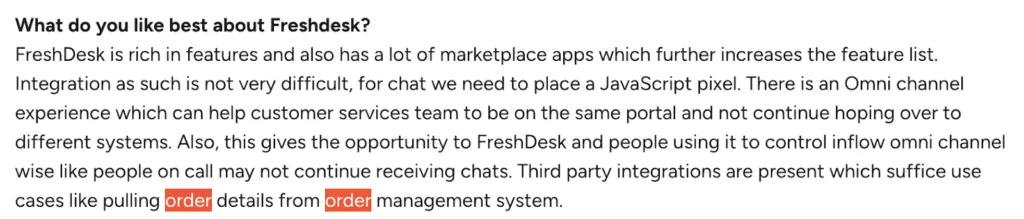
Pull orders and shipments from multiple platforms via marketplace apps, then model them as Custom Objects to persist context. Workflow Automator and Freddy intent detection route WISMO tickets automatically, verify identity, fetch the latest carrier scan, and branch logic by case.
Explore Kayako for order orchestration without vendor lock-in.
Time-triggered rules re-check carrier status after N hours and post proactive updates without agent touch. Webhooks open claims with carriers or 3PLs and notify customers with precise ETAs.
Gorgias is strong for quick Shopify actions in-thread, but Freshdesk's native data model plus event- and time-based workflows handles multi-system handoffs and exception paths with fewer gaps.
Gorgias wins at ticket-based pricing for multi-brand, pooled teams
Pricing/value is where Gorgias' model can shine for the right operations:
Ticket-based economics map better to pooled, shared-service teams running multiple brands. You pay for resolved volume, not idle licenses across shifts or geographies—useful for part-time or specialized agents.
Verified customers on Capterra mark pricing as a reason to switch from other platforms:
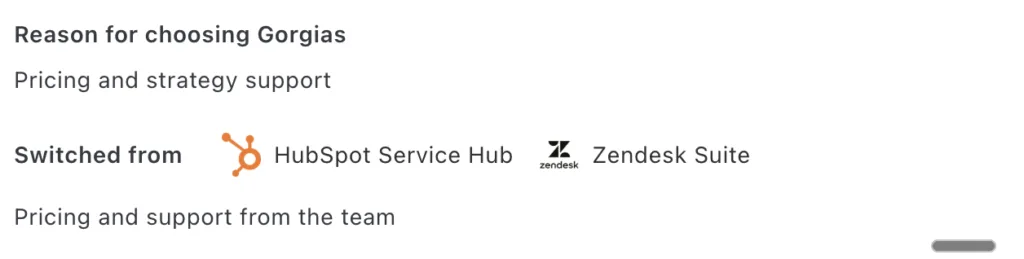
Automation tied to conversation metadata and channel trims handle time and reduces cost per resolution at scale. Even for non‑ecommerce organizations, brand-aware macros, tagging, intents, and SLAs reduce manual triage that wastes time and money.
Gorgias wins at brand-first scalability and governance
Gorgias treats brand as a first-class object instead of an afterthought:
Centralize one workspace and govern access, signatures, business hours, and channel identities per brand. Routing uses brand conditions out of the box, so emails to brand A, DMs for brand B, and WhatsApp for brand C land in the right queues without rule sprawl.
One G2 comment says it best:

Cross-brand analytics come standard, letting you benchmark SLAs, CSAT, and backlog by brand without custom stitching. Adding a new brand is a configuration exercise, not a parallel deployment—spin-up time is hours, not weeks.
Freshdesk wins at returns and repetitive questions via no-code bots
Returns and repetitive questions see the same advantage with Freshdesk's deeper orchestration capabilities:
Freshdesk bots let customers self-serve returns in chat, email, or the portal, using dynamic forms that validate policy windows, order value thresholds, and reason codes before an agent is involved.
Automations can create an RMA in Loop, Returnly, or a custom RMA service via webhook, generate labels, and post instructions back to the thread. When the return is first scanned, a webhook updates the ticket and triggers an exchange order or refund task.
Compared to Gorgias' ecommerce macros and tracking widget, Freshdesk's no-code orchestration and time-based automations let you encode the full RMA journey and edge cases in one place.
Freshdesk wins at CRM-level revenue attribution
Freshdesk ties support to revenue at the CRM level, not just the checkout level:
Agents can create or update deals from a ticket via the native Freshsales integration. Tickets auto-associate to contacts and accounts, so every reply, tag, and resolution maps to pipeline movement.
A G2 reviewer’s words sum it up:
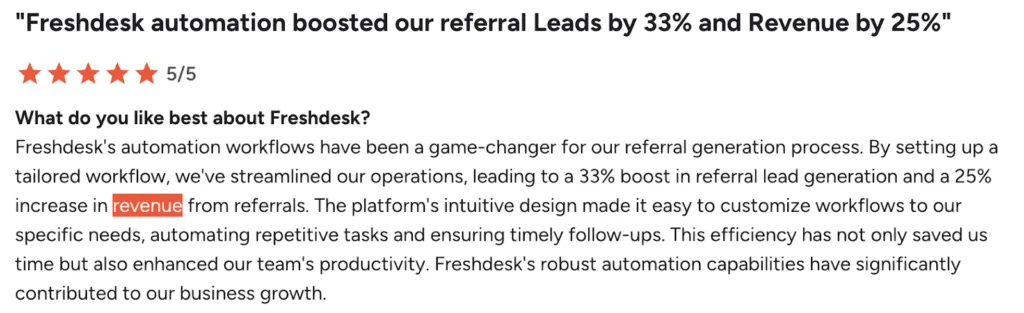
You can attribute closed-won revenue back to the originating ticket, category, channel, and agent with deterministic links. This works across ecommerce, subscription, and B2B motions—not only carts.
Gorgias focuses on a purchase-within-window model optimized for storefronts but doesn't model opportunities, stages, or account-level influence across long cycles.
Freshdesk wins at analytics breadth across tickets, deals, and products
Reporting depth is broader in Freshdesk for organizations that need comprehensive business intelligence:
Build dashboards that blend ticket metrics with ARR/MRR, opportunity stages, products, and segments from Freshsales or subscription apps. Slice revenue influenced by SLA adherence, first-response time, intent, or escalation path.
As one G2 user put it plainly:
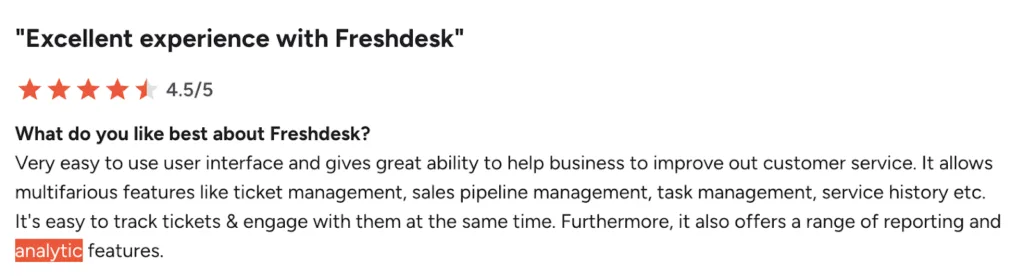
Track protected revenue from retention tickets alongside costs-to-serve to get net impact by team. Schedule exports or use the API to push unified ticket–deal data into your BI stack for cohort and lifecycle analysis.
Gorgias' revenue views are valuable for DTC teams but remain opinionated and agent-centric. Freshdesk gives you schema-level control to answer harder questions about where support accelerates pipeline.
Freshdesk wins at multi-platform commerce integrations and an extensible sidebar
Freshdesk outperforms Gorgias when your ecommerce stack extends beyond Shopify:
Marketplace and app framework deliver plug‑and‑play, bi‑directional integrations with Shopify/Plus, BigCommerce, Magento, Klaviyo, Recharge, and Yotpo in one agent workspace.
A Capterra review highlights this point:

The sidebar is actionable: surface cards that pull live order, subscription, and loyalty data and let agents execute tasks with guardrails. Actions can be locked behind roles, logged for audits, and tested in a sandbox.
Gorgias offers strong Shopify actions, but Freshdesk's extensibility, governance, and breadth across non‑Shopify platforms make the sidebar a true system‑of‑action.
Freshdesk wins at enterprise operations, governance, and predictability
At scale, Freshdesk's operations stack is harder to outgrow:
Freddy AI triages intents like WISMO, returns, and cancellations, auto‑populates order fields, and routes by skills, brand, and SLA without rules sprawl. Time‑ and event‑based workflows update order attributes and escalate VIP issues across all channels in one queue.
Analytics span all channels and objects, so you can build dashboards that tie agent actions to subscription churn saves, loyalty adjustments, warranty costs, and CSAT by storefront. Enterprise controls let you standardize support across brands and regions without custom tooling.
How to Choose Between Freshdesk vs Gorgias
Your best choice depends on the weight you put on speed-to-resolution inside the helpdesk versus orchestration and governance across systems and teams:
Your Commerce Stack and Channels
- Mostly Shopify/Shopify Plus with heavy social and chat volume? Gorgias' commerce-native actions, integrated voice, and omnichannel rules will reduce handle time and boost revenue attribution
- Multi-platform Shopify + Magento/BigCommerce/WooCommerce, subscriptions, loyalty, and CRM-led motions? Freshdesk's marketplace breadth, custom objects, and Freshsales linkage will give you cleaner governance and analytics at scale
Operational Philosophy
- If you prioritize actions inside the ticket with minimal context-switching, and want support to behave like a storefront extension, Gorgias is designed for that
- If you need audited approvals, cross‑system tasks, multi-team workflows, and campaign-level oversight, Freshdesk's workflow automator and analytics are stronger
Self‑Service Strategy
- For transactional self‑service embedded in your storefront widget track/edit/cancel/update, Gorgias makes it seamless with policy guardrails
- For complex, form-driven self-service that spans RMAs, carriers, and 3PL handoffs, Freshdesk's bots and time/event automations provide end‑to‑end orchestration
Revenue Analytics Requirements
- If "which conversation drove which sale?" is your core metric and you want agent/macro/channel revenue tied directly to ticket threads, Gorgias gives you native, fast answers
- If you need CRM-grade attribution, pipeline movement, ARR/MRR blending, and BI-ready joins across tickets, deals, and products, Freshdesk with Freshsales is purpose-built
SLA and Routing Complexity
- Commerce-aware SLAs value, fulfillment, LTV and channel-specific response targets are easier in Gorgias out of the box
- Skills-based routing by language, campaign, storefront, and long-running workflows with pauses and escalations are more flexible in Freshdesk
Social Operations at Scale
- If you want social to behave like any other message channel with shared rules and macros, Gorgias simplifies
- If you must govern public replies, track performance by campaign/ad set/language, and inject approvals and audits, Freshdesk brings enterprise rigor
Pricing and Team Structure
- Variable volume across seasons and pooled coverage across multiple brands? Gorgias' ticket-based pricing maps to resolved workload and keeps idle-seat costs low
- Predictable seat-based pricing with enterprise controls and data policies is Freshdesk's lane, especially for large, distributed teams
Time to Value and Maintenance
- Gorgias is typically faster to spin up hours, not weeks, with less duplication when adding brands
- Freshdesk's extensibility is deeper but may require more initial configuration and ongoing governance—worth it if you need the control
The Bottom Line
Freshdesk vs Gorgias isn't about which tool is better—it's about which tool matches your operating model and growth stage without forcing expensive compromises.
Gorgias is the commerce-native helpdesk that embeds voice, social, and storefront actions into a single ticket thread, with intent-driven automation and revenue-first analytics that frontline teams can act on immediately. If your priority is compressing handle time, meeting commerce-aware SLAs, and attributing revenue to conversations without stitching data, Gorgias delivers speed and clarity—especially for Shopify-centric brands and multi-brand teams that want ticket-based economics.
Freshdesk is the better fit when your world is multi-platform, multi-team, and governance-heavy. It brings audited approvals to Shopify actions, orchestrates edge cases like partial refunds and replacements end‑to‑end, governs social DMs and ad comments with campaign-level SLAs and analytics, and ties support to revenue at the CRM level. For organizations that need enterprise controls, data residency, BI-grade analytics, and predictable seat pricing, Freshdesk pulls ahead.
Choose Gorgias if you're a DTC or retail brand that wants support to behave like your storefront—with clickable order actions, integrated voice, and revenue insights in one workspace that makes your team faster from day one.
Choose Freshdesk if you're running a multi-brand, multi-platform stack that needs end-to-end orchestration, cross-team approvals, campaign-grade social governance, and CRM-level measurement that scales without losing visibility.
Anchor your decision to the workflows that drive 80% of your tickets WISMO, returns, cancellations, edits, promos and the metrics your leadership cares about revenue influenced, SLA reliability by value/tier, refund accuracy, and policy adherence. Then implement for those use cases first, measure the impact, and expand with the platform's strengths.
That's how you turn the Freshdesk vs Gorgias choice from a tool debate into an operational advantage that actually drives business results.