Discover 12 B2B customer service best practices to improve customer retention, strengthen relationships, reduce churn, and deliver better support experiences.
B2B buyers judge you against their best consumer experiences, and a missed expectation costs a contract, not a refund. This guide covers 12 B2B customer service best practices for 2026, from dedicated account owners and tiered SLAs to AI-driven autonomous resolution, each paired with the stat that proves it works.
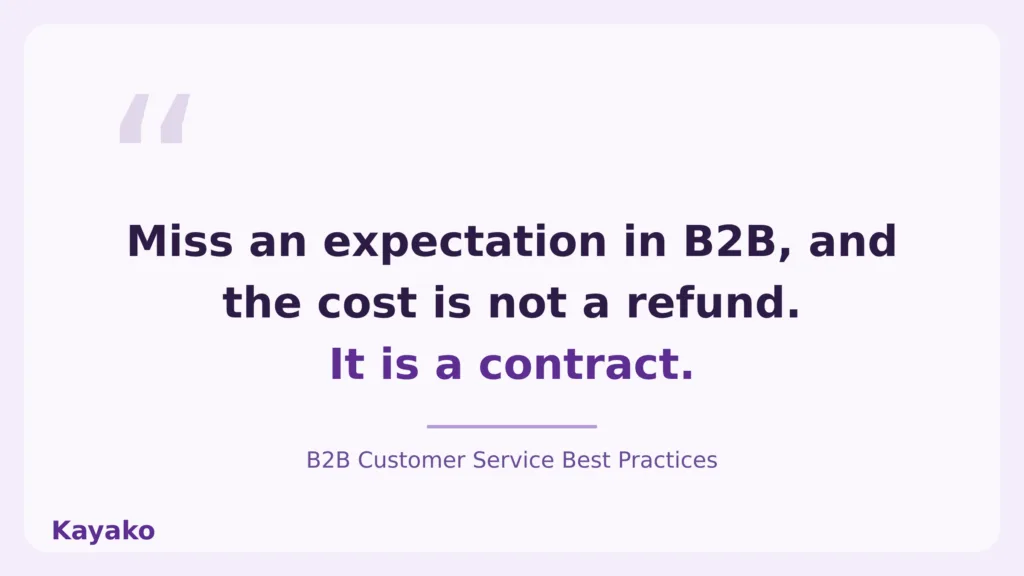
B2B buyers no longer grade you against other vendors. They grade you against the last great consumer experience they had. When a reply lags, or an account manager forgets the history, the cost is not a refund. It is a contract. Renewals quietly hinge on dozens of these small moments, and most teams never see the ones they lose.
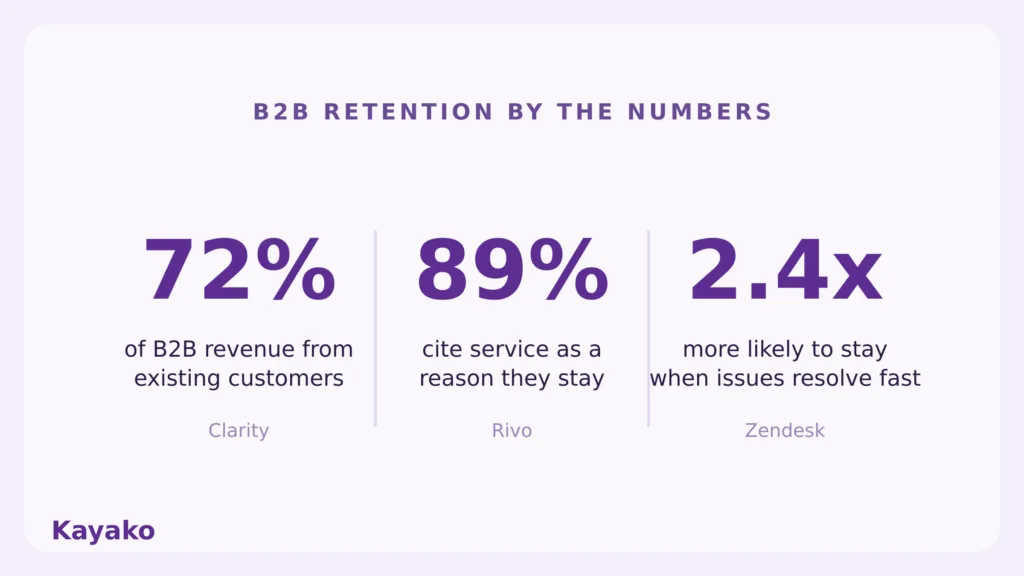
The stakes are in the data. Rivo reports that 89 percent of B2B customers name service as a primary reason they stay, and half switched vendors in a single year over service alone. Clarity finds 90 percent of buyers now expect an immediate response. This guide covers 12 B2B customer service best practices for 2026, the tactics that separate teams that keep and grow accounts from teams that spend every quarter replacing them. If you are looking for a deep dive into what goes into the foundations of customer experience, start with our guide to B2B customer service.
Related read: B2B customer service tools
What Makes B2B Customer Service Different
B2B customer service is not B2C with a logo swapped in. A B2B relationship is ongoing, not a one-time sale. You serve multiple stakeholders inside one account, from the daily end user to the executive who signs the renewal, and each judges you on different things. Service levels are often written into a contract, so a missed response is a breach, not just a bad day. And a single account can carry six or seven figures, which means one poor experience puts real revenue at risk.
Zoom frames it well. B2C support is the cashier, fast and transactional, while B2B support is the concierge, consultative and built on the relationship. That shift matters, because Fin reports only 14 percent of B2B leaders believe they deliver top-tier experiences. The gap is the opportunity.
Why B2B Customer Service Best Practices Matter Now
Best practices are not a polish on top of the product. In B2B, they are the revenue strategy. Let’s start with the cost of getting it wrong. Clarity estimates avoidable switching drains 136.8 billion dollars from B2B sellers every year, and that acquiring a new customer costs 5 to 7 times more than keeping one. Roughly 72 percent of B2B revenue comes from customers you already have, so your renewal and expansion base, not your pipeline, is where most growth lives. Protecting that base is cheaper, faster, and more predictable than constantly refilling the top of the funnel.
Related read: B2B Customer service strategy
The upside is just as concrete. Top-performing B2B companies retain close to 90 percent of customers, while the average sits between 76 and 81 percent. That spread compounds into millions over a multi-year contract. Service moves the number directly too. Zendesk reports customers are 2.4 times more likely to stay when their issues resolve quickly, and personalization lifts revenue across the board. Support is no longer a cost center. It protects net revenue retention and slows churn, the two metrics that decide whether a B2B company grows or leaks.
12 B2B Customer Service Best Practices
Here are the 12 practices that consistently separate teams that retain accounts from teams that replace them. Most pair a clear action with a measurable payoff.
1. Assign dedicated points of contact for key accounts
Queue-based support works for one-off questions. It fails the moment an account needs continuity. When a customer re-explains their setup to a new agent every time, trust erodes quietly until renewal. Assign a named owner to every enterprise and mid-market account. That person knows the account’s history, goals, and quirks, and the customer knows exactly who to call. This is the relationship manager model Zoom ties to strong B2B service. Tier your accounts by value, give the top tiers a dedicated contact or pod, and make that owner visible in the support tool so any agent can route correctly. No high-value customer should ever feel like a stranger to the team that serves them.
2. Build one unified customer record across sales, support, and success
Siloed systems create siloed service. When sales, support, and success each keep their own version of the account, the customer pays for the gaps. They repeat their history on every ticket, and your team decides with half the picture. The fix is one shared record every team reads from. The agent answering a billing question should see the same onboarding notes, open opportunities, and past escalations the account manager sees. It is also the foundation for automation. Salesforce found a unified data strategy makes a successful AI rollout 1.4 times more likely, and that 88 percent of service leaders now prioritize connecting their tools. Get the record right first, and every other practice here gets easier.
3. Define and enforce tiered SLAs
In B2B, service levels are often a contractual promise, not an aspiration. A tiered service level agreement sets clear response and resolution targets by priority, so a production outage and a cosmetic bug are never treated the same. Tiering protects your highest value accounts without overspending on every ticket. Critical issues for top-tier customers get the fastest clock, routine requests follow a standard path, and everyone knows what to expect. The targets must be realistic and visible. HubSpot reports 67 percent of customers expect a resolution within three hours, so a vague promise to reply soon no longer clears the bar. Define the tiers, write them into the tool, and track attainment. A missed SLA in B2B is a fast path to non-renewal.
4. Train teams on the client’s business, not just the product
The best B2B agents understand more than the product. They understand the customer’s business well enough to judge how much a problem actually hurts. Consider a system slowdown. At 2 in the afternoon for a retailer mid-sale, it is an emergency. At 2 in the morning during a quiet window, it is a scheduled fix. An agent who knows the account treats those tickets differently, and the customer feels understood rather than processed. Build this into enablement. Brief your team on each major account’s industry, goals, and seasonal pressure points, and keep that context on the account record so it survives staff changes. Product training tells your team what the software does. Business training tells them why it matters to this customer, and in a relationship that renews, the second kind of knowledge earns trust. Make this context part of every account handoff, so the knowledge compounds instead of leaving with the agent who built it.
5. Shift from reactive to proactive support
Reactive support waits for the ticket. Proactive support reaches out before the customer has to. Watch the signals that predict trouble: a drop in product usage, a spike in errors, a slow response to a renewal email. Then act on them. Clarity reports proactive outreach lifts CSAT by 12 to 18 percent, and that predictive analytics can flag an at-risk account more than 90 days before its renewal date. That window is enough to fix the problem while it is still fixable. Pick three or four health signals you can track today, set thresholds that trigger outreach, and give an owner responsibility for following up. Proactive service tells the customer you are paying attention even when nothing is broken.
6. Personalize at scale
B2B buyers expect to be treated as a specific account with a specific history, not a row in a queue. Personalization at scale delivers that feeling without hiring an agent for every customer. It starts with the unified record. When your team can see who the customer is, what they bought, and where they have struggled, every reply can reference real context instead of a generic script. Wing Assistant lists personalization alongside proactive support and data analytics as the pillars of strong B2B service, because personalization signals that the relationship matters. Automation makes it sustainable. Use the data you already hold to tailor responses, surface relevant help content, and route customers to the person who knows them. Done well, personalization at scale feels handcrafted to the customer and runs efficiently for you.
7. Treat onboarding as a retention lever
The fastest way to lose a B2B customer is a weak start. Onboarding is where the relationship is won or quietly lost, long before the renewal conversation. A customer who reaches first value quickly becomes a customer who renews. One who stalls in setup starts questioning the decision within weeks. HubSpot reports effective onboarding can increase retention by 50 percent, and TeleCRM treats it as the foundation the rest of the service relationship is built on. Treat the first 90 days as a structured program, not a handoff. Map the milestones that signal real adoption, assign an owner to guide the customer to each one, and check in on a schedule rather than waiting for a problem. Measure time to first value and watch it like the retention metric it is.
8. Invest in self-service and a strong knowledge base
Sophisticated B2B buyers often prefer to solve problems themselves. They want an answer at the moment they hit the wall, not a ticket and a wait. A good knowledge base, clear documentation, and a searchable help center let customers resolve routine questions without ever opening a ticket. That frees your team for the complex, relationship-sensitive work only a human can do, and it gives customers speed around the clock. The key is quality and upkeep. Self-service only works if the content is accurate, easy to find, and maintained as the product changes. Track which articles deflect tickets and which generate follow-up questions, then fix the gaps. For a deeper look at building this layer, see our guide to customer self-service. Done right, it is support that scales while you sleep.
9. Use AI to deflect tier one volume
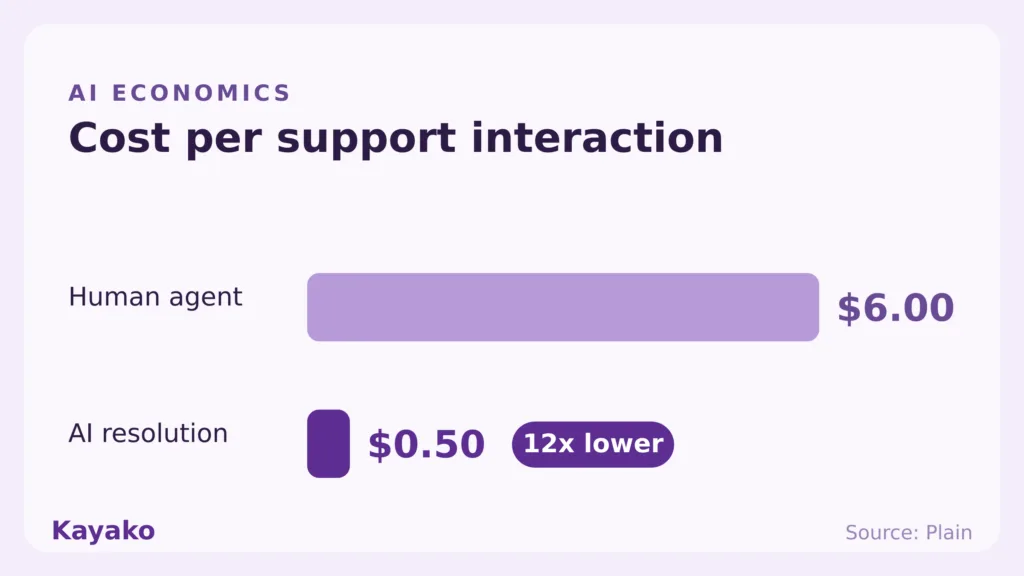
AI has moved from deflecting questions to resolving them. The most effective B2B teams now let AI handle high-volume, structured requests end to end, so humans focus on conversations that need judgment and empathy. Think order status, invoice copies, documentation lookups, and basic troubleshooting. These are repetitive, rules-based, and ideal for autonomous resolution. The economics are hard to ignore. Plain estimates an AI-handled interaction costs about 50 cents, against roughly 6 dollars for a human agent. At B2B volume, that gap funds the team you keep for complex work. The goal is not to remove people. It is to aim them at the work that protects relationships, while AI clears the routine tier. Autonomous resolution on tier one volume is the new baseline, not a future ambition.
10. Close the feedback loop in writing
Most teams collect feedback. Few close the loop on it. Telling a customer what changed because of their input is one of the most underused retention moves in B2B. When a customer reports a problem or requests a feature, the interaction does not end at acknowledgment. It ends when you come back and say what you did. Even a short note that a fix shipped or a request reached the roadmap turns a complaint into evidence that the relationship is a two-way street. Build a simple mechanism for it. Track feedback to an owner, tie it to the account record, and follow up in writing when something moves. Customers who see their input change the product stop comparing you to alternatives, because they feel like partners rather than buyers.
11. Measure the right metrics
You cannot improve what you measure poorly. First response time is easy to track, but on its own it tells you almost nothing about whether a B2B relationship is healthy. Measure the things that map to renewal. Customer effort score tells you how hard it was for the customer to get help. Account-level net promoter score tells you whether the people who renew would recommend you. Time to resolution on critical tickets tells you whether you keep your most important promises. Tie each metric to an owner and review it on a cadence, watching trends at the account level, not just the aggregate, because one unhappy enterprise customer can outweigh a hundred satisfied small ones in revenue terms. What you choose to measure is what your team will improve.
12. Run quarterly business reviews
The quarterly business review is the highest-leverage account activity most teams underuse. It is a structured forum, outside any support ticket, to talk about value delivered, problems solved, and what comes next. A good QBR does three things. It shows the customer the outcomes they have achieved, so the value is explicit rather than assumed. It surfaces friction early, while there is time to fix it before renewal. And it opens the door to expansion, because the conversation naturally turns to goals the customer has not met yet. Run them on a rhythm for your top accounts, prepare with real data from the account record, and bring the people who can make decisions on both sides. A QBR is not a status meeting. It is where a vendor becomes a partner, and partners renew and grow.
Common B2B Customer Service Mistakes to Avoid
Every best practice has a failure mode, and the most common B2B service mistakes are simply these practices done in reverse. The first is no clear owner. When accounts live in a shared queue, no one feels responsible, and customers sense it. The second is memory loss between tickets. If your team starts from zero on every interaction, you are punishing loyal customers for staying. Front describes how missed handoffs and fragmented context across teams and channels quietly degrade the experience in multi-team operations.
Other traps repeat across companies. Ignoring health signals until the cancellation arrives. Treating onboarding as a sales handoff rather than a structured program. Measuring speed while ignoring effort. Letting self-service content rot until it generates more tickets than it deflects. KPMG maps these moments of failure across the relationship life cycle, and the pattern is consistent. The damage rarely comes from one dramatic event. It accumulates from small, avoidable lapses that add up to a customer who stops trusting you. Audit for these failure modes before they reach a renewal.
How AI Is Reshaping B2B Customer Service Best Practices
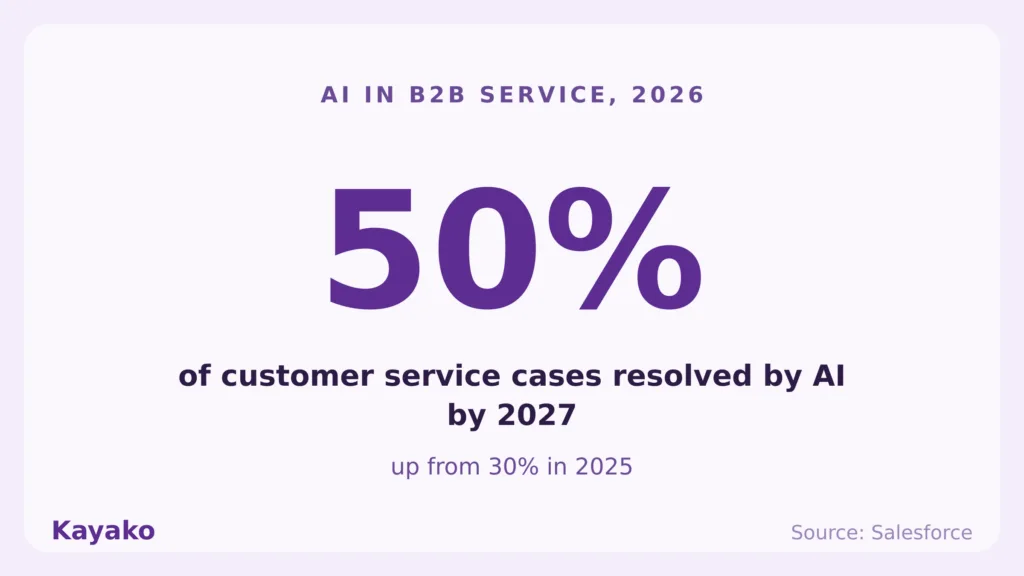
Artificial intelligence is rewriting what good B2B service looks like, and the bar is moving from assistance to autonomy. For years, AI in support meant suggestions for a human to approve. That assist mode is now the floor, not the ceiling. The target is autonomous resolution, where AI completes the request end to end. Salesforce reports AI resolved about 30 percent of cases in 2025 and projects 50 percent by 2027, a shift that changes the math on every support budget.
The gains extend to the humans too. Salesforce Ben notes reps working alongside AI spend 20 percent less time on routine cases and drive a 15 percent lift in upsell, because they are freed to focus on revenue conversations. The most advanced systems are account-aware. They read the customer record before they respond, so the automated answer carries the same context a senior agent would have. That is the difference between a chatbot and a genuine service layer, and it is where B2B support is heading in 2026.
B2B Customer Service Best Practices in Action
The practices are not theory. The companies known for B2B service run on them. Salesforce tiers support by account value, giving its largest customers dedicated technical account managers while routine questions flow to scaled channels, which is the dedicated contact and tiered SLA practices working together. Slack built its reputation partly on proactive incident communication, telling customers about issues before they flood the queue. HubSpot structures support by plan and pairs it with a deep self-service library, so customers get the right level of help and can solve routine problems on their own.
The thread connecting them, as Fin notes, is consistency across channels. A customer never has to repeat context, because every team works from the same record. None of these companies invented a new practice. They executed the fundamentals on this list with discipline. The lesson is that consistency beats novelty, and the playbook is already known. For more examples mapped to the same playbook, see our B2B customer service guide.
How Kayako Operationalizes These Practices
Knowing the practices is one thing. Operationalizing them across a growing account base is another, and this is where Kayako is built to help. Kayako’s SingleView brings sales, support, and success history into one record, so every agent sees the full account the moment a ticket opens. That is the unified record practice, delivered by default. Agent Kay handles tier one volume through autonomous resolution, clearing order status, invoices, and routine troubleshooting so your team can focus on relationship-sensitive work. Automation workflows and AI triage route every conversation to the right owner, and built-in SLA enforcement keeps your contractual promises measurable and visible.
The pricing model fits B2B too. Kayako charges per resolved ticket rather than per seat, so scaling support does not mean scaling license costs. The results are concrete. Aurea used Kayako to preserve full account context through staff turnover, saving an estimated 20,000 dollars per agent transition by ensuring no customer history was ever lost. That is the dedicated contact and unified record practices paying back in hard numbers. It is the difference between knowing the playbook and running it every single day across every account.
Book your Kayako strategy session →
Every conglomerate, irrespective of its scale, is bound by the need for discipline to excel in customer service. Loyalty is earned when customers know there is transparency in communication and in the services provided. When actions start meeting the promised delivery timelines, companies secure a user base that not only aligns with the brand for its services but also acts as an ambassador, voicing the virtues of the enterprise. A feat which is no small in the day and age of massive competition.
Frequently Asked Questions
What are the most important B2B customer service best practices?
The highest-impact practices are assigning dedicated account owners, unifying your customer record across teams, enforcing tiered SLAs, onboarding for fast time to value, and using AI to resolve routine tickets. Together, they protect retention and expansion, which is where most B2B revenue lives.
How is B2B customer service different from B2C?
B2B service supports ongoing relationships with multiple stakeholders per account, often under contractual service levels, where a single account can carry six or seven figures. B2C service is faster and more transactional.
How do you measure B2B customer service?
Track metrics that map to renewal: account-level NPS, customer effort score, time to resolution on critical tickets, and net revenue retention. Watch trends at the account level, since one enterprise customer can outweigh many small ones in revenue.
How can AI improve B2B customer service?
AI now resolves routine, structured tickets autonomously, which cuts cost to serve and frees specialists for complex work. The mature 2026 model is hybrid. AI handles tier one volume, and humans take the ambiguous and sensitive cases.
How do you reduce B2B churn through service?
Catch risk early with proactive outreach on health signals, fix friction before renewal, onboard for fast value, and close the feedback loop so customers see their input matter. Service quality is one of the strongest predictors of B2B retention.