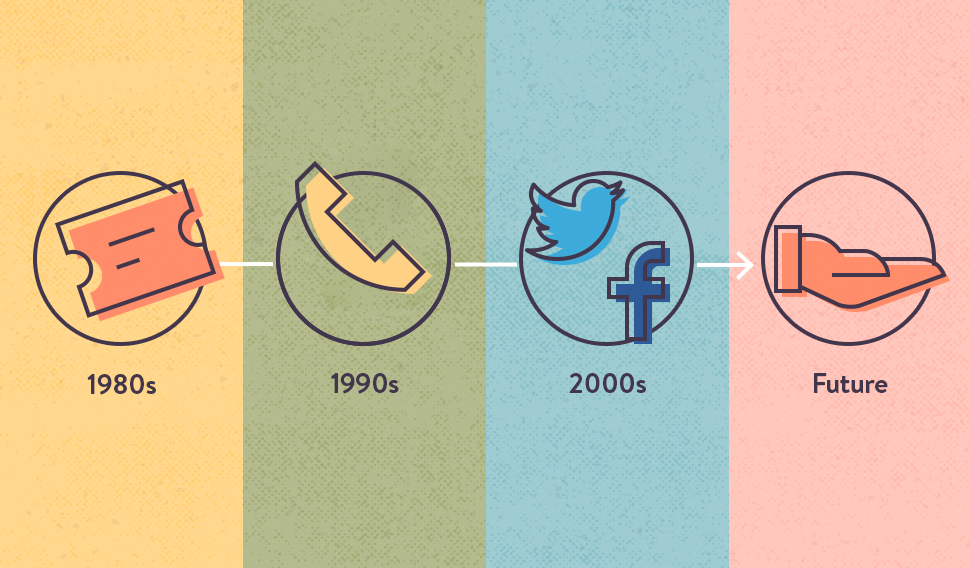
The Evolution of Customer Service: From Clay Tablets to AI Agents
Explore the complete history and evolution of customer service — from ancient clay tablets to agentic AI. Discover how AI is reshaping support in 2025 and how to scale without adding headcount.
Picture this: you’re in ancient Mesopotamia. A frustrated merchant has chiselled the world’s first customer complaint into a clay tablet. No Yelp. No Twitter thread. Just raw, human frustration etched into stone.
Fast-forward 3,700 years and the complaint is the same. What’s unrecognisable is how businesses respond to it. We’ve gone from handshakes in village markets to AI agents resolving tickets in under two minutes. The history of customer service is, at its core, a story of relentless human ambition to do one thing better: make the customer feel heard.
In this guide, we trace the full arc of the evolution of customer service — the milestones, the missteps, and the AI-powered future that’s already here. Whether you’re a support leader or a business strategist, by the end of this piece you’ll know exactly where the industry is heading — and how to get ahead of it.
1. A Brief History of Customer Service
From Clay Tablets to Handshakes: The Ancient Roots
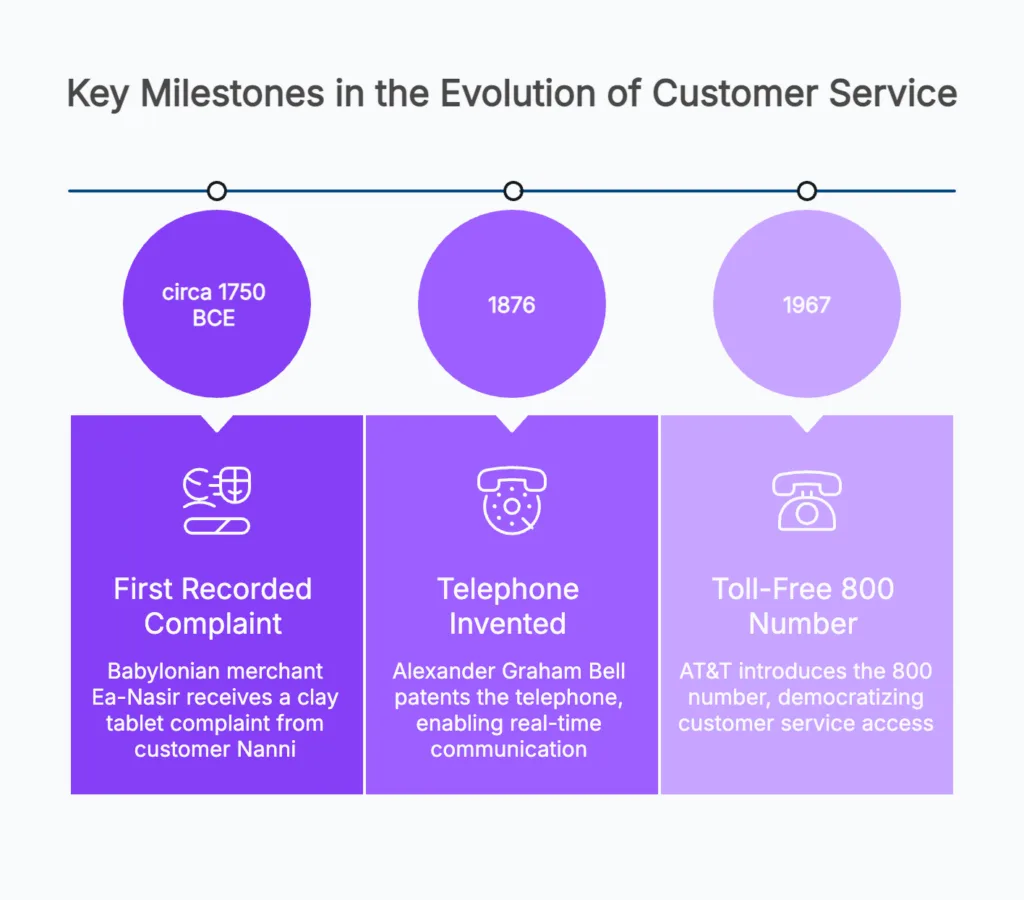
The oldest recorded customer complaint dates to circa 1750 BCE. A Babylonian merchant named Ea-Nasir received a furious clay-tablet letter from a customer called Nanni, accusing him of delivering the wrong grade of copper. The tone? Scalding. The demand? A full refund. According to the British Museum, this tablet — now on display in London — proves that customer dissatisfaction is not a modern invention.
For centuries, customer service was intensely personal. Merchants knew their customers by name. Trust was built face-to-face. Reputation was everything — and it travelled by word of mouth alone. In a village market, one bad transaction could end a career.
The Industrial Revolution: Trading Intimacy for Scale
Steam engines and railways didn’t just move goods — they moved commerce beyond the village square. For the first time, sellers and buyers were strangers. Trust had to be institutionalised.
Companies like Sears and Montgomery Ward built empires on mail-order catalogues, turning distant transactions into reliable brand experiences. In New York department stores, pneumatic tube systems zipped orders across entire buildings — an early signal that efficiency and customer experience were always intertwined.
The takeaway? Scale is always won or lost on the quality of the systems behind it.
The Telephone Revolution: Speed Meets Service
Alexander Graham Bell’s 1876 invention gave businesses their first real-time customer channel. But it wasn’t until 1967 — when AT&T introduced the toll-free 800 number — that customer service truly democratised. Suddenly, calling for help cost nothing. The modern call centre was born.
The limitations were obvious by today’s standards: set business hours, siloed agent notes, no customer history. But the call centre era built something that would define every decade that followed: the expectation of immediate, direct access to help.
According to Gartner, even today over 80% of customer service interactions still originate from a desire for human conversation — a statistic that traces directly back to that first 800-number dial tone.
Struggling to scale support without breaking the bank?
The Digital Tsunami: Email, Web, and the Rise of eCommerce
The internet didn’t just add a new channel — it rewired customer expectations entirely. Microsoft Outlook (1996), Hotmail, and then Gmail made asynchronous support the norm. Customers no longer needed to call; they could type.
Then came Amazon and Zappos — and everything changed again. These companies didn’t just sell products; they sold experiences. Amazon’s one-click purchasing, Zappos’s legendary no-questions-asked returns policy, and the rise of live chat set a new benchmark: fast, frictionless, and deeply personal.
Social media and messaging apps followed. WhatsApp, WeChat, Telegram — platforms originally built for private chats — became front-line support channels. By 2020, the average consumer was using nine distinct channels to interact with brands, according to a Salesforce State of the Connected Customer report.
“Customer experience has overtaken price and product as the key brand differentiator.” — Walker Information, CX Future Study
2. The Evolution of Customer Service in the Digital Age
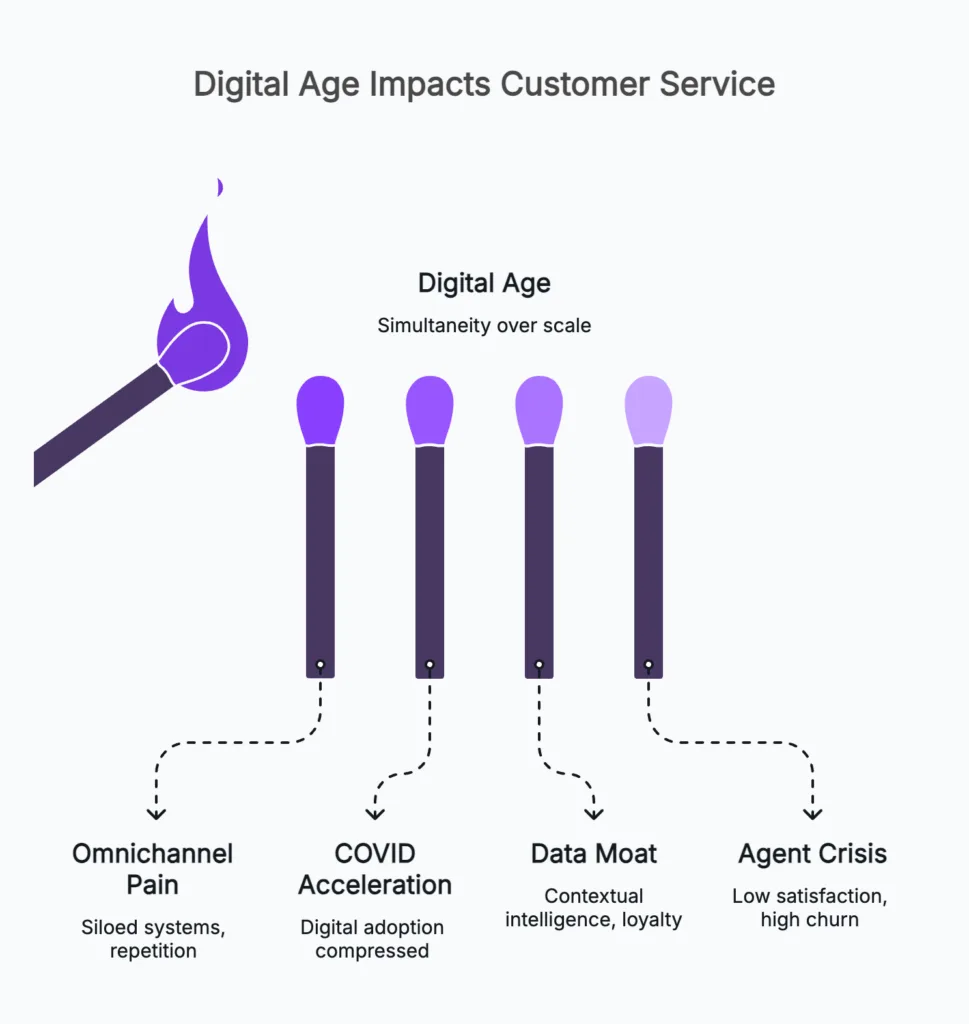
If the industrial era was about scale, the digital era is about simultaneity. Customers don’t move through a linear journey anymore. They zigzag. They start on Instagram, continue via email, escalate on chat, and expect every touchpoint to know their full history. That’s not a high bar — it’s a different sport entirely.
The Omnichannel Promise (and the Painful Reality)
Omnichannel sounds great in a board deck. In practice, most companies are running siloed systems held together with spreadsheets and wishful thinking. Customers repeat themselves. Agents scramble. CSAT scores suffer.
The data is brutal: nearly 80% of executives cite legacy IT systems as the single biggest barrier to delivering seamless customer service, according to the Capgemini World Customer Experience Report. That’s not a technology problem — it’s a strategic failure.
True omnichannel care means unified data, unified workflows, and a single agent view of the customer — what Kayako calls SingleView™. Without that, you’re not offering omnichannel support. You’re offering chaos with extra steps.
COVID-19: The Digital Accelerant Nobody Asked For
March 2020 didn’t just close offices. It compressed five years of digital adoption into five months. According to the Capgemini report, 86% of consumers engaged brands digitally — through email or websites — during the pandemic. Many for the first time.
The businesses that had invested in self-service knowledge bases, AI chatbots, and robust digital support infrastructure thrived. Those that hadn’t scrambled to catch up — often deploying half-baked solutions that frustrated customers more than they helped.
The lesson? Digital-readiness is not an IT project. It’s a business survival strategy.
See how 100+ teams scale support without adding headcount → Get Your Blueprint
Data: The New Competitive Moat
The brands winning at customer service today aren’t winning on price or even product. They’re winning on contextual intelligence. Sephora’s live chat doesn’t just answer questions — it recommends products based on your purchase history. Amazon’s Alexa doesn’t just take orders — it anticipates them.
This is what AI-powered sentiment analysis and customer intelligence tools make possible: moving from reactive to predictive service. The companies deploying these tools aren’t just reducing tickets — they’re building durable customer loyalty that’s almost impossible to poach.
The Agent Crisis Nobody’s Talking About
Here’s a number that should keep every support leader up at night: only 16% of customer service agents say they’re satisfied at work, per the Capgemini research. Sixteen percent.
Agents are drowning in repetitive tickets, context-switching between six different tools, and getting no real-time support when they need it. The result? High churn, inconsistent service quality, and a customer experience that mirrors the dysfunction underneath.
The evolution of customer service in the digital age isn’t just about customer experience. It’s equally about agent experience. Fix the latter, and the former follows.
3. From Scripted Bots to Conversational AI: The Leap That Changed Everything
Remember those maddening phone trees? “Press 1 for billing. Press 2 for… sorry, I didn’t understand that.” Interactive Voice Response (IVR) systems were the first generation of automation — efficient for the business, infuriating for the customer.
The rule-based chatbots of the early 2000s were marginally better. They could handle scripted FAQs, deflect simple queries, and — occasionally — send you spiralling into a loop of unhelpful menus. Progress, but barely.
Then large language models (LLMs) arrived. And everything shifted.
What Makes Modern Conversational AI Different
Today’s AI chatbots don’t just pattern-match keywords. They understand context, intent, tone, and nuance. They hold multi-turn conversations. They escalate gracefully to human agents when needed. They operate in 40+ languages without flinching.
The numbers back this up:
- ABN Amro’s “Anna” AI agent handles over 3.5 million voice and text conversations per year — cutting wait times dramatically (Capgemini, 2025).
- TrueLayer’s “Ema” resolves 82% of support cases without any human intervention, while continuously learning from interactions (Capgemini, 2025).
- Klarna’s AI assistant cut ticket resolution time from 11 minutes to under 2 — generating multi-million dollar efficiency gains (Capgemini, 2025).
“AI won’t replace human agents — but bad AI might replace your customers.” — Kayako
The difference between AI that works and AI that damages your brand is not just the technology. It’s the implementation strategy. Read more on why contact centre AI doesn’t always work — and what to do about it.
Multi-Modal and Agentic AI: The Next Frontier
We’re now entering the era of agentic AI — systems that don’t just respond to queries but proactively manage customer journeys. Think: an AI that detects a shipping delay before the customer notices, proactively reschedules a delivery, sends a personalised apology, and issues a goodwill discount — all without human intervention.
Multi-modal AI takes this further, blending voice, text, image recognition, and video to create richer, more accessible support experiences. This is particularly powerful for scaling Tier 1 support — the repetitive, high-volume queries that currently consume most of your team’s time. For more on this shift, see our deep-dive on why Tier 1 support will never be the same.
Ready to implement AI on your first support queue?
4. The Role of Artificial Intelligence in Transforming Customer Service
Let’s be direct: AI isn’t coming to customer service. It’s already here. The question isn’t whether to adopt it — it’s whether you’ll implement it strategically or bolt it on haphazardly and wonder why it’s not working. (Hint: 95% of DIY AI implementations fail, per Kayako’s own customer data.)
Generative AI: From Static FAQs to Adaptive Assistants
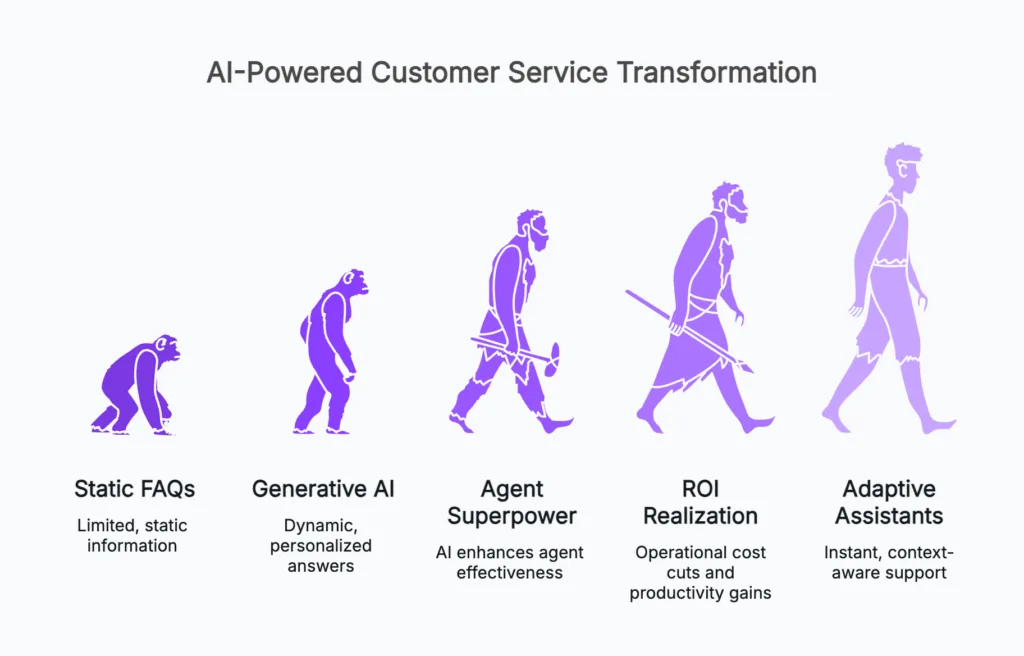
Generative AI transforms the self-service experience from a static FAQ graveyard into a dynamic, context-aware conversation. Instead of hunting through a knowledge base, customers get instant, personalised answers — in their language, in their tone, at 3am on a Sunday.
Europe’s Eneco eMobility deployed Gen AI and cut case wrap-up times by 50%, freeing agents to focus on complex queries that genuinely require human judgement (Capgemini, 2025). That’s not incremental improvement. That’s operational transformation.
AI as an Agent Superpower
The best AI in customer service doesn’t replace agents — it makes them dramatically more effective. Real-world deployments show AI helping agents:
- Surface the right answer instantly — no more hunting across six tabs
- Summarise long conversation threads — so agents join mid-ticket with full context
- Auto-translate — enabling global teams to support customers in any language
- Suggest next-best responses — trained on your best-performing tickets
United Airlines’ ‘Mars’ platform integrated data streams to cut admin work significantly. Comcast’s ‘Ask Me Anything’ LLM-powered agent support earned over 80% positive customer feedback (Capgemini, 2025).
The ROI Is Real — But Only With The Right Implementation
The benefits of AI in customer service are well-documented:
- Operational cost cuts of up to 24%
- Agent productivity improvements of 18%
- Resolution times dropping from 11 minutes to under 2
- CSAT scores improving when FCR, resolution time, and cost-per-ticket are all optimised together
But here’s the catch: less than 50% of firms feel ready for full AI adoption despite sky-high expectations, per Capgemini’s research. The gap between ambition and execution is where most AI investments go to die.
The businesses that win don’t try to boil the ocean. They start with one support queue, prove ROI, then scale. More on that methodology in Section 6.
For a full breakdown of what to measure when AI is deployed, read our guide on measuring AI’s impact: metrics that define customer success.
5. Benefits, Challenges, and the Honest Truth About Modern Customer Service Tech
The Wins Are Real
When customer service technology is deployed well, the impact is undeniable:
- Customer Satisfaction: Faster, personalised, empathetic service drives loyalty. According to PwC, 73% of consumers say experience is a key factor in their purchasing decisions.
- Operational Efficiency: Lower average handle time, fewer escalations, dramatically reduced cost per ticket.
- Agent Retention: By offloading repetitive tasks, AI reduces burnout — critical when only 16% of agents currently feel fulfilled.
- Revenue Generation: AI insights inform proactive outreach, personalised upsells, and churn prevention — transforming support from a cost centre into a growth engine.
- Scalability: Cloud infrastructure and AI agents enable businesses to handle volume spikes without ballooning headcount.
- Inclusivity: Multilingual, multi-modal AI opens premium support experiences to customers who were previously underserved.
The Roadblocks Are Real Too
Let’s not pretend this is easy. The barriers to transformation are significant:
- Data silos and legacy IT: Over 70% of executives cite this as their top challenge (Capgemini, 2025).
- Cultural resistance: Half of employees feel unprepared for AI. Change management is not optional.
- Security and compliance: AI processing sensitive customer data requires robust governance frameworks — non-negotiable in regulated industries.
- AI quality: Poorly trained models hallucinate, give wrong answers, and damage trust. “Set it and forget it” is not an AI strategy.
- Over-automation: Customers still want humans for complex, emotional interactions. Get the blend wrong and you’ll pay in churn.
The companies that crack these challenges don’t just improve their support metrics — they build a durable competitive advantage that’s genuinely hard to replicate.
6. The Future of Customer Service: Trends Shaping 2025 and Beyond
The next chapter of the evolution of customer service won’t be written by the companies with the biggest budgets. It’ll be written by the ones with the clearest strategy. Here’s what the landscape looks like right now:
Agentic AI: The Autonomous Support Maestro
Agentic AI moves beyond answering questions to proactively managing entire customer journeys. A cancelled flight? An agentic AI rebooks it, adjusts the hotel, and suggests restaurants nearby — all before the customer realises there’s a problem. A package delay? The AI flags it, reroutes if possible, and sends a personalised update automatically.
For support teams, this means omnichannel AI support becomes genuinely seamless — not just a marketing claim.
Hybrid Teams: The New Normal
The either/or debate about AI versus humans is over. The answer is both, in the right proportion. According to Capgemini, 64% of firms forecast marked service quality improvements from AI-human hybrid teams within three years.
AI handles the volume. Humans handle the nuance. Neither replaces the other — they make each other better.
Hyper-Personalisation at Scale
Big data, IoT, and location intelligence are enabling support experiences that feel like the village merchant of old — but at global scale. Proactive alerts before problems arise. Smart upsells at exactly the right moment. Service that adapts to your mood, history, and context in real-time.
For a full picture of where this is heading, read our guide on the future of AI in customer service.
Ethical AI: Transparency Is Non-Negotiable
As AI governs more service interactions, customers and regulators are demanding honesty. Which interactions are AI-handled? How is data used? How are biases mitigated? The brands that answer these questions proactively will build trust. The ones that hide behind automation will lose it.
Premium Service as a Revenue Stream
Customer willingness to pay for enhanced experiences is surging. 60% of customers say they’d pay more for priority support, personalised concierge services, and faster resolutions (Capgemini, 2025). Customer service is no longer just a cost centre — it’s a monetisable asset.
7. How Kayako Helps You Navigate This Evolution
You’ve traced the entire arc of the history of customer service. Now the question is: where does your business sit in this story — and where do you want to be?
Most support leaders know they need AI. What they don’t know is how to implement it without a massive headcount, a blown budget, or a six-month integration project that derails the team.
That’s exactly the problem Kayako was built to solve.
The Kayako Approach: Prove ROI, One Queue at a Time
Kayako’s philosophy is deliberately different from the “boil the ocean” approach that causes most AI implementations to fail. Instead of a wholesale platform replacement, Kayako lets you start with one support queue, implement AI with expert guidance, prove measurable ROI, then scale.
Here’s what that looks like in practice:
- Step 1 — Pick one support queue: Start focused. Don’t try to transform everything at once.
- Step 2 — Expert AI implementation: Kayako’s professional services team implements your AI agent — no DIY guesswork.
- Step 3 — Streamline workflows: Automate triage, routing, and repetitive responses using Kayako’s AI automation engine.
- Step 4 — Measure what matters: Track CSAT, First Contact Resolution, Total Resolution Time, and Cost Per Ticket on a clear KPI dashboard.
- Step 5 — Scale with confidence: Once ROI is proven, roll out to additional queues and support lines.
Key Kayako Features That Drive Results
- SingleView™ Customer Context: Every agent sees the full customer history — no more asking customers to repeat themselves.
- AI-Suggested Responses: Real-time suggestions trained on your best-performing tickets, improving consistency and speed.
- Ticketing Software with Intelligent Routing: The right ticket goes to the right agent (or AI) every time.
- Self-Service Portal & Knowledge Base: Deflect up to 90% of repetitive tickets before they reach your team.
- Kayako Messenger: Seamless live chat experience for agents and customers, fully integrated with omnichannel support.
- Help Center Analytics: Identify knowledge gaps, track self-service deflection, and continuously improve your support content.
- Integrations (Slack, Zapier, Salesforce): Connect Kayako to your existing stack in hours, not months.
The Numbers Kayako Customers See
When Kayako is implemented correctly — with expert oversight and the right workflow design — here’s what support leaders consistently experience:
- CSAT scores improve as First Contact Resolution, resolution time, and cost per ticket all move in the right direction simultaneously.
- Ticket backlogs clear as AI handles the repetitive volume that was previously eating agent hours.
- Industry-leading $1 cost per ticket — compared to $15–$35 for a human-handled ticket, according to Gartner CX benchmarks.
- Support scales without scaling headcount — the outcome 100+ Kayako customers have already proven.
“The legacy approach was: more agents, more cost, more bloat. The Kayako approach is: scale with AI, prove ROI one queue at a time.”
Join 100+ teams scaling support with Kayako AI
Conclusion: The Score Is Still Being Written
From a clay tablet in Mesopotamia to an AI agent resolving 82% of tickets autonomously — the evolution of customer service is one of the most compelling stories in business history. At every inflection point — the telephone, the internet, the smartphone, generative AI — the companies that adapted fastest built lasting competitive advantages. The ones that waited wrote case studies about why they lost.
We’re at one of those inflection points right now. Agentic AI, hybrid teams, hyper-personalisation, and ethical automation are not future trends — they’re present realities for the support leaders who’ve already made their move.
The question is simple: are you one of them?
If you’re ready to scale your customer support without scaling your headcount — and you want a battle-tested strategy backed by 100+ successful implementations — start with a Kayako Strategy Session. It’s the fastest way to move from “thinking about AI” to “proving ROI on it.”
FAQs
1. What was customer service like before chatbots?
A. Before AI chatbots, customer service revolved around phone and face-to-face interactions. Call centres emerged in the 1960s, supported by basic automation like IVR systems and toll-free numbers. Agents manually logged tickets, had no real-time AI assistance, and were limited to set business hours.
2. What is the evolution of customer service in simple terms?
A. The evolution of customer service follows four broad phases: (1) Personal — face-to-face transactions in local markets; (2) Scaled — call centres and mail-order systems; (3) Digital — email, web, and social media support; (4) Intelligent — AI-powered, omnichannel, proactive customer experiences. We’re firmly in Phase 4 now.
3. What is multi-modal AI in customer service?
A. Multi-modal AI processes different data types simultaneously — text, voice, images, video — to create richer, more natural and accessible customer interactions. It enables capabilities like voice-to-text transcription, image-based product support, and video troubleshooting guides, extending AI support far beyond simple chatbots.
4. How does emotional intelligence work in AI agents?
A. Advanced AI models use sentiment analysis and natural language understanding to gauge tone, mood, and intent in real-time. This enables them to modulate conversation style, respond with appropriate empathy, and intelligently escalate emotionally charged interactions to human agents.
5. How do I scale customer support without hiring more agents?
A. The proven approach is to: (1) identify your highest-volume, most repetitive support queue; (2) implement an AI agent on that queue with expert guidance; (3) measure CSAT, FCR, and cost-per-ticket; (4) scale once ROI is proven. Kayako’s 5-step methodology, deployed with 100+ customers, makes this process predictable and low-risk. Learn more about scaling customer support, or book a strategy session to see how it applies to your team.
Ready to write the next chapter of your customer service story?