Quick summary: Inside sales happens remotely, by phone, email, and video, while outside sales happens in the field, face to face. Inside sales is cheaper, faster, and easier to scale; outside sales wins larger, more complex deals through in-person relationships. Outside reps typically earn more, though inside sales is growing faster, and most teams now blend the two. This guide compares them head-to-head, breaks down the roles and salaries, and helps you decide which fits your business.
The choice between inside vs outside sales shapes how a team sells, what it costs, and who it hires. Inside sales reps work remotely and sell through the phone, email, and video. Outside sales reps travel to meet prospects in person, whether at the client’s office, a trade show, or a site visit. The distinction sounds simple, but it ripples into cost, hiring, compensation, and the kind of deals a team can realistically win. Both close deals, but they suit different products, deal sizes, and buyers, and getting the mix right has a direct effect on cost and growth. It is one of the first structural decisions a sales leader makes, and it is expensive to reverse once a team is built around it. Choose wrong and you either overspend sending field reps after small deals or lose big ones by trying to close them over a video call.
The economics tell much of the story. An inside sales call costs around $50 compared with roughly $308 for an outside sales call, per Pointclear figures cited by Mailshake, a difference of more than six times before a single deal is closed. Understanding the trade-off between them is one of the foundational decisions in building a sales team, and it affects everything from your hiring plan to your cost of acquiring a customer. This guide defines both models, compares them head-to-head, breaks down the rep roles and salaries, and ends with how to choose. It is a companion to our deeper look at what inside sales is, and where that guide goes deep on the inside model alone, this one sets the two side by side. Start with the definitions.
What is inside vs outside sales?
Inside sales is selling conducted remotely, from an office or home, using phone, email, video calls, and other digital tools. Reps never need to meet a prospect in person. It grew with SaaS and cloud communications and is now the default model for many software and mid-market companies. Modern tools like video conferencing, CRM automation, and sales engagement platforms mean an inside rep can run a full sales cycle, from first touch to signed contract, without ever leaving their desk. What was once a support function for the field team has become a primary sales channel in its own right.
Outside sales, also called field sales, are sales conducted in person. Reps travel to meet prospects and clients, attend on-site meetings, and build relationships face to face, often over weeks or months for a single account. The in-person element is the whole point: some deals are won on trust that is hard to build over a screen. It suits large, complex, or high-value deals where trust and in-person demonstration matter. Enterprise software, industrial equipment, medical devices, and other considered purchases often still rely on field sales, because a six- or seven-figure decision tends to want a human in the room. The line between them has blurred as remote selling has matured, and some reps now do a bit of both, but the two models still describe genuinely different ways of working. Both fit within a broader B2B sales motion, and the clearest way to see the difference is side by side.
Inside vs outside sales: head-to-head
The two models differ on almost every practical dimension, from where the rep sits to how big the deal is and how long it takes to close. The table lays out the contrast, and each row has real consequences for how you staff and budget a team.
| Dimension | Inside sales | Outside sales |
|---|---|---|
| Location | Remote, office, or home | In the field, on-site |
| Channel | Phone, email, video | Face-to-face meetings |
| Cost per contact | Around $50 | Around $308 |
| Deal size | Smaller, transactional | Larger, complex |
| Sales cycle | Shorter | Longer |
| Best for | Volume, SMB, SaaS | Enterprise, high-value |
The cost gap compounds at scale. Outside sales teams pay 40% to 90% more to acquire a customer than inside teams, per ZS Associates figures cited by Notta. That difference is why so many companies default to inside sales and reserve field selling for their largest opportunities. When a rep can reach dozens of prospects a day from a desk instead of driving to three meetings, the math favors inside sales for anything but the biggest deals. That six-fold cost gap is why finance teams tend to push for inside sales wherever the deal size allows it. The cost per contact is only part of it; the sheer number of conversations an inside rep can have also fills the pipeline faster. The numbers only make sense once you understand what each rep actually does.
Inside vs outside sales rep: the roles
The day-to-day work of an inside rep and an outside rep looks very different, even when they sell the same product to the same kind of buyer. The tools, the rhythm, and the skills that make someone great in each role are not the same, which is why reps often specialize in one.
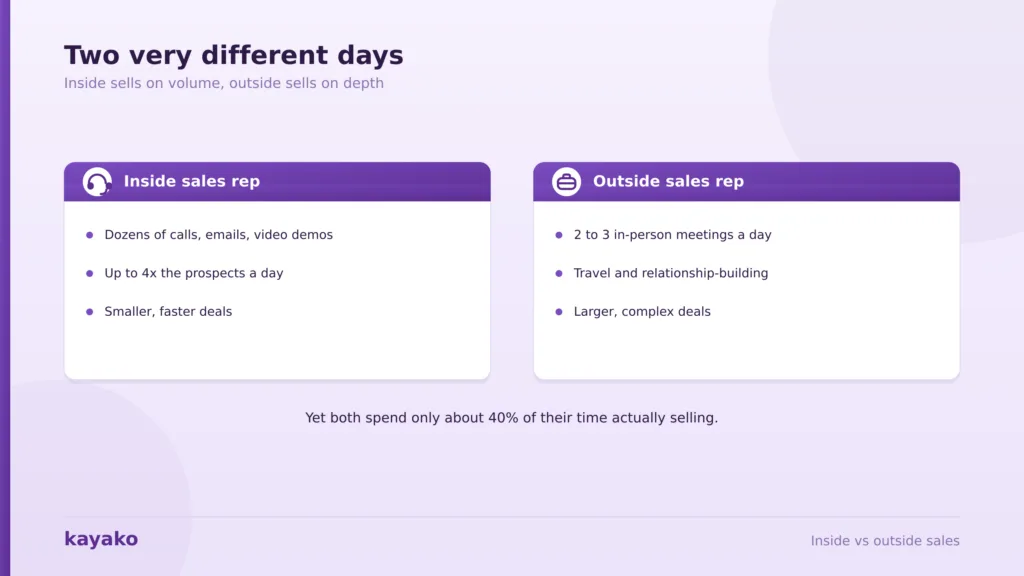
The inside sales rep. Works from a desk, running high volumes of calls, emails, and video demos. The role rewards efficiency, quick follow-up, and comfort with a CRM and sales tools, along with the discipline to work a long list of prospects without losing track of any of them. Speed matters enormously here: responding to a fresh lead within minutes rather than hours can be the difference between a deal and a dead end, so inside teams live and die by their process. An inside rep can work far more prospects in a day than a field rep, since no travel is involved. A typical day might include dozens of calls and emails and a handful of video demos, all tracked in a CRM, with the emphasis on speed of response and disciplined follow-up.
The outside sales rep. Spends the day in meetings, at client sites, or at events, building relationships in person. The role rewards presence, relationship-building, and the patience to work on longer, larger deals. Reading a room, building rapport over meals and site visits, and navigating a buying committee in person are skills that do not always transfer from the phone, and they are exactly what large deals often require. Fewer meetings happen per day, but each one carries more weight. A field rep might have two or three meetings in a day after travel, so the skill is in making each interaction count and nurturing relationships over a longer cycle. The upside is depth: an outside rep often understands a major account far better than a phone-based rep ever could, which is exactly what large, complex deals reward.
Both share a frustrating reality: reps spend only about 40% of their time actually selling, with the rest lost to admin and research, per Salesforce figures cited by Qwilr. Inside reps offset this partly through volume, working up to four times the prospects of field reps at lower cost, per SPOTIO. Outside reps offset it differently, by concentrating that limited selling time on the deals large enough to justify a personal visit. Strong sales enablement helps both spend more time in front of buyers. Those different roles come with different paychecks, which is the question most people want answered.
Inside vs outside sales salary
Outside sales reps generally earn more than inside reps, reflecting larger deals and more experience, though figures vary widely by source, so it helps to see several.
- Payscale. Inside reps average around $56,000 in total pay versus about $69,000 for outside reps, a gap of roughly $12,000, per QuotaPath.
- Indeed. Reports a similar shape, with inside reps near $58,000 and outside reps near $77,000 as national averages, per Indeed.
- Zippia. Puts averages a little lower, with inside around $44,000 and outside around $60,000, per Zippia.
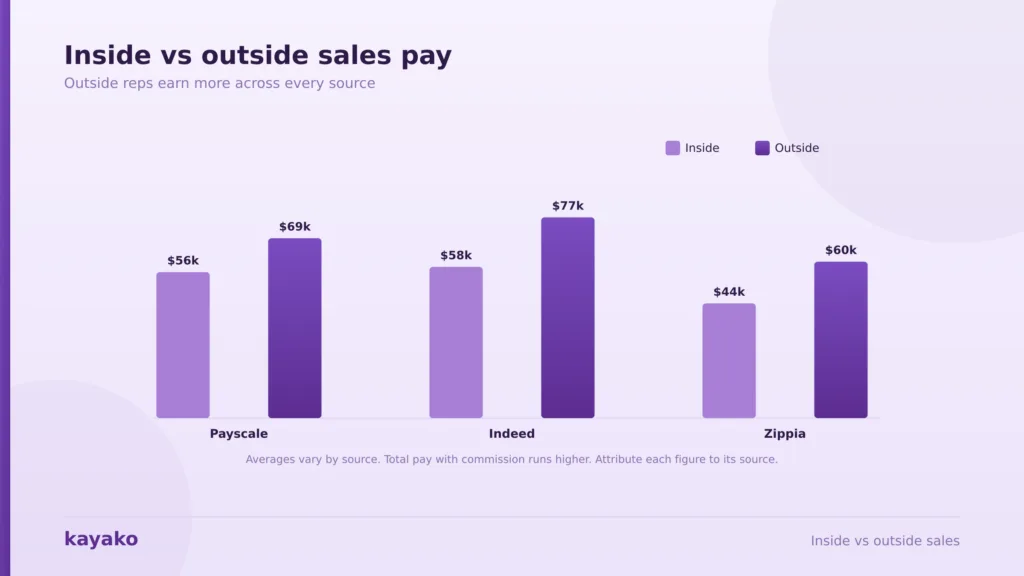
The pattern across every source is consistent, even when the exact numbers are not: outside reps out-earn inside reps by a meaningful margin. Treat any single figure with caution, since salary depends heavily on industry, region, seniority, and how much of the pay is commission, but the direction is reliable across sources. Note that Glassdoor and similar total-pay figures often run much higher because they fold in commission and bonuses on top of base salary. The gap reflects the value of the larger deals field reps close, but it is not the whole picture. Compensation structures also differ: outside roles often carry higher base salaries to offset travel and longer cycles, while inside roles can lean more heavily on commission tied to volume. And the gap is narrowing as inside sales takes on bigger deals, because inside sales is where the growth is.
Pros and cons of each
Neither model is better in the abstract; each wins in different situations, and the honest way to compare them is to weigh what you gain against what you give up.
Inside sales pros and cons. It is cheaper, faster, and highly scalable, and it suits shorter cycles and smaller deals. Adding capacity is as simple as adding a seat and a headset rather than a territory. The trade-off is that it can struggle with the largest, most complex sales that benefit from an in-person relationship, and some buyers still expect to meet a person before signing a major contract.
Outside sales pros and cons. It wins large, complex, relationship-driven deals and builds deep trust. The trade-off is cost, longer cycles, and limited scalability, since a rep can only be in one place at a time. Travel, expenses, and higher salaries make each field rep a significant investment, which only pays off when the deals are large enough to justify it.
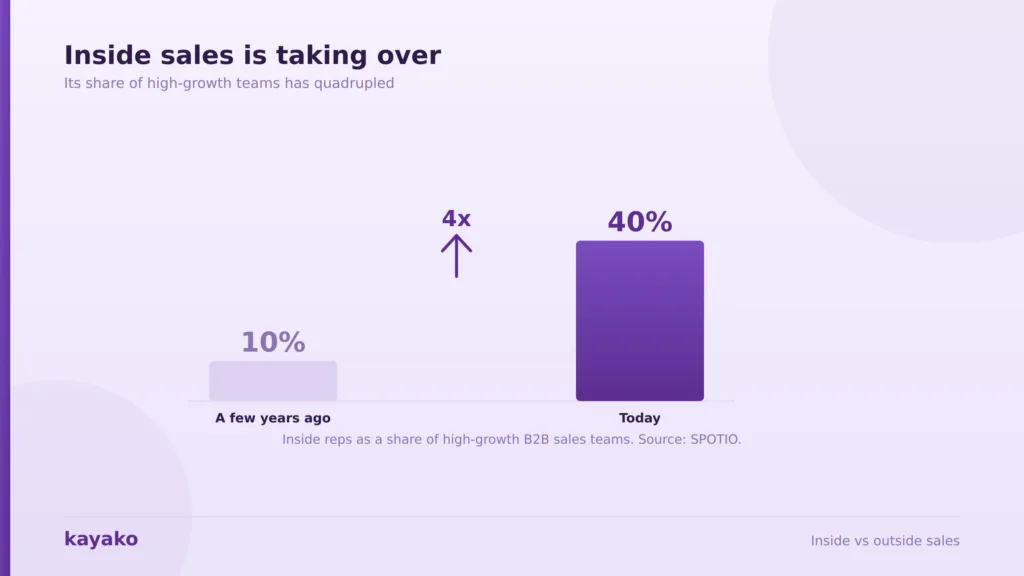
The momentum is clearly with inside sales. Inside reps now make up about 40% of high-growth B2B sales teams, up from roughly 10% a few years ago, per SPOTIO. That growth is one reason most teams no longer choose strictly between the two. The rise of inside sales does not mean field sales is disappearing, since the largest and most relationship-driven deals still reward an in-person approach, but its share of total selling keeps shrinking. As remote buying has become normal and inside tools have grown more capable, deals that once demanded a field rep can increasingly close over video, pulling more volume into the inside model every year.
The hybrid model
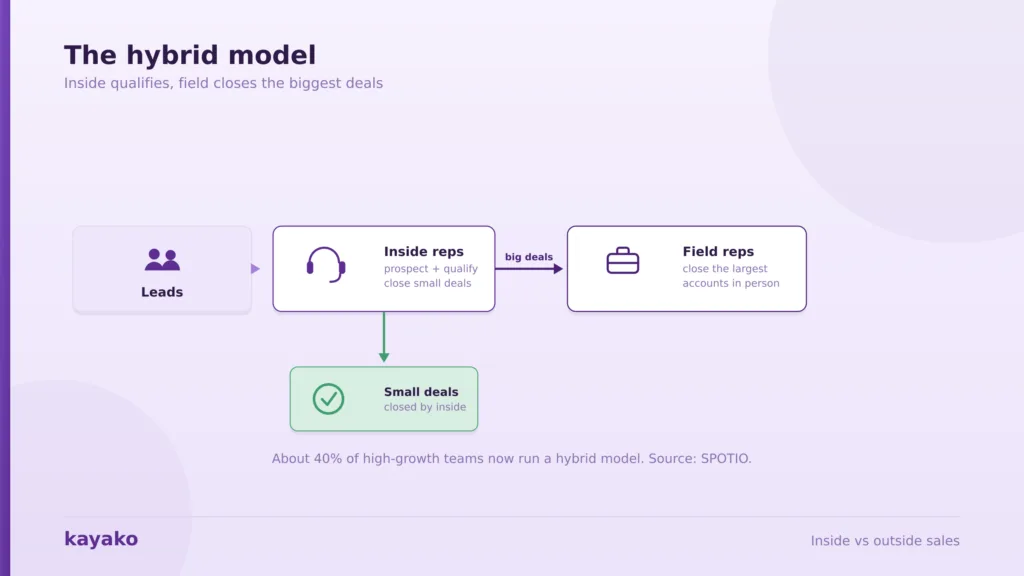
In practice, the inside-versus-outside choice is increasingly a false one. Most modern teams run a hybrid model, using inside reps to prospect, qualify, and handle smaller deals, while field reps focus their time on the largest, most complex opportunities. About 40% of high-growth teams now use a hybrid approach, per SPOTIO.
The hybrid model captures the efficiency of inside sales and the closing power of field sales at once. A common structure has inside reps qualify and nurture every lead, then hand the largest opportunities to a field rep to close in person, so expensive field time is spent only where it moves the needle. The handoff between the two is where hybrid teams often win or lose, so a clear, agreed threshold for escalation matters as much as the reps themselves. It also reflects how buyers now behave, mixing video calls with occasional in-person meetings and doing much of their research alone before ever speaking to a rep. A rigid inside-only or outside-only structure fits that reality poorly, whereas a hybrid team can meet buyers wherever they are. That leaves most teams with a question of balance rather than a binary choice: not whether to use inside or outside sales, but how much of each, and where to draw the line between them.
Which should you choose?
The right model follows from your product, your deal size, and your buyer, not from a preference for one style of selling. Answer those three questions honestly, and the model usually picks itself.
- Choose inside sales for lower-cost, higher-volume products, shorter cycles, and buyers comfortable purchasing remotely, which describes most SaaS and SMB sales.
- Choose outside sales for large, complex, or high-trust deals where an in-person relationship justifies the higher cost, common in enterprise and certain industries.
- Choose a hybrid if you sell across a range of deal sizes, which is true for most growing companies. Let inside reps handle volume and field reps handle the flagship accounts, and set a clear deal-size threshold for when a lead moves from one to the other.
Whichever model you pick, the sale is only the beginning of the customer relationship, and that is where a different team takes over.
Keep the customers your sales team works hard to win, with Kayako.
After the sale: where support fits
Inside and outside sales both answer the same question: how do you win a customer? They do not answer the equally important one: how do you keep them? That job falls to customer support, and it matters to the bottom line as much as the sale does, because acquiring a new customer costs far more than keeping an existing one. A team that pours money into sales but neglects support is filling a leaky bucket, adding customers at the top while losing them out the bottom, and no amount of clever inside or outside selling fixes that. Increasing customer retention by just 5% can raise profits by 25% to 95%, per Bain.
This is the honest, secondary place a support platform like Kayako fits in a sales conversation. It plays no part in closing the deal, but it protects the value of every deal your reps close by resolving post-sale questions quickly so customers stay. An AI-driven support platform resolves routine issues fast and keeps the cost of serving each customer low, which is what lets a growing customer base stay profitable rather than becoming a support burden. Fast, reliable support is what turns a first purchase into customer lifetime value, and what makes improving retention and cross-selling possible. A strong retention rate quietly amplifies everything the sales team does, since every customer kept is one the team does not have to replace just to stay flat. Whether those customers were won by an inside rep on a video call or a field rep over dinner, what keeps them is the same: a product that delivers and support that resolves problems quickly when they arise.
Protect the revenue your sales team wins, with Kayako.
Inside sales is remote, cheaper, faster, and easier to scale, suiting smaller and mid-sized deals. Outside sales is in-person, more expensive, and slower, but it wins the largest, most complex opportunities and tends to pay reps more. Inside sales is growing faster, and most teams now blend both, using inside reps for volume and field reps for flagship accounts. The trend line is clear even if field sales is not going anywhere: more selling happens remotely every year, and the tools keep making it more effective.
Choose based on your deal size, product complexity, and how your buyers prefer to buy, and lean hybrid if you span a range. There is no prize for loyalty to one model; the teams that win match their motion to their market and adjust as both change. Then remember that winning the customer is only half the work. A signed contract is a beginning, not an ending, and keeping that customer, through fast and reliable support, is what turns a closed deal into lasting revenue and the referrals and renewals that compound on top of it.
Frequently asked questions
What is the difference between inside and outside sales?
Inside sales is conducted remotely, using phone, email, and video, so reps never need to meet prospects in person. Outside sales, or field sales, are conducted face to face, with reps traveling to meet prospects and clients. Inside sales is cheaper, faster, and easier to scale, while outside sales suits larger, more complex, relationship-driven deals. Most modern teams blend the two, using inside reps for volume and field reps for high-value accounts.
What does an inside vs outside sales rep do?
An inside sales rep works from a desk, running high volumes of calls, emails, and video demos, and can cover many prospects a day. An outside sales rep spends the day in person, at client sites, meetings, and events, building relationships and working fewer but larger deals. The inside role rewards efficiency and CRM skill, while the outside role rewards presence and relationship-building. Both often spend only about 40% of their time actually selling.
Who earns more, inside or outside sales reps?
Outside sales reps generally earn more than inside reps, reflecting their larger deals and greater experience. Figures vary by source: Payscale shows a gap of roughly $12,000 in total pay, and Indeed reports national averages near $58,000 for inside versus $77,000 for outside reps. Total-pay figures from sources like Glassdoor run higher because they include commission. The consistent pattern is that outside reps out-earn inside reps by a meaningful margin, though the gap is narrowing as inside sales takes on larger deals, and total pay in both roles depends heavily on commission and the size of the deals closed.
Is inside or outside sales better?
Neither is universally better; it depends on your product, deal size, and buyer. Inside sales is better for lower-cost, higher-volume products with shorter cycles and buyers comfortable purchasing remotely. Outside sales is better for large, complex, high-trust deals where an in-person relationship justifies the higher cost. Most growing companies use a hybrid model, letting inside reps handle volume while field reps focus on their largest, most strategic accounts.
What is a hybrid sales model?
A hybrid sales model combines inside and outside sales, using inside reps to prospect, qualify, and close smaller deals while field reps focus on the largest and most complex opportunities. It captures the efficiency and scalability of inside sales alongside the closing power of in-person field sales, letting a company scale its pipeline cheaply while still bringing the full weight of a personal relationship to its most important deals. About 40% of high-growth teams now use a hybrid approach, partly because buyers themselves mix remote video calls with occasional in-person meetings, so the model matches how people actually buy today.