Quick summary: Inside sales is selling remotely through phone, email, and video rather than in person. It is built for volume and speed, costs far less per interaction than field sales, and now makes up a large and growing share of B2B selling. This guide defines inside sales, compares it with outside sales, walks through the process, roles, tools, and metrics, and covers the hybrid model most teams now run. It closes with an honest note on what happens after the sale, where support and retention take over.
Inside sales is how most modern B2B companies actually sell. Instead of driving to meetings, reps work from an office or from home, reaching prospects by phone, email, and video, and managing the whole cycle through a CRM. It trades the handshake for reach and speed, and over the past decade, it has moved from a supporting role to the center of how software and services get sold. The change tracks how buyers behave: they research online, take calls over video, and increasingly prefer a fast remote conversation to a scheduled visit.
The economics are hard to argue with. An inside sales call costs about $50 on average, versus roughly $308 for an outside sales call, according to Pointclear figures compiled by Mailshake. This guide explains what inside sales is, how it compares with outside sales, the process and roles behind it, the tools and metrics that matter, and where the model is heading. It is written for anyone weighing how to structure a sales team, not just for people who already live in one. It ends where the sale ends, and the relationship begins, with a short, honest look at the support side. Whether you are building an inside team from scratch or deciding how it should coexist with field sales, the goal here is a clear, practical picture rather than a pitch.
What is inside sales?
Inside sales is the practice of selling products or services remotely, through digital and phone-based channels, rather than through face-to-face meetings. A rep qualifies leads, runs demos over video, handles objections, and closes, all without leaving their desk. What used to require a calendar full of visits now happens across a series of calls and emails, compressing a sales cycle that once took weeks into days. It is common in software, technology, and other industries where the product can be shown and explained on a screen. The defining trait is not the office or the headset; it is that the entire relationship, from first touch to signed contract, happens through digital channels rather than in a room.
The model is built around efficiency and volume. Because reps are not traveling, they can work many more prospects in a day and keep deals moving through the pipeline faster. That same efficiency lets a company test new segments cheaply, since trying a new market means adding a sequence, not a territory. Inside sales sits alongside B2B sales as a whole, and for many companies, it is now the default motion rather than the exception. Part of that rise is practical: remote selling lets a company enter new markets without opening an office or putting a rep on a plane, so growth is no longer tied to geography. To see why the balance has tilted, it helps to compare inside sales directly with the older, field-based approach.
Inside sales vs outside sales
Inside and outside sales both close deals, but they do it in different ways, at different costs, and for different kinds of deals. The clearest way to see the difference is side by side.
| Inside sales | Outside sales | |
|---|---|---|
| Channel | Phone, email, video | In-person meetings |
| Cost per interaction | About $50 a call | About $308 a visit |
| Best for | Lower deal value, short cycles | High value, complex deals |
| Volume | High, many prospects a day | Low, few meetings a day |
| Ramp time | Faster, 3 to 4 months | Slower, 6 to 9 months |
A useful way to read the table is that inside sales optimizes for reach, while outside sales optimizes for depth. Neither is a compromise; they are answers to different questions about how a buyer wants to be sold to. The cost gap is the headline. Beyond the per-call figure, outside sales teams pay 40% to 90% more to acquire a customer than inside teams, according to ZS Associates data compiled by Notta, largely because of travel, hospitality, and the time lost between meetings, none of which move a deal forward on their own.
Those are what economists would call non-recoverable costs, and they are precisely what inside sales strips out. Outside sales still wins for large, complex, relationship-driven deals, where a room and a handshake carry weight and a single contract can justify days of a rep’s time. The Pareto logic holds: a field rep may spend a week cultivating one account, but if that account has the highest lifetime value, the investment pays off. For most other deals, inside sales reach more buyers for less, which is why the balance has tilted its way over the past decade. The rise of video and reliable remote infrastructure removed most of the reasons a buyer once needed a rep in the room. That reach only pays off with a disciplined process, which is the next piece.
Keep the customers your sales team works to win, with Kayako
The inside sales process
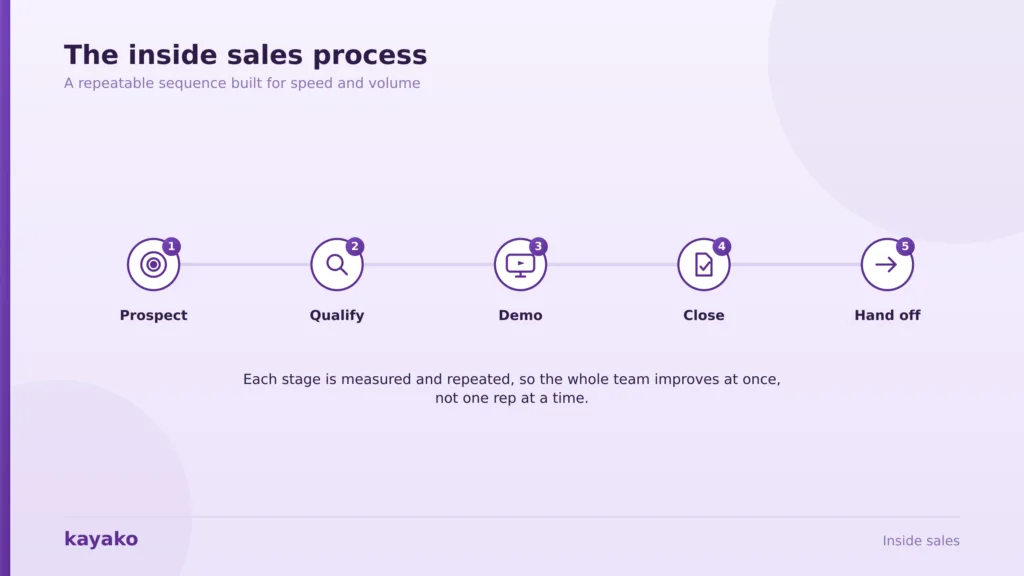
Inside sales runs on a repeatable sequence. The details vary by company, but the backbone is consistent, and its speed is the point. Because so much of the work is digital, each stage can be measured, tuned, and repeated, which is what lets an inside team improve month over month rather than relying on individual talent alone. A field team improves one rep at a time; an inside team can improve a whole step of the process at once, then roll it out to everyone.
- Prospect. Build and prioritize a list of target accounts and contacts, often with the help of data and enrichment tools. A sharper list at this stage saves wasted effort at every stage after it.
- Qualify. Reach out and confirm fit through discovery, so time goes to the leads most likely to buy rather than the ones least likely to say no politely.
- Demo. Show the product over video, tailored to the prospect’s goals rather than a generic tour. A focused demo that solves one real problem beats a full-featured tour almost every time, because buyers remember the moment the product solved their problem, not the list of features.
- Handle objections and close. Work through concerns, agree on terms, and finalize the deal digitally, then confirm next steps in writing so nothing is ambiguous.
- Hand off. Pass the new customer to onboarding and support with full context, so nothing is lost at the handoff, and the customer never has to re-explain what they just bought and why.
Volume is what makes the model work. Inside reps often engage 40 to 60 prospects a day through structured outreach sequences, per figures from monday, far more than a field rep could meet in a week. That volume is only useful if it is aimed well, which is why qualification early in the process matters so much: engaging sixty of the wrong prospects is busier, not better. That throughput depends on reps knowing exactly what to do at each step. It also depends on a clean handoff at the end: a customer who reaches onboarding without their context intact starts the relationship by repeating themselves, which is the opposite of the fast experience the sale promised. All of that rests on how the team is structured, which comes down to roles and skills.
Inside sales roles and skills
An inside sales team is usually split into specialized roles rather than one person doing everything, because a single rep juggling prospecting, demos, and closing tends to do all three at half strength. The structure lets each stage of the process run at volume, and it means a struggling number can be traced to a specific role rather than a vague sense that sales is underperforming.
- Sales development rep (SDR) and business development rep (BDR). Focus on the top of the funnel: prospecting, first outreach, and qualifying leads before handing them on.
- Account executive (AE). Takes qualified opportunities through demo, negotiation, and close, owning the deal from the moment it is qualified to the signature.
- Sales manager. Coaches the team, sets targets, and keeps the pipeline healthy. Good managers spend most of their time developing reps, not just inspecting numbers.
The skills that matter are the ones that translate over a phone or a screen: crisp communication, quick rapport, disciplined follow-through, and comfort with the tools. Resilience matters too, since inside reps hear no far more often than they hear yes, and the best ones treat each call as practice rather than a verdict. Strong enablement makes a real difference here, which is why sales enablement has become central to how inside teams ramp and perform. Skilled reps still need the right stack behind them, so the tools deserve their own look.
Inside sales tools
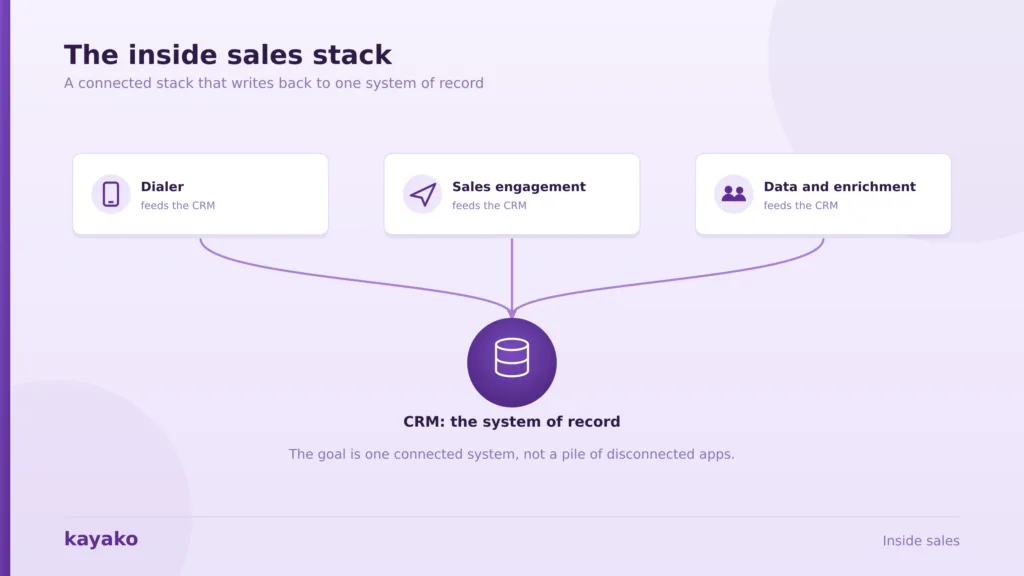
Inside sales is tool-heavy by nature, since everything happens through software. The stack is not a luxury; it is the difference between a rep who spends the day selling and one who spends it copying data between systems. A few categories cover most of what a team needs.
- CRM. The system of record for accounts, contacts, and pipeline. Everything else feeds into it, and a stack is only as good as how cleanly it writes back to the CRM.
- Dialer and phone. Speeds up outbound calling and logs activity automatically, so a rep is not choosing between dialing and record-keeping.
- Sales engagement. Runs multi-step email and call sequences so outreach stays consistent and no follow-up is forgotten, which matters given how many deals need several attempts.
- Data and enrichment. Finds and verifies contact details so reps spend time selling, not searching, since bad data quietly wastes more selling hours than almost anything else.
Buyers weigh these tools carefully, and user sentiment on review sites like G2’s sales engagement category tends to reward accuracy, ease of use, and how well a tool fits an existing CRM. The stack matters because reps lose so much time to non-selling work, and every tool that removes a manual step gives that time back to selling. Just how much time is at stake is exactly what the metrics reveal.
Inside sales metrics
Inside sales live or die on a handful of numbers. They tell you whether the volume is turning into revenue and where time is leaking.
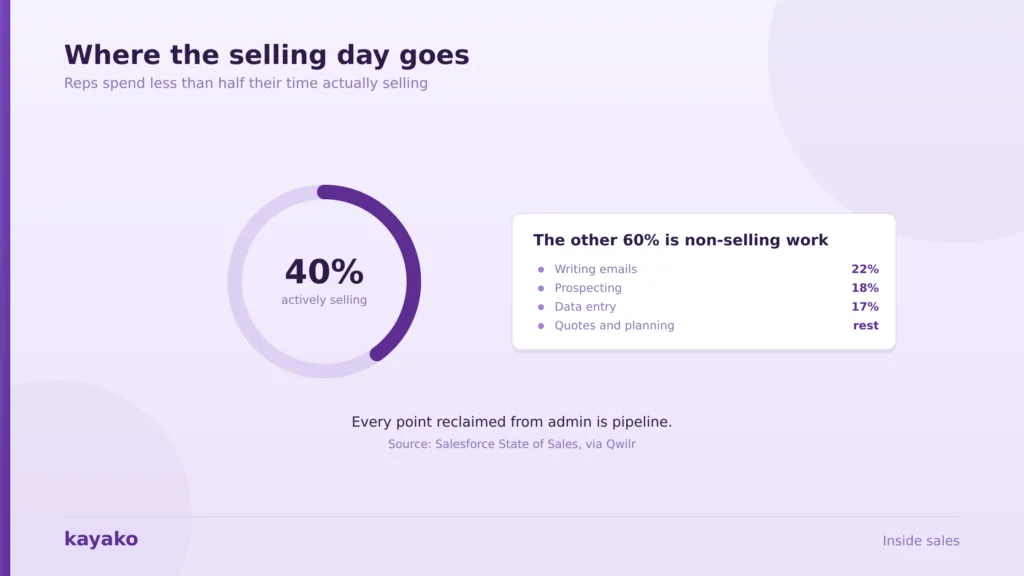
Start with how reps spend their day, because it is sobering. Reps spend only about 40% of their time actively selling, with the other 60% going to non-selling work like admin, data entry, and research, according to Salesforce State of Sales data compiled by Qwilr. Every point reclaimed from that overhead is pipeline. The reps who win are rarely the ones who work the most hours; they are the ones whose hours are protected for the work only a person can do.
These figures explain why so much of modern sales tooling is aimed at automation: the fastest way to sell more is often to stop reps from doing work a system could do. Speed is the next lever. Between 35% and 50% of sales go to the vendor that responds first, and 80% of sales need five or more follow-ups, even though many reps give up after one, per figures compiled by SPOTIO. Quota attainment tracks closely with activity, too: research on B2B teams has found that reps holding five or more real conversations a day hit a noticeably higher share of quota than those managing fewer. The core metrics that track all this are speed to lead, conversion rate, quota attainment, and customer acquisition cost. That last one, CAC, is where inside sales connects to the wider business, since it ties directly to customer lifetime value. A low acquisition cost only helps if the customer stays long enough to be worth more than they cost to win. Metrics show where the model is efficient, and the honest answer on where it fits comes down to weighing its trade-offs.
Pros, cons, and the hybrid model
Inside sales is not automatically better than outside sales; it is better for certain deals. Knowing the trade-offs is what lets a team choose well.
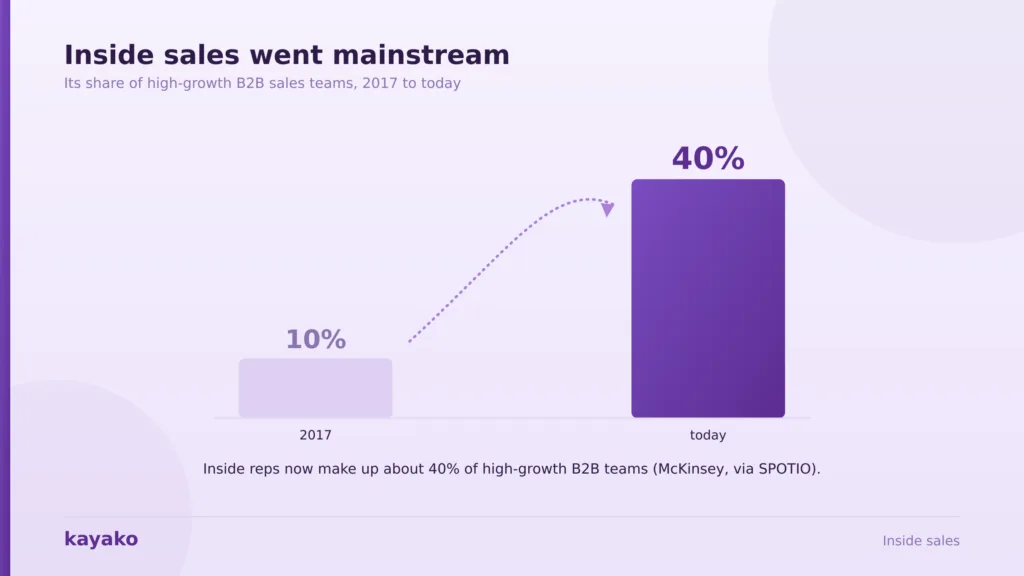
The case for inside sales. It is cheaper and faster to ramp, and it reaches far more prospects, and it lets a company scale coverage without scaling travel budgets. Inside reps make up around 40% of high-growth B2B sales teams, up from roughly 10% in 2017, and can cover 4x the prospects at half the cost of field reps, per McKinsey data compiled by SPOTIO.
The case against. It can struggle with very large, complex, or relationship-heavy deals, where in-person trust still matters and a buyer may want to look a rep in the eye before committing a large budget. For those, a field motion earns its higher cost. Inside sales can also feel impersonal if it is run purely for volume, so the strongest teams keep a human touch even at scale.
Which is why most teams no longer choose one; they blend both. About 40% of high-growth teams now run a hybrid model, where inside reps qualify and field reps close the biggest deals, per SPOTIO. In that model, the two motions stop competing and start feeding each other, provided the compensation plan rewards the inside rep for a qualified handoff rather than leaving them uncredited. The right mix depends on deal size, buyer preference, and how you sell. A hybrid model does add coordination cost, so it works best when the handoff between inside and field is defined clearly, and both sides are credited for the win. Whatever the model, the sale is only the beginning of the customer relationship, which is where support enters the picture.
After the sale: where support fits
Inside sales is not a support function, and Kayako is not a sales tool, so it would be dishonest to pretend the two overlap much. They meet at one important point: the handoff. Inside sales wins the customer; support and retention decide whether that customer stays and grows. And retention is where the real money is, because the cost of winning a customer is only recovered if they stay long enough to pay it back.
The math is well established. Increasing customer retention by just 5% can raise profits by 25% to 95%, according to Bain research published in Harvard Business Review. A hard-won new customer who churns in the first months erases the acquisition cost the sales team just spent, and then some, because the effort that went into closing them is gone with them. Retention, in other words, is what makes all the acquisition math work in the first place. Fast, reliable support protects that investment, and it also opens the door to expansion through cross-selling. A customer who trusts that problems get solved quickly is a customer who buys more, refers others, and renews without a second thought.
This is where Kayako fits, honestly and narrowly. It does not help you sell; it helps you keep the customers your sales team works to win, through fast, autonomous customer support. That is a deliberately narrow claim, and it is the only honest one to make in a guide about sales. Case study: Trilogy. Using Kayako, Trilogy eliminated 80% of its ticket volume and cut ticket age from 17.6 hours to under 2 minutes, the kind of responsiveness that keeps a new customer from regretting the purchase. Strong customer communication after the sale is what turns a closed deal into a lasting one, which is the note this guide ends on.
Inside sales is remote, digital, high-volume selling, and for most B2B companies, it is now the primary way deals get done. It costs far less per interaction than field sales, ramps faster, and reaches more buyers, which is why it has grown from a niche into the mainstream. Outside sales still wins the largest, most complex deals, and the smart answer for most teams is a hybrid of the two.
Match the model to your deals, invest in the process and tools that let reps spend more time actually selling, and measure speed to lead and CAC closely. The teams that do this well treat inside sales as a system to be tuned rather than a headcount to be added, and they win more for every dollar they spend. Then remember that the sale is a beginning, not an end. Keeping the customer, through fast and reliable support, is what turns inside sales effort into lasting revenue and stronger retention.
Frequently asked questions
What is inside sales in simple terms?
Inside sales is selling remotely, through phone, email, and video, rather than in person. Reps work from an office or from home and manage the whole sales cycle, from prospecting to close, without meeting the customer face to face. It is built around speed and volume, so reps can work many more prospects in a day than a field seller could meet. Inside sales is common in software and technology, where products can be demonstrated on a screen.
What is the difference between inside sales and outside sales?
Inside sales is remote and digital, using phone, email, and video, while outside sales is face-to-face, with reps traveling to meet prospects in person. Inside sales is cheaper per interaction, faster to ramp, and higher volume, which suits lower-value deals and shorter cycles. Outside sales costs more but builds deeper relationships, which suits large, complex deals where trust is decisive. An inside call costs about $50 on average versus around $308 for an outside visit, and most teams now blend the two.
What does an inside sales representative do?
An inside sales representative sells remotely, handling some or all of prospecting, qualifying leads, running product demos over video, handling objections, and closing deals, all through phone, email, and a CRM. On specialized teams, the role splits so each person can get very good at one stage: SDRs and BDRs focus on prospecting and qualifying, while account executives take qualified opportunities through to close. The common thread is high-volume, digital selling, and disciplined follow-up, since most sales require several attempts.
What tools do inside sales teams use?
The core stack is a CRM as the system of record, a dialer or phone system for outbound calls, a sales engagement tool to run email and call sequences, and data or enrichment tools to find and verify contacts. The aim is a connected stack where information flows automatically, not a pile of disconnected apps a rep has to reconcile by hand. Many teams add video conferencing, scheduling, and analytics. The goal of the stack is to reduce non-selling work, since reps spend only about 40% of their time actually selling and the rest on admin, research, and data entry.
Is inside sales better than outside sales?
Neither is universally better; each fits different deals. Inside sales is more cost-effective and scalable, reaching more prospects for less, which suits lower-value, higher-volume, shorter-cycle deals. Outside sales builds the in-person trust that large, complex, relationship-driven deals often need. Because both have clear strengths, around 40% of high-growth teams now run a hybrid model, using inside reps to qualify and field reps to close the biggest opportunities. The trend reflects buyers who research digitally but still want a human for the highest-stakes decisions.