Rapport building is the work of creating trust and mutual understanding with another person, so conversations feel like a partnership rather than a transaction. This guide defines rapport, breaks down the core skills and techniques with examples, covers how to build it over the phone and in sales, and explains the psychology behind why it works. The through-line: rapport is built by making the other person feel genuinely heard.
People decide how they feel about a conversation within its first few moments, long before the facts are in. That instinct is why two support agents can give the same answer and leave customers feeling completely different, and why a salesperson who listens closes deals, a colleague with better slides loses. Trust is the deciding variable, and it is in short supply: HubSpot Research has found that only about 3% of buyers say they trust salespeople. Starting from that low a base, the ability to build a genuine connection is not a soft skill. It is the skill.
Rapport building is how you close that trust gap. It is the deliberate practice of creating a positive connection defined by mutual respect and understanding, so the person across from you feels comfortable, valued, and heard. This guide covers what rapport actually is, the skills and techniques that build it, how it works on the phone and in sales, and the psychology that explains why a few small behaviors change how much people trust you.
What is Rapport?
Rapport is a relationship of mutual understanding and trust, where both people feel comfortable and in sync. The word traces back to a French verb meaning to bring back or to relate, and that is exactly what it describes: two people relating to each other easily. Synonyms include connection, affinity, and harmony, and to build rapport simply means to establish that sense of ease with someone, whether a customer, a client, a colleague, or a patient.
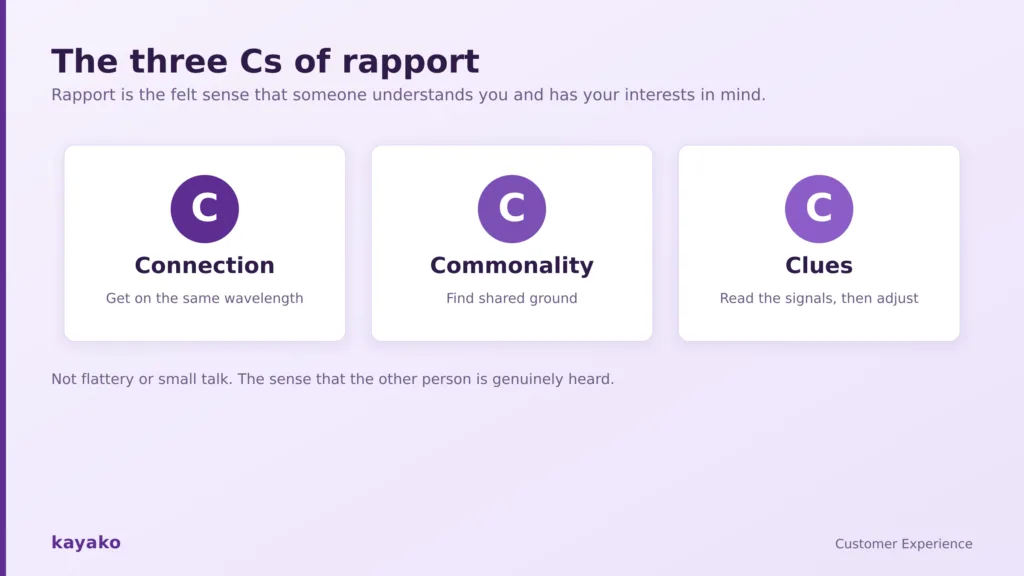
A useful way to frame it comes from the three Cs of rapport: connection, or getting on the same wavelength; commonality, or finding shared ground; and clues, or reading the verbal and nonverbal signals that tell you how to adjust. Rapport is not flattery or small talk for its own sake. It is the felt sense that the other person understands you and has your interests in mind, and it forms the foundation that every productive conversation is built on. Crucially, rapport is not a one-time achievement but a state you maintain, which can be built quickly with the right attention and lost just as fast with a careless or dismissive moment. Understanding why it matters so much is the next step.
Why Rapport Building Matters
Rapport is what turns a single interaction into a relationship, and the business case for it is direct. When people feel heard, they trust more, share more, and stay longer. Research summarized by Cerebral Selling shows that buyers who feel connected to the person they are dealing with are 2 to 3 times more likely to share the deeper context that leads to a good outcome (Cerebral Selling). In a support setting, that deeper context is the difference between solving the real problem and solving the surface one, and it shows up over time in your support metrics.
The absence of rapport is expensive. Zendesk reports that 73% of consumers will move to a competitor after multiple poor experiences, and more than half will leave after a single bad one. Those departures are rarely about price. They are about feeling like a ticket number rather than a person, which is a rapport failure at its core. The problem is compounded by a broader erosion of interpersonal skill: about 71% of Americans believe their ability to connect in person has worsened over the past two decades (Smith.ai), which means deliberate rapport now stands out more than it used to. The skills that create it are learnable, and they start with a small set of behaviors.
Rapport Building Skills
Rapport rests on a handful of communication skills, and the good news is that all of them can be practiced. The foundational ones are active listening, empathy, mirroring, finding common ground, and personalization. None requires a particular personality, and each compounds: the more consistently you use them, the more natural the connection becomes.
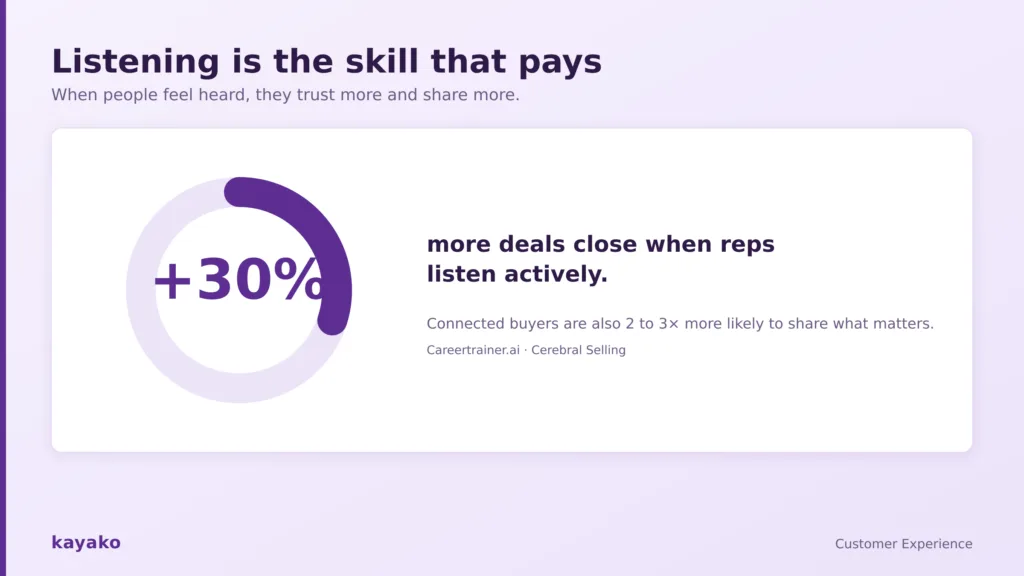
Listening is the one that does the heaviest lifting. Active listeners in sales roles close about 30% more deals than colleagues who do not use listening techniques, and 82% of marketers say that listening to customer pain points improves how they communicate value (Careertrainer.ai). The pattern is consistent across roles: when people feel heard, they respond in kind. Strong customer service practices are built on exactly these skills, and the right support tools make them easier to apply at volume by surfacing the context an agent needs. None of this is complicated, but it does take deliberate practice, because the default in most conversations is to wait for a turn to talk rather than to listen. Putting these skills into practice takes specific techniques.
How to Build Rapport (Techniques With Examples)
Skills become useful when they turn into repeatable techniques. Here are five that work in almost any conversation, each with an example you can adapt.

Five techniques that build rapport, each a learnable behavior rather than a trait.
Practice active listening
Active listening means focusing fully on what the other person is saying rather than planning your reply. Put away distractions, then paraphrase what you heard to confirm you understood it. Example: a support agent who says, “So the charge appeared twice, and the refund has not landed yet, is that right?” proves they were listening and lets the customer correct any detail before the work starts. That small confirmation does more for trust than any scripted apology.
Mirror and match
People feel more at ease with those who resemble them, so subtly matching another person’s pace, tone, and language builds quiet rapport. If a customer is brief and businesslike, match that; if they are warm and chatty, soften to meet them. Mirroring is not mimicry, and it should never be obvious. It is simply meeting people closer to where they are, rather than forcing them to adjust to you.
Find common ground
Shared ground is the fastest route to connection. A brief, genuine point of overlap, a city, a frustration, a goal, gives a conversation something to stand on. Example: noticing a customer mentions they are a small business owner and replying that you know how precious their time is turns a transaction into a moment of recognition. The key word is genuine, because manufactured commonality is worse than none.
Show empathy
Empathy is naming and validating what the other person feels before moving to the fix. “That sounds genuinely frustrating, and I would be annoyed too,” costs nothing and changes the temperature of the entire exchange.
Customers can tell the difference between an agent processing them and one who understands them, and the second earns patience, the first never will. Empathy does not mean agreeing with every complaint or over-apologizing; it means acknowledging the feeling as legitimate before you move to solve the problem, so the person feels met rather than managed.
Personalize and remember context
Nothing signals care like not having to be told something twice. Remembering a customer’s history, referencing their last conversation, and picking up where you left off tells them they are known rather than processed.
This is where technology matters, because a person cannot hold hundreds of histories in their head, but a system that surfaces the full record lets every agent open a conversation already informed. That kind of continuity is what makes personalization feel real rather than scripted. Certain conversations, though, test these techniques more than others, starting with the phone.
Rapport Building Questions and Examples
Open-ended questions are the engine of rapport, because they invite the other person to talk and give you the material to connect with. Rather than questions that can be answered yes or no, reach for ones that open a door: “What prompted you to look into this now?”, “What would a good outcome look like for you?”, or “What has your experience with this been so far?” In support, a simple “walk me through what happened” often surfaces the real issue faster than a checklist ever could, because it hands the customer the floor instead of narrowing them into pre-set options.
The technique is not only the question, but what you do with the answer. Following up on a specific detail the person mentioned, rather than moving to your next scripted line, is what proves you were listening. A good rapport question earns a real answer; a good follow-up turns that answer into trust. The mistake to avoid is treating questions as a checklist to clear rather than a conversation to have, because a customer can always tell when they are being interviewed instead of heard. Some channels make this harder than others, and the phone is the classic test.
How to Build Rapport With Customers Over the Phone
On a call, you lose body language and have only your voice, pace, and words to build a connection, which makes deliberate technique matter more. Start by slowing down slightly and warming your tone, because a rushed greeting signals that the customer is an interruption. Use their name naturally, and use verbal nods, brief acknowledgments like “I see” or “that makes sense,” to replace the visual cues they cannot see you give.
Restating is even more powerful on the phone than in person. Because the customer cannot see you taking notes or nodding along, saying “let me make sure I have this right” and summarizing their issue is often the only proof they get that you are engaged. Done well, a phone conversation can build rapport as effectively as a face-to-face one, and measuring the effect through your customer experience metrics will show it. Beyond the phone, the setting shapes how rapport is built.
Turn fast, personal support into loyal customers with Kayako
Building Rapport in Different Contexts
The core skills stay the same, but the emphasis shifts depending on who you are building rapport with.
With clients in sales
In sales, rapport is a trust accelerator, and listening is the lever. High-performing sellers listen more than they talk, roughly following a 70-30 split in favor of listening, because buyers who feel understood share the context that lets a seller tailor the right solution. Salesforce has reported that when salespeople rank what most affects converting a prospect, listening tops the list. Rapport here is not charm; it is disciplined attention.
With coworkers
Among colleagues, rapport is built through consistency and reliability more than any single conversation. Small talk, shared wins, and following through on what you said you would do accumulate into trust. Remote teams have to be more deliberate about it, because the casual moments that build rapport in an office do not happen on their own, so the connection has to be scheduled and sustained rather than left to chance.
In counseling and care settings
In counseling, healthcare, and other care contexts, rapport is the precondition for everything else, because a person will not open up to someone they do not trust. Here, empathy and unhurried, judgment-free listening carry the most weight, and even small signals of attention can determine whether someone shares what actually matters. Understanding why these behaviors work at all is where the psychology comes in.
The Psychology of Rapport
The reason a few small behaviors build so much trust is rooted in how people are wired. One of the most replicated findings in interpersonal psychology is that people feel warmer, safer, and more trusting toward those who make them feel heard. That is why active listening works: it is not a trick; it satisfies a basic human need to be understood.
Mirroring draws on a related effect. Psychologists have documented the chameleon effect, the unconscious tendency to mimic the postures, gestures, and speech patterns of the people we interact with, and the finding that this mimicry increases how much those people like us. When you subtly match someone’s pace and language, you are working with a mechanism the brain already runs on autopilot.
Even the words matter: research on how specific language shapes perception shows that describing something precisely, rather than vaguely, signals that you were genuinely paying attention. None of this replaces sincerity, but it does explain why sincere attention is felt so strongly. It also explains why shortcuts fail: people are remarkably good at detecting performed interest, because the same wiring that rewards genuine attention punishes the fake kind with a feeling of being handled.
The practical takeaway is not to add techniques on top of indifference, but to pay real attention and let the techniques carry it. That understanding points to where tooling can help rather than hinder.
Kayako in Practice: Rapport at Scale Through Context
Rapport is human, and no software builds it for you. What technology can do is remove the friction that makes rapport hard to sustain once you are handling hundreds of conversations a day. The single fastest way to break rapport at scale is to make a customer repeat themselves, and that happens whenever an agent opens a conversation without the history in front of them.
This is the specific, honest place a support platform helps. Kayako’s SingleView keeps a customer’s full history, past conversations, and account details on one record, so an agent starts every interaction already knowing the context rather than asking the customer to recap. Its AI agent, Agent Kay, which is a genuine AI agent rather than a scripted chatbot, handles routine questions instantly and personalizes responses using that same history, so even automated replies feel informed rather than generic.
The effect on rapport is indirect but real: when the mechanics of remembering are handled, agents are freed to do the human part, the listening and empathy that software cannot fake. You can see where this is heading in Kayako’s view of the future of AI in customer service. Rapport still has to be earned in every conversation, but the right context makes it far easier to earn.
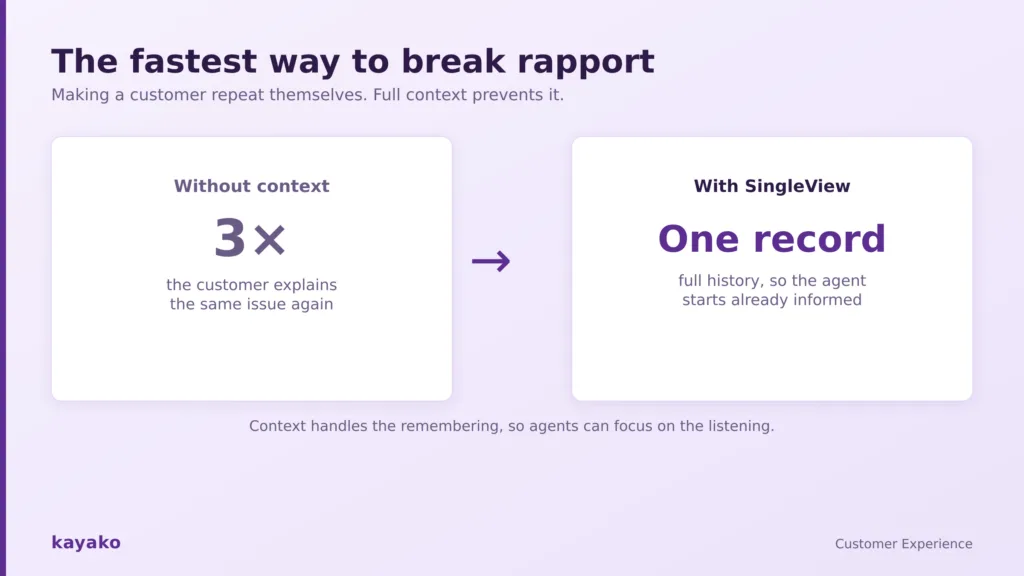
The fastest way to break rapport at scale is making customers repeat themselves.
Rapport building is not a personality trait that some people are born with. It is a set of learnable behaviors: listen actively, match the person in front of you, find genuine common ground, show empathy, and remember what matters to them. Each one signals the same underlying message: that you see the other person as a person, and that message is what earns trust. Practice the techniques until they feel natural, pay closer attention than feels necessary, and let the tools handle the remembering so you can focus on the listening. Do that consistently, and rapport stops being something you hope for and becomes something you reliably create.
Frequently asked questions
What is rapport?
Rapport is a relationship of mutual understanding and trust in which both people feel comfortable and in sync. It is characterized by a positive connection built on respect, where each person feels heard and valued. In practice, rapport is the felt sense that the person you are talking to understands you and has your interests in mind, and it forms the foundation of any productive conversation, whether in support, sales, or everyday life.
How do you build rapport with customers?
Build rapport with customers by listening actively and paraphrasing what you heard, matching their tone and pace, finding genuine common ground, showing empathy before jumping to a fix, and remembering their history so they never repeat themselves. Open-ended questions like “walk me through what happened” invite them to share, and following up on the specific details they mention proves you were listening, which is what actually builds trust.
What are the most important rapport building skills?
The core skills are active listening, empathy, mirroring, finding common ground, and personalization. Of these, active listening does the most work, because feeling heard is the single strongest driver of trust. The skills reinforce each other and can all be practiced, so rapport is less a matter of natural charm than of consistently using a small set of learnable behaviors in every conversation.
How do you build rapport over the phone?
On the phone, you have only your voice, so slow down slightly, warm your tone, and use the customer’s name naturally. Replace the visual cues you cannot give with verbal nods like “I see” or “that makes sense,” and restate the customer’s issue back to them, since summarizing what you heard is often the only proof they get that you are fully engaged. Done deliberately, phone rapport can be as strong as face-to-face.
What is the psychology behind rapport?
Rapport works because people are wired to trust those who make them feel heard, one of the most replicated findings in interpersonal psychology. Mirroring draws on the chameleon effect, the unconscious tendency to mimic others, which increases how much they like us. Precise, specific language also signals genuine attention. None of this replaces sincerity, but it explains why a few small behaviors, done sincerely, have such a strong effect on trust.