Social media customer service is not optional anymore. Every brand with a public social presence has a support operation, whether it manages one or not. The question in 2026 is not whether to do social CS, it is whether to staff it yourself, hire a partner, or run both in parallel. This guide covers the outsourcing decision in full: the case for, the case against, what it actually costs, and the providers worth considering.
What Social Media Customer Service Means in 2026
Social media customer service is the practice of resolving customer issues, responding to mentions, handling DMs, moderating comments, and managing reviews across public social platforms like X (Twitter), Instagram, Facebook, TikTok, LinkedIn, and increasingly WhatsApp Business. Unlike email or phone support, social CS happens in public by default, with a response time expectation measured in minutes rather than hours.
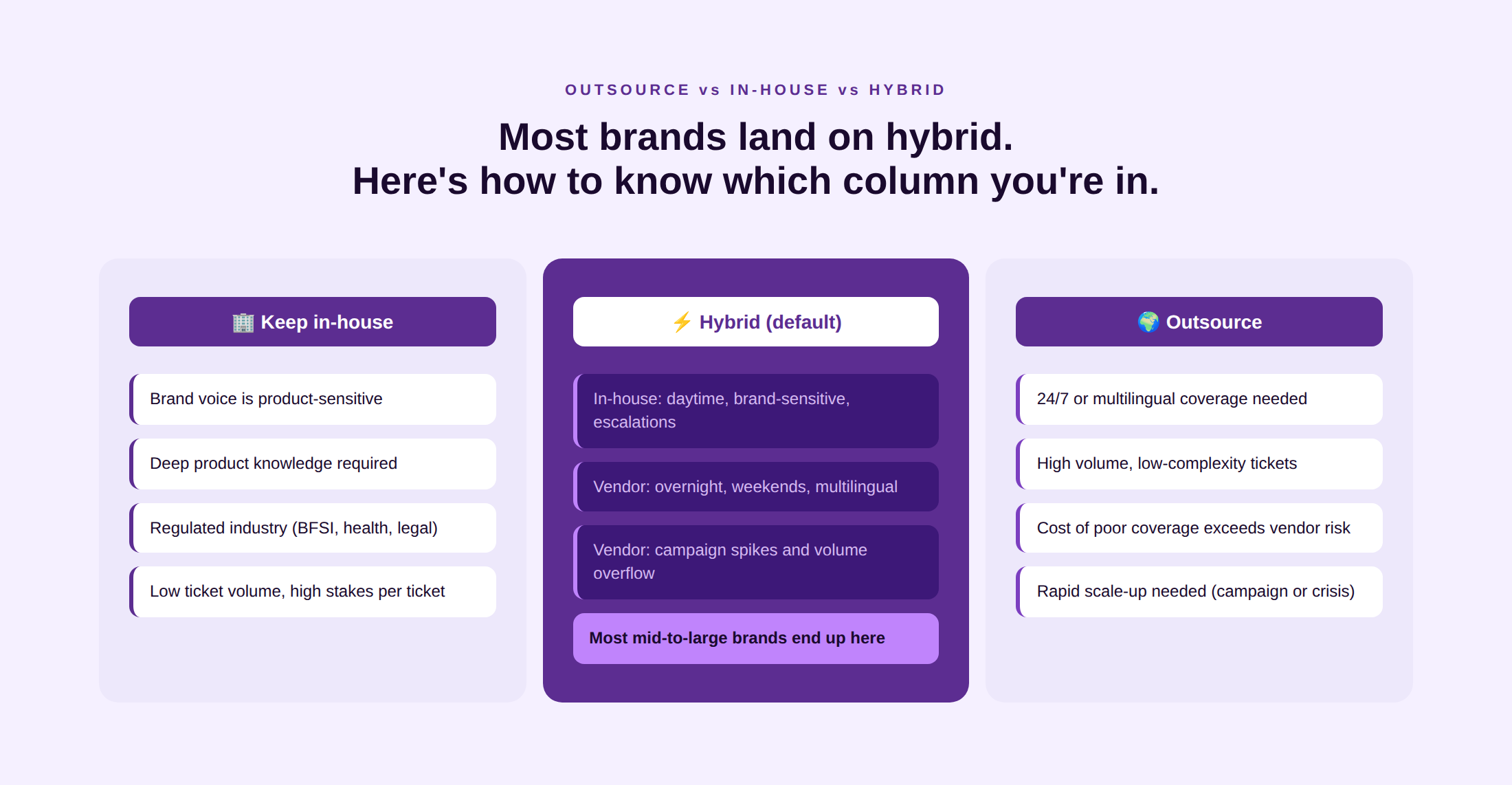
Brands face three structural choices: handle it entirely in-house, outsource it entirely to a BPO or specialist agency, or run a hybrid model where in-house teams handle brand-sensitive and escalated interactions while a vendor covers volume, overflow, or after-hours coverage. The hybrid model is the most common configuration for mid-to-large brands in 2026. The right choice depends on your volume, brand complexity, language requirements, and risk tolerance.
Related read: Top social media customer service platform
See how social media customer support platforms connect public social interactions to a unified customer record so that outsourced teams never start a conversation from zero.
What Is Social Media Customer Service Outsourcing?
Social media customer service outsourcing is the practice of contracting an external provider to handle some or all of the customer service interactions that occur on social media channels. The scope varies by model:
- Full BPO outsourcing. A large contact center vendor staffs and runs the entire social CS queue. The vendor provides agents, management, tooling, and reporting. This is the most common model for high-volume consumer brands.
- Specialist agency outsourcing. A smaller, higher-touch social agency handles the queue, often on a retainer basis with a dedicated team. Better for brand-voice-sensitive operations; more expensive per interaction than BPO.
- Hybrid outsourcing. In-house agents handle brand-sensitive, escalated, and complex interactions. The vendor handles overnight coverage, volume spikes, multilingual queues, or specific channel types. This is the default for most brands above 50,000 monthly social interactions.
The scope of work typically includes: DM responses across all platforms, comment triage and replies, mention monitoring and escalation, review management (Google, Trustpilot, App Store), and content moderation where required.
Why Brands Outsource Social Media Customer Service
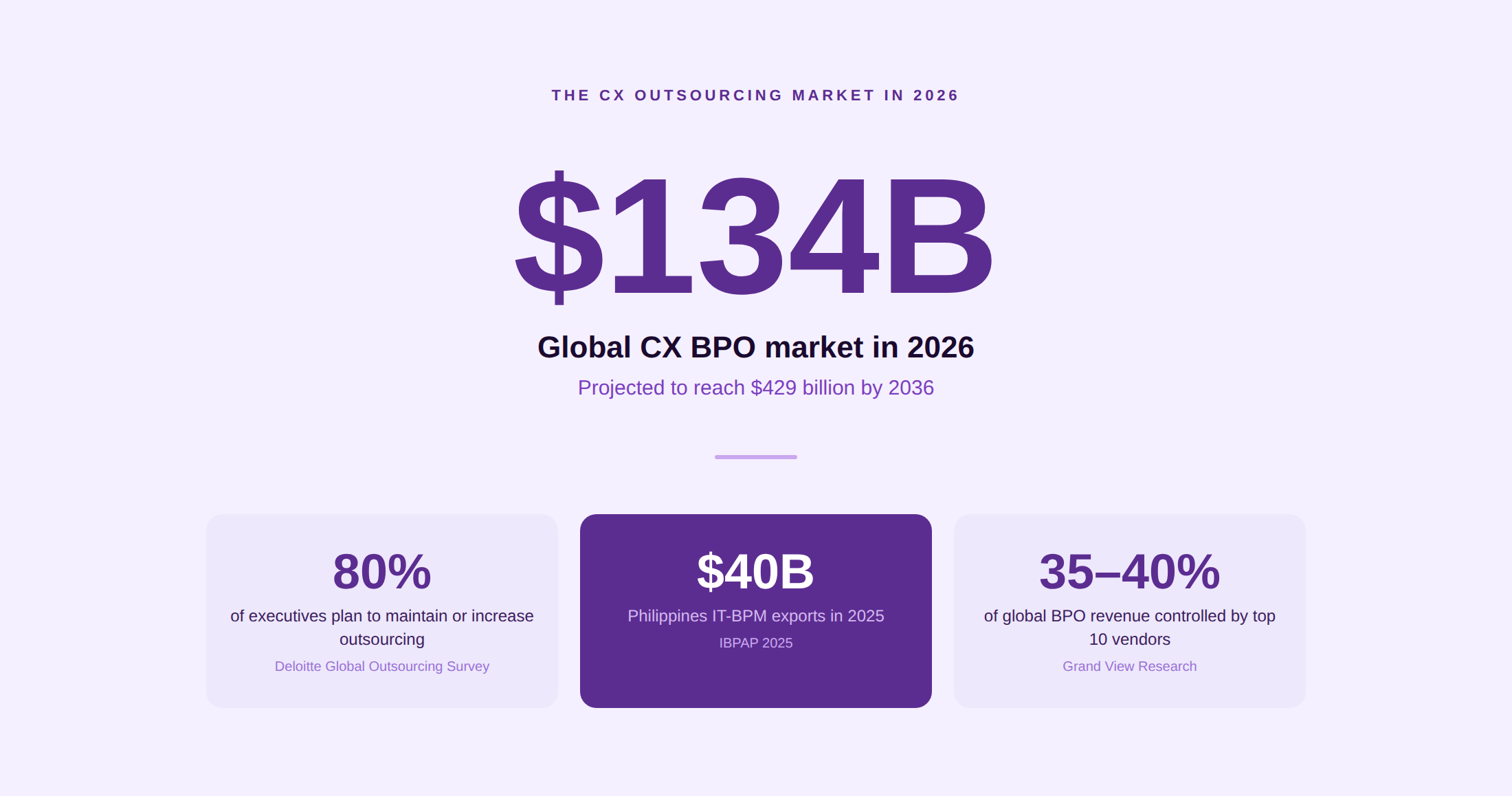
The global CX outsourcing market reached $134 billion in 2026 and is projected to reach $429 billion by 2036 (Fact.MR). That scale reflects four operational drivers that push brands toward outsourcing rather than building in-house:
- 24/7 coverage without 24/7 headcount. Social media customer expectations do not respect business hours. 40% of customers expect a reply within one hour, and that expectation holds on evenings, weekends, and bank holidays. Building a 24/7 in-house social team requires three shift rotations, significant HR overhead, and escalating salary costs. An outsourced team, often in a lower-cost time zone, provides the coverage at a fraction of the internal cost.
- Multilingual coverage at scale. A brand selling into 15 markets needs agents who can respond in Spanish, French, Arabic, Portuguese, and German simultaneously. Building multilingual expertise in-house at the required depth is an organizational challenge; BPOs with global delivery networks handle it as a standard contract item.
- Volume spikes during incidents and campaigns. A product launch, a PR crisis, or a viral moment can multiply inbound social volume by 10x in hours. An in-house team of five agents absorbs that spike poorly. A BPO with elastic staffing absorbs it without degrading SLAs on the rest of the queue.
- Cost arbitrage. Philippine IT-BPM sector generated $40 billion in export revenues in 2025 with 1.9 million workers (IBPAP, cited in Digital Minds BPO). The hourly rate difference between a US in-house social agent and an equivalent-skilled Philippine-based BPO agent is significant, and for routine social CS interactions (order status, returns, FAQ-type product queries), that cost arbitrage is defensible.
Prod Social Media Customer Service Outsourcing: Pros
- Speed to coverage. A BPO can staff a dedicated social CS team within weeks, not the months it takes to hire, train, and onboard an equivalent in-house team.
- Scalability without HR risk. Headcount scales up for a campaign and down afterward without redundancy costs or HR complexity.
- Multilingual reach on demand. Access to language coverage that would require specialist hiring in-house.
- Predictable cost structure. Per-hour, per-FTE, or per-ticket pricing converts a variable HR cost into a predictable line item. SLA penalties create vendor accountability that internal performance management rarely matches.
- Access to specialist tooling. Large BPOs invest in social listening, sentiment analysis, and AI-assisted response platforms that individual brands would not procure independently.
- Reduced HR burden. Recruitment, training, attrition management, and shift scheduling for a 24/7 social team are organizationally expensive. A vendor carries that burden.
Cons of Social Media Customer Service Outsourcing
Most competing articles on this topic only cover the upside. The cons are equally important to understand before signing a contract.
- Brand voice drift. Social media interactions carry significant brand-building weight. An outsourced team working from a style guide will, over time, produce responses that gradually diverge from the authentic brand voice, particularly for nuanced or culturally sensitive topics. Weekly QA audits and regular brand immersion sessions are the structural mitigation.
- Slower escalation paths. An outsourced agent handling a public crisis in a Facebook thread needs a faster path to your PR and legal teams than an in-house agent sitting in the same building. Escalation workflows between vendor and client are frequently the weakest link in outsourced social CS operations. See apology letter format and crisis response framing for how these escalation moments should be structured.
- Knowledge base fragmentation. Outsourced agents access a knowledge base you maintain. When the knowledge base is outdated, the agents give wrong answers, but the wrong answers appear under your brand name in public threads.
- Data security and GDPR exposure. Every DM handled by an outsourced agent passes through a third-party system. That creates data transfer obligations under GDPR and CCPA, requires data processing agreements (DPAs), and demands security certifications (SOC 2, ISO 27001) from any vendor handling personal data in customer interactions.
- Lower context for complex product questions. A BPO agent handling tier-1 social queries for a B2B SaaS product with a complex feature set will inevitably give lower-quality answers than an in-house agent with product experience. This is not a vendor failure; it is a structural limitation of the knowledge transfer problem. Complex B2B products and enterprise brands have a higher in-house threshold for this reason. See how B2B customer service differs from consumer CS in the depth of product knowledge required.
See how Kayako’s unified customer timeline gives outsourced teams the full context they need before the first message, so brand voice is protected at every interaction. See Kayako
When to Outsource vs. Keep It In-House
Keep it in-house when:
- Brand voice is product-sensitive. Luxury brands, healthcare providers, financial services, and B2B SaaS companies with complex products all carry reputational risk from off-voice social responses that routine BPO delivery cannot consistently mitigate.
- Product complexity requires deep knowledge. If most of your social CS queries require product expertise that takes months to acquire, the knowledge transfer cost of outsourcing approaches the HR cost of hiring.
- Regulatory compliance ties social to other channels. In regulated industries (banking, insurance, healthcare, legal) where social interactions may constitute regulated communications, in-house compliance control is frequently mandatory.
Outsource when:
- You need 24/7 or multilingual coverage. These are the cleanest outsourcing use cases. The volume justifies the overhead, and the quality bar for after-hours routine queries is lower than for daytime brand-sensitive interactions.
- Ticket volume is high but low-complexity. E-commerce order status, shipping queries, return initiation, and FAQ-type product questions are the highest-volume, lowest-complexity categories. They deflect well to outsourced teams without significant brand-voice risk.
- The cost of poor coverage outweighs the cost of an imperfect vendor. A brand that cannot staff overnight coverage and receives public unanswered complaints every night is in a worse position than one with an outsourced overnight team whose responses are occasionally slightly off-voice.
Hybrid is the default for most brands
The pattern that most mid-to-large brands converge on: in-house team covers business hours and brand-sensitive interactions; outsourced vendor covers overnight, weekends, multilingual queues, and volume spikes. In-house handles escalations; vendor handles tier-1. This is the configuration that balances coverage, cost, and brand control for the largest number of operational profiles. See omnichannel customer service for how to connect both in-house and outsourced touchpoints in a unified customer record.
Types of Social CS Outsourcing Providers
Large CX BPOs
Full-service outsourcing at scale. They provide staffing, management, tooling, and reporting. Suitable for brands with high social volume that prioritize SLA coverage over brand voice precision.
- Teleperformance. Largest global CX BPO with approximately 410,000 employees (GigaBPO, 2026). Handles social CS for consumer brands across 300+ languages. Best for very high-volume social queues.
- Concentrix. Post-Webhelp merger, Concentrix is among the top three global CX providers with strong digital and social CS capabilities. Enterprise contracts with SLA guarantees and dedicated brand teams.
- Foundever (formerly Sitel and SYNNEX). Strong mid-market and enterprise capability. Known for structured onboarding processes that reduce brand-voice drift. Handles social alongside full omnichannel CX.
- TaskUs. Specialist strength in creator economy, gaming, and digital platform social CS. Particularly strong for brands managing TikTok, Instagram, and YouTube at volume. Strong content moderation alongside customer service.
- TTEC. Technology-led BPO with strong AI integration in its social CS workflows. Good fit for brands that want AI-assisted agent tooling built into the contract rather than procured separately.
Specialist social agencies
Higher-touch, retainer-based, often better for brand voice but higher cost per interaction than BPO. Suitable for brands where voice quality matters more than cost optimization.
- We Are Social. Global social agency with strong brand-voice capability. More commonly engaged for social strategy than pure CS, but handles CS as part of integrated social management for premium brands.
- Social Chain. Known for creator-led social engagement. Better for brands where social CS and community management overlap significantly.
Hybrid platforms (software plus on-demand staffing)
- Influx. On-demand support platform that pairs Kayako-style helpdesk tooling with a trained agent pool available on a subscription basis. Best for brands that want 24/7 overflow coverage without a full BPO relationship. Strong for e-commerce and SaaS.
- Helpware. Mid-market outsourcing provider with strong digital CS capabilities and more boutique account management than enterprise BPOs. Good fit for brands between 5 and 50 in-house agents.
How to Choose the Right Provider
Provider selection checklist
Brand-voice training process: how does the vendor absorb and maintain brand voice over 12+ months?
Channel coverage: which platforms does the vendor handle natively vs. via integrations?
Language coverage: which languages are supported and at what quality tier?
SLA commitments: response time and resolution time by priority and channel, with penalty clauses
Pricing model: per-hour / per-FTE / per-ticket, and what is in scope for each model
Data security: SOC 2 Type II, ISO 27001, and GDPR/CCPA readiness with DPA available
Escalation workflow: how does the vendor escalate to your in-house team and with what SLA?
Reporting transparency: what dashboards and data exports are available to you in real time?
Cultural fit references: ask for two reference calls with clients in your industry
Technology stack: what tooling does the vendor use and does it integrate with your CRM and helpdesk?
Pricing Models and What It Actually Costs
Three pricing models dominate the social CS outsourcing market in 2026:
- Per-hour. Typical for specialist agencies and hybrid platforms. The client pays for agent time, regardless of ticket volume. Predictable cost; creates an incentive for agents to spend time on interactions rather than close them quickly.
- Per-FTE / per-seat. Typical for large BPOs. The client pays a fixed monthly cost per dedicated full-time equivalent. Best for predictable, consistent volume. Scales with headcount rather than ticket volume.
- Per-resolution / per-ticket. Emerging model, particularly for AI-enabled BPOs and hybrid platforms. Cost aligns directly with output. Unpredictable when AI deflection rates vary month to month.
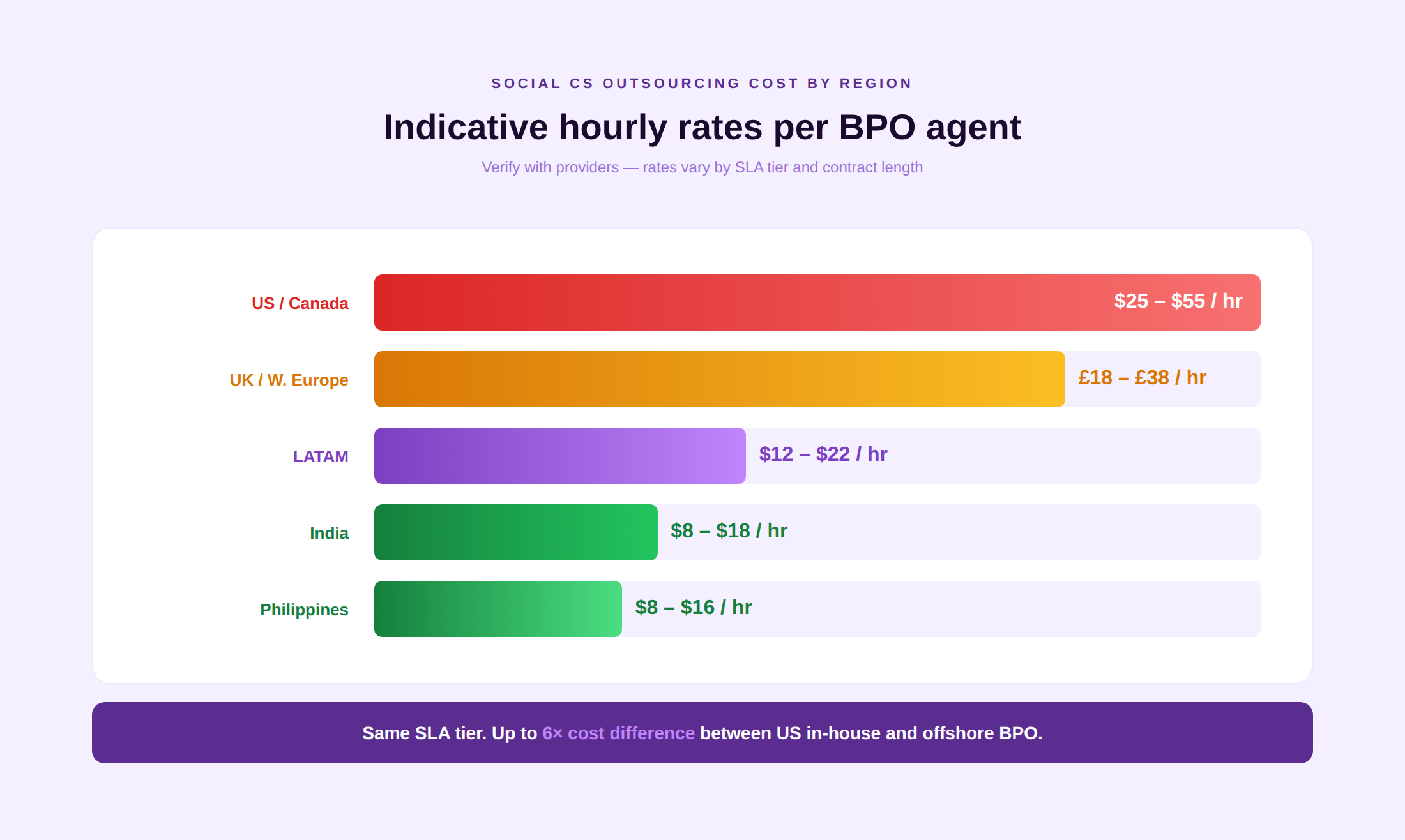
Indicative price bands by region (verify with providers as pricing varies by SLA tier, contract length, and complexity):
- United States / Canada. $25 to $55 per hour for social CS agents in a BPO. Higher for specialist agencies.
- United Kingdom / Western Europe. £18 to £38 per hour equivalent. GDPR compliance adds data security costs.
- India. $8 to $18 per hour. Strong for English-language and multilingual operations. NASSCOM-affiliated providers have structured quality frameworks.
- Philippines. $8 to $16 per hour. The largest English-language CX BPO market globally. $40 billion in IT-BPM exports in 2025 (IBPAP).
- LATAM (Colombia, Costa Rica, Mexico). $12 to $22 per hour. Growing nearshore option for US brands needing Spanish-English bilingual coverage with overlapping time zones.
These are indicative ranges only. Actual costs vary significantly by SLA tier, volume commitment, training requirements, and contract length. Always request a detailed statement of work before comparing quotes.
Top Providers for Social Media Customer Service
Teleperformance
The largest global CX BPO with approximately 410,000 employees and operations in 100 countries. Handles social CS across 300+ languages with dedicated brand teams for enterprise accounts. Best for very high-volume social queues requiring global time zone coverage and multilingual depth. G2 rating 4.3/5.
Concentrix
Post-Webhelp merger, Concentrix is one of the top three global CX providers. Strong digital and social CS capability with enterprise SLA structures and dedicated account management. Known for technology integration in agent workflows. Best for mid-market to enterprise brands with omnichannel complexity.
Foundever
Formed from the Sitel and SYNNEX merger. Strong structured onboarding processes that reduce brand-voice drift, making it a better-than-average choice for brands where voice quality is a primary concern. Good mid-market pricing relative to Teleperformance and Concentrix.
TaskUs
Specialist strength in creator economy, gaming, and digital-first brand social CS. Particularly capable for TikTok, Instagram, and YouTube-heavy social queues where content moderation and customer service overlap. Strong AI integration in agent workflows.
TTEC
Technology-led BPO with AI-assisted agent tooling built into the standard service model. Good fit for brands that want AI deflection and agent assist as part of the BPO contract rather than a separate technology procurement. Strong presence in North America and Europe.
Influx
On-demand hybrid platform pairing helpdesk tooling with a trained, subscription-accessible agent pool. Best for e-commerce and SaaS brands that need 24/7 overflow coverage without committing to a full BPO headcount model. Monthly subscription pricing; scales up and down with volume. Good alternative for teams between 5 and 25 in-house agents.
Helpware
Mid-market digital CS outsourcing provider with more boutique account management than enterprise BPOs. Good fit for brands with 5 to 50 in-house agents wanting a flexible partner for overflow, multilingual, or after-hours social coverage without enterprise-scale procurement overhead.
Risks and How to Mitigate Them
Brand voice drift
The most common long-term failure mode in outsourced social CS. The fix is structural, not contractual: (1) create a social CS style guide with at least 25 real examples of on-voice and off-voice responses, (2) require the vendor to run all new agents through a brand immersion program before going live, (3) run weekly QA audits where in-house reviewers score 10 to 15% of all vendor responses against the style guide, (4) include style guide compliance in SLA metrics, not just response time.
Data security exposure
Every customer DM handled by an outsourced agent passes through a third-party system with third-party access. Mitigate through: (1) SOC 2 Type II and ISO 27001 certification as a non-negotiable vendor requirement, (2) a data processing agreement (DPA) that explicitly covers social platform data under GDPR/CCPA, (3) minimum-access principles as agents should not see data they do not need to resolve the interaction, (4) audit rights in the contract allowing your security team to review vendor data handling annually.
Escalation black holes
Outsourced agents handle an escalation trigger like a crisis mention, a legal threat, a media inquiry, and get stuck if the escalation path is unclear or slow. In such a case, you need to fix: (1) document every escalation type with a named in-house owner and a response-time SLA, (2) create a dedicated escalation Slack channel with real-time vendor access, (3) run quarterly fire drills simulating a crisis escalation to test the workflow before a real incident requires it. See how customer communication management platforms maintain unified escalation records across in-house and outsourced teams.
Implementation Checklist: The Rollout Playbook
Six-step outsourcing rollout
1. Document the brand voice: write the social CS style guide with 25+ real examples before the vendor sees your account
2. Define escalation rules: document every escalation type, the trigger condition, the in-house owner, and the response SLA
3. Run a 30 to 60-day pilot on one channel: single channel, single issue category, full QA review of 100% of interactions
4. Set up shared reporting: vendor and in-house team see the same dashboard — response time, CSAT, escalation rate, QA score
5. Run weekly QA reviews: in-house reviewer scores 10 to 15% of all vendor responses against the style guide every week
6. Build the feedback loop: a weekly sync between in-house brand team and vendor team lead to share knowledge base updates, product changes, and voice calibration
Case Studies
KLM: the multilingual partner model
KLM Royal Dutch Airlines handles social CS in 12 languages across a 24-hour operation. The scale required to staff that capability in-house would be prohibitive. KLM uses a combination of in-house social care agents for Dutch and English on the primary X account, with outsourced multilingual specialists handling French, Spanish, German, Italian, Portuguese, and other language queues. The result is a social CS operation that publishes its live response time on its X profile and consistently meets it across all languages. The model works because KLM maintains in-house ownership of brand-sensitive escalations while the vendor handles the volume and language depth.
E-commerce brand using TaskUs for TikTok and Instagram
A DTC consumer brand experiencing rapid TikTok growth faced a social CS problem: comment volume on product videos was outpacing the in-house team’s capacity, particularly for overnight and weekend coverage when engagement peaks. The brand contracted TaskUs to handle TikTok comments and Instagram DMs for non-brand-sensitive queries (shipping status, return initiation, product FAQs) while the in-house team retained all brand collabs, influencer queries, and complaint escalations. Average handle time on outsourced interactions was tracked and improved by 28% over 90 days as the vendor team built product knowledge (improving average handle time through structured knowledge base maintenance is documented separately in Kayako’s AHT guide).
SaaS brand using Influx for after-hours overflow
A mid-market SaaS company with a five-person in-house support team used Influx to extend social CS coverage from 9am to 5pm (in-house) to 24/7 (Influx handles overnight and weekends). The in-house team trained Influx agents on the product over four weeks using a structured knowledge base. Influx handles tier-1 queries (password resets, billing queries, onboarding FAQs) autonomously, escalating everything else to the in-house queue with a full interaction summary. The company reduced overnight unanswered social mentions by 91% and increased overnight CSAT from no data (because no one was responding) to 4.1/5.
A company takes a call based on its operation, whether it needs help with its social image or not. It’s an individual call which varies from company to company, citing their operations, budget, headcount, and public reception. If the going is effective and no red flags appear, then an in-house function should suffice. Or else, outsourcing the social media function is a very wise call.
FAQs
What does social media customer service outsourcing cost?
Pricing varies significantly by region, provider type, and pricing model. Indicative ranges: US/Canada BPO at $25 to $55/hour, India at $8 to $18/hour, Philippines at $8 to $16/hour, LATAM at $12 to $22/hour. Specialist agencies typically charge higher per-hour rates than BPOs but provide higher brand-voice quality. Per-FTE BPO contracts typically run $1,500 to $4,500/month per agent depending on location and SLA requirements. Always verify with providers as pricing varies by contract length and SLA complexity.
Should I outsource or keep social media customer service in-house?
Keep it in-house when: your brand voice is product-sensitive, product complexity requires deep knowledge, or regulatory compliance ties social to other channels. Outsource when: you need 24/7 or multilingual coverage, ticket volume is high but low-complexity, or the cost of poor coverage outweighs the cost of an imperfect vendor. Most mid-to-large brands use a hybrid model: in-house for daytime and brand-sensitive interactions, outsourced for overnight, multilingual, and volume spikes.
What SLAs should I expect from a social media CS provider?
Minimum expectations for 2026: first response time under 1 hour for standard queries, under 15 minutes for escalations during business hours. Resolution time for tier-1 queries under 4 hours. QA score above 85% on brand-voice compliance. CSAT above 75% on vendor-handled interactions. Escalation to in-house within 15 minutes for crisis-level triggers. SLA penalties should be contractually specified with clear definitions of each metric and measurement methodology.
How do I protect my brand voice with an outsourced team?
Four structural mechanisms: (1) a social CS style guide with at least 25 real response examples (on-voice and off-voice), required reading for every vendor agent before going live; (2) weekly QA audits where in-house reviewers score 10 to 15% of vendor responses against the guide; (3) brand immersion sessions for the vendor team at onboarding and quarterly thereafter; (4) brand-voice compliance as a contractual SLA metric, not just a soft expectation. Voice drift is a slow process; catching it requires systematic weekly review, not periodic surveys.
Who are the largest social customer service BPOs?
The five largest global CX BPOs with significant social CS capability are Teleperformance (approximately 410,000 employees, 100 countries), Concentrix (post-Webhelp merger), Foundever (formed from Sitel and SYNNEX), TaskUs (strong in digital-first and creator economy brands), and TTEC (technology-led with AI integration). Top 10 BPO vendors control 35 to 40% of global BPO revenues (Grand View Research, 2024).
Can I outsource social media CS only for nights and weekends?
Yes. This is one of the most common outsourcing configurations in 2026. Hybrid models where in-house teams cover business hours and outsourced agents cover overnight and weekends are standard across mid-market e-commerce, SaaS, and consumer brand operations. Influx and Helpware both specialize in this model. The key requirements are a clean knowledge base handover at shift change, a documented escalation path for overnight incidents, and a QA review process that covers overnight interactions specifically, not just the overall queue.
See how Kayako gives outsourced social CS teams the full customer context they need before every interaction, at $1 per AI-resolved ticket. See Kayako