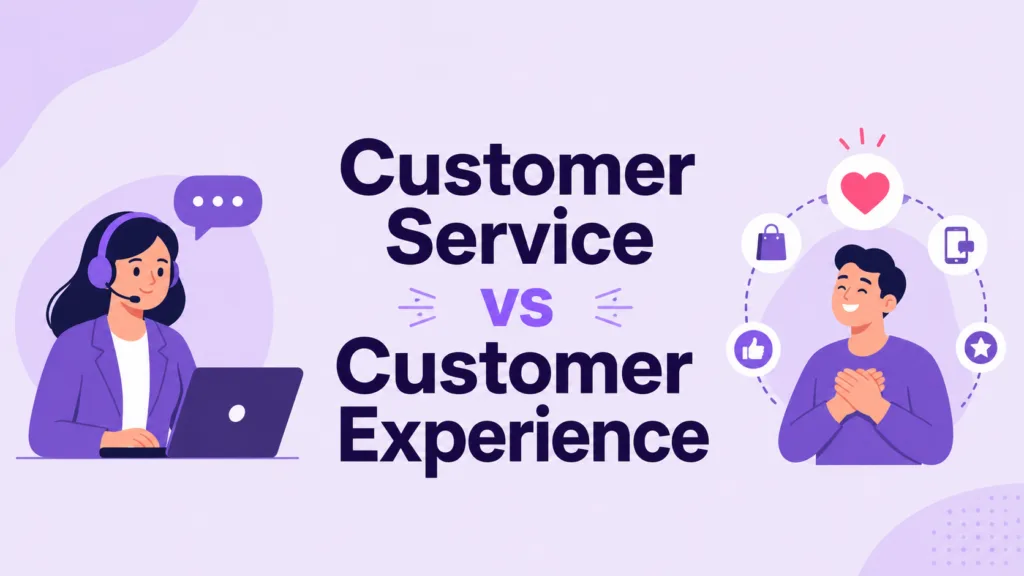
Quick summary: Customer service is one part of customer experience. Customer service is the reactive help you give during a specific interaction, measured by things like first-contact resolution and CSAT. Customer experience is the sum of every interaction across the whole relationship, measured by NPS, lifetime value, and churn. Service sits inside experience, both drive revenue, and the companies that win invest in both, increasingly with AI that resolves issues instantly while keeping the wider experience consistent.
The difference between customer service and customer experience is one of the most useful distinctions in business, and one of the most muddled. The two terms get used as if they mean the same thing, but they describe different scopes of work, owned by different teams, and measured in different ways. Getting the difference right changes how you organize, what you measure, and where you invest. Confuse them, and you end up optimizing a support queue while the broader relationship quietly erodes, or polishing a brand experience while a slow support desk sends customers to competitors. The two are not interchangeable levers, and pulling the wrong one wastes effort where it will not move the outcome you actually care about.
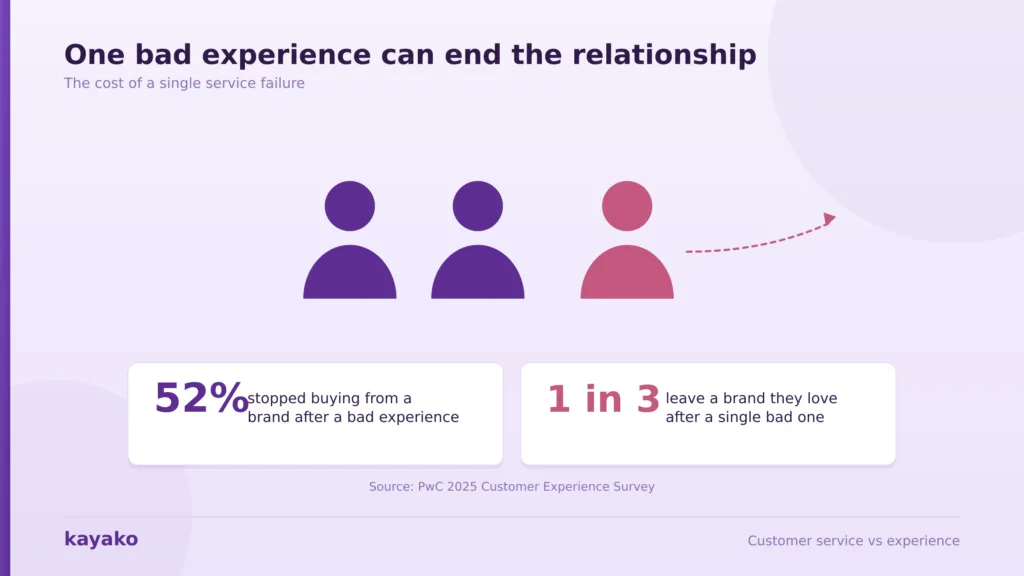
It matters commercially, not just semantically. In PwC’s 2025 Customer Experience Survey, 52% of consumers said they stopped buying from a brand after a bad experience, and nearly a third walked away specifically over poor service. Those are not marginal numbers; they describe customers a company already paid to acquire, lost over experiences it could have controlled. This guide defines each term, maps the real differences, shows how they work together, and covers the metrics and the role AI now plays. By the end, the goal is not just a tidy definition but a clearer sense of where to focus your team and your budget.
What is customer service?
Customer service is the support a company provides when a customer needs help, before, during, or after a purchase. It is usually reactive and interaction-level: a customer has a question or a problem, and the team resolves it. It happens across channels such as email, chat, phone, and social, and it is typically owned by a dedicated support team. The defining trait is that it is triggered by a need: something went wrong, or a customer has a question, and the team responds. Its success is judged on that specific exchange, was the issue resolved, and did it feel easy, and did it take little effort on the customer’s part. Because it is the most direct human contact many customers have with a brand, it also carries a disproportionate emotional charge, which is why a single interaction can shape how a customer feels about the whole company.
Service is where problems get solved, and it carries real weight on its own. Poor service is a leading reason customers leave, and strong service is a proven loyalty driver. In fact, about 96% of customers say service quality is essential to their loyalty to a brand, per figures compiled from industry research, and poor service costs US businesses tens of billions of dollars a year in lost custom. Building it well is the subject of B2B customer service best practices, but service is only one slice of how a customer perceives a brand. It is the slice customers remember most vividly, though, because it is where they needed something and either got it or did not. To see the rest, you need the wider idea of experience.
What is customer experience?
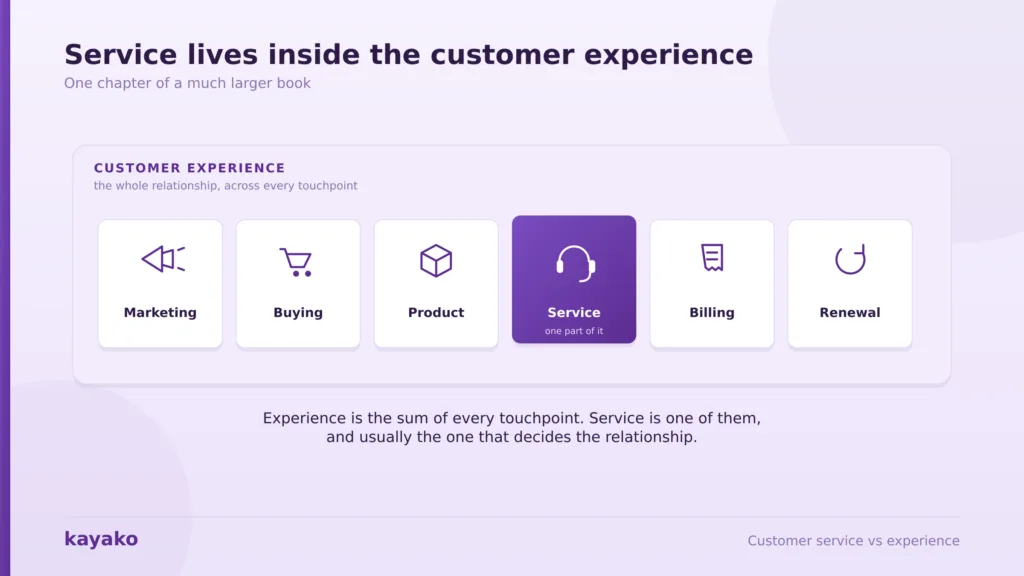
Customer experience, often shortened to CX, is the sum of every interaction a customer has with a company across the entire relationship. It spans marketing, the buying process, the product itself, support, billing, and renewal, plus every small moment in between, from the tone of an email to the ease of a checkout. It is the total impression a customer forms, shaped by every touchpoint rather than any single one. A customer might never call support, yet still form a strong opinion of your brand from your website, your onboarding, your billing, and your product. Each of those touchpoints deposits a small impression, positive or negative, and experience is the running total. Experience is that cumulative feeling, and it is why two companies with identical products can be perceived completely differently.
Where service is a moment, experience is the whole arc. It is largely designed by the company across departments, and it is measured by how customers feel over time, not just whether one issue has been resolved. Because it spans everything, it is owned by the whole organization, and it correlates tightly with growth, which is why so many businesses now compete on it. By some estimates, 89% of companies now compete primarily on customer experience, and CX-focused companies see up to 30% higher customer lifetime value, per data compiled from Gartner research. That relationship between the two ideas is the heart of the matter.
Deliver service that lifts the whole experience, with Kayako
Customer service vs customer experience: the key differences
The clearest way to hold the two apart is across four dimensions: scope, timing, ownership, and measurement.
- Scope. Customer service is a single interaction. Customer experience is the entire relationship, across every touchpoint.
- Timing. Service is mostly reactive, triggered when a customer needs help. Experience is proactive and continuous, designed in advance.
- Ownership. Service is owned by the support team. Experience is owned by the whole company, from marketing to product to finance.
- Measurement. Service is measured on resolution and satisfaction at the interaction level. Experience is measured by loyalty and value over the lifetime. The two rarely move in lockstep, which is exactly why you track them separately. A team can hit every service target and still lose customers if the wider experience disappoints, and the reverse is just as true.
Each dimension reinforces the same point. Service is narrow, immediate, and reactive; experience is broad, ongoing, and designed. The simplest way to remember it: customer service is one chapter, customer experience is the whole book. Both are essential, but they demand different owners, different tools, and different measures, which is where most organizational confusion comes from. The table below lays out the differences side by side.
| Customer service | Customer experience | |
|---|---|---|
| Scope | A single interaction | The entire relationship |
| Timing | Mostly reactive | Proactive and ongoing |
| Owner | The support team | The whole organization |
| Focus | Solving a problem | Every touchpoint and feeling |
| Key metrics | FCR, CSAT, response time | NPS, CLV, churn |
Customer service is one part of the wider customer experience, not a separate thing.
Seeing them side by side makes the relationship obvious, and it also points to the different metrics each one demands.
A great service score with rising churn is the clearest sign these two levels have come apart, and it is worth watching for.
The metrics for each
Because service and experience operate at different levels, they need different measures. Mixing them up is a common mistake.
Customer service metrics
Service metrics track individual interactions: first-contact resolution, customer satisfaction score (CSAT), average response and resolution time, and customer effort score. They answer a focused question: Did we resolve this issue quickly and well? Focused and immediate, these are the numbers a support team watches day to day, and they live within customer support metrics. They are fast-moving and tactical: a dip in first-contact resolution or a spike in response time tells you something is wrong this week, and points to a specific fix. Because they are interaction-level, they are also easy to act on quickly, which is why support teams review them daily rather than quarterly.
Customer experience metrics
Experience metrics track the whole relationship: Net Promoter Score (NPS), customer lifetime value (CLV), churn rate, and overall satisfaction. They answer a broader question: is this relationship healthy and growing, and would this customer choose us again? Where service metrics are a weekly pulse, these are the long-run signal of whether the whole effort is paying off. These sit alongside the wider set of customer experience metrics. Read together, they answer whether the value a customer gets over time is growing, which no single service interaction can tell you. A great service score with rising churn is a warning that the experience is failing even when individual interactions succeed, which is why both matter. Experience metrics move more slowly and strategically: they tell you whether the relationship is compounding into loyalty and revenue, or slowly coming apart despite competent day-to-day support.
Why both matter: the business case
Service and experience each drive revenue, and the data behind both is strong.
Experience is now a primary buying factor, weighed as heavily as price or product for a growing share of buyers. 73% of customers say experience is a key part of their purchasing decisions, and 86% say they are willing to pay more for a better one, per figures compiled from PwC and Walker research. Salesforce finds that 88% of customers say the experience a company provides matters as much as its products and services, and that 84% want to be treated like a person, not a number. A positive experience is also more persuasive than marketing: 65% of consumers say it influences them more than great advertising. CX leaders also grow faster: Forrester’s CX Index links CX leaders to as much as 4.8x the revenue growth of laggards over five years, per figures compiled from Forrester research. Personalization compounds the effect, with 80% of consumers more likely to buy from a brand that tailors the experience.
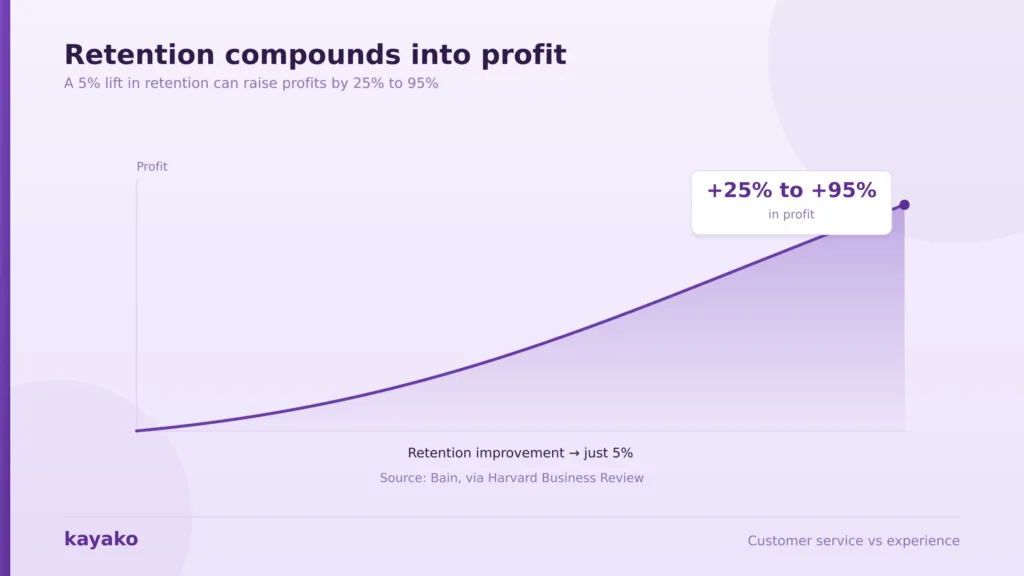
Service has its own hard numbers. About one in three customers will walk away from a brand they love after a single bad experience, per PwC, and most never say why, since only about 1 in 26 unhappy customers actually complain. The rest simply leave. Retention ties it all together: increasing retention by 5% can raise profits by 25% to 95%, per Bain research published in Harvard Business Review. Good service protects the relationship that good experience builds, which is why they work best together. There is also a word-of-mouth dividend: customers who rate their experience highly spend as much as 140% more and stay loyal several times longer, per data compiled by ClearlyRated, so the two working together do not just retain customers, they turn them into advocates.
How customer service and customer experience work together
Service is a subset of experience, and a high-stakes one. A single support interaction can lift the entire relationship or sink it, because service moments tend to be emotional, arriving when a customer is frustrated or stuck. These are the highest-stakes touchpoints in the entire experience, precisely because the customer arrives already caring about the outcome. Handle that moment well, and you strengthen the whole experience. Handle it badly, and one bad interaction can undo months of good ones. This is why service punches above its weight in shaping experience. The asymmetry is real: customers weigh negative moments more heavily than positive ones, so a single unresolved service failure can outweigh a dozen smooth touchpoints elsewhere in the relationship.
That is why the two cannot be managed in isolation. A company can design a beautiful experience across marketing and product, then lose the customer over a slow, impersonal support reply. Because customers experience a brand as one relationship, not as separate departments, consistency across every touchpoint is what holds the experience together, and service is often the touchpoint that tests it hardest, because it is where the customer is most invested in the outcome. Customers who rate their experience at the top end spend significantly more and stay loyal far longer than average, so the payoff for getting these moments right compounds over the life of the account. Because a strong service recovery can turn a frustrated customer into a more loyal one than they were before the problem, the highest-stakes moments are also the biggest opportunities. Aligning them is the core of a strong B2B customer service strategy. The practical takeaway is to treat your support desk not as a cost center but as the front line of the experience, since it is where the relationship is most often tested and most quickly lost. And AI is changing what is possible on both fronts.
How AI is raising the bar on both
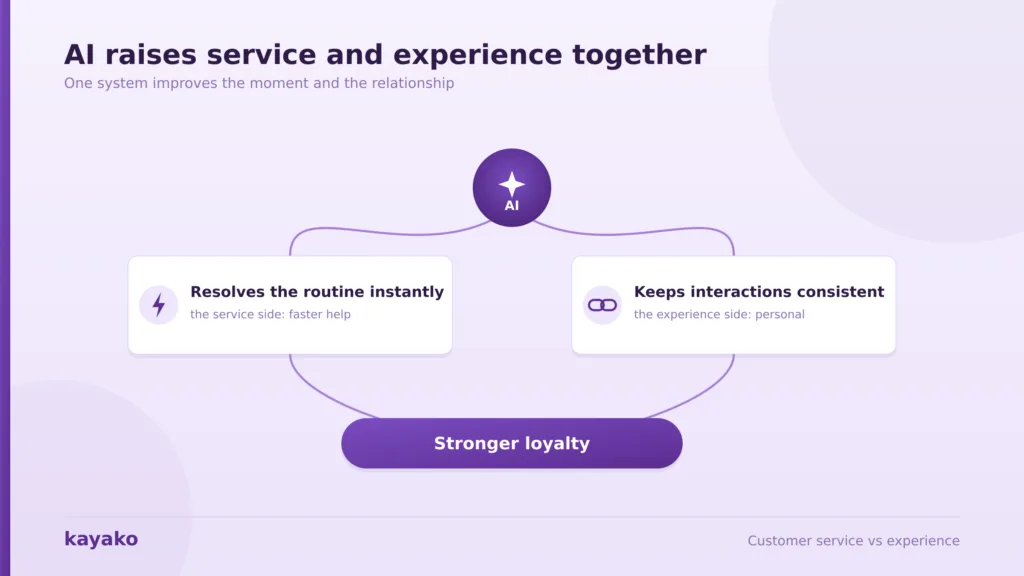
AI is improving service and experience at the same time, from different angles. On the service side, AI resolves routine issues instantly, which lifts first-contact resolution and cuts response time, the core service metrics. On the experience side, AI personalizes interactions and keeps context consistent across channels, which lifts loyalty and lifetime value. The two effects reinforce each other: every issue the AI resolves instantly is both a better service outcome and a smoother experience, and every piece of context it carries forward makes the next interaction feel more personal.
The balance matters, though. PwC found that even as AI use grows, 86% of consumers still say human interaction is moderately or very important in their brand experience. The winning pattern is AI that resolves what it can instantly and hands off to a person when empathy or judgment is needed, with full context passed along so the customer never restarts. Done well, this raises the service metrics and the experience metrics at the same time, rather than trading one for the other. Real examples of AI in customer service show that combination in action, and it is exactly how a modern platform improves both at once.
Resolve issues instantly and keep every experience consistent with Kayako
The best implementations make the AI invisible to the customer, who simply experiences fast, accurate help that remembers who they are. That is the standard worth aiming for: not AI for its own sake, but resolution so quick and context so complete that the service moment strengthens the relationship instead of straining it.
How to improve both, and how Kayako helps
Improving service and experience together comes down to speed, consistency, and context, the three things customers notice whether or not they can name them. Resolve issues fast, keep every interaction consistent across channels, and give every agent the full history so no customer repeats themselves. Kayako is built for exactly this: Agent Kay resolves routine issues autonomously, which lifts the service metrics, while SingleView keeps the experience consistent by giving everyone one view of the customer, so the person who greets a returning customer already knows their history and never asks them to repeat it. The result is service that feels personal at scale, which is precisely where experience is won. A customer who gets an instant, accurate, context-aware answer does not experience a support ticket; they experience a company that clearly knows them, and that impression is what loyalty is built on. Its omnichannel AI support ties the channels together, so a conversation that starts on chat and continues over email never loses its thread. Every channel draws on the same record, which is what keeps the experience feeling like one relationship rather than a series of disconnected transactions. Priced per resolution rather than per seat, it also means the service improvements scale without the cost climbing in lockstep.
The result shows up in both sets of numbers. Case study: Trilogy. Using Kayako, Trilogy eliminated 80% of its ticket volume, cut ticket age from 17.6 hours to under 2 minutes, and saved $5 million. Faster resolution improves the service metrics directly, and the consistency of an autonomous, context-aware system improves the experience that keeps customers for years. One number captures both effects: when ticket age falls from most of a day to under two minutes, the customer feels heard immediately, and the relationship carries less friction into every future interaction. That is the payoff of treating service as the front line of a wider experience.
Customer service and customer experience are not competing ideas; one lives inside the other. Service is the reactive help you give in a single interaction, measured on resolution and satisfaction. Experience is the whole relationship, measured by loyalty and lifetime value. Service is a chapter, experience is the book, and neither works without the other.
The companies that win invest in both. They resolve individual issues fast, and they design a consistent experience across every touchpoint, increasingly with AI that handles the routine and frees people for the moments that need them. Crucially, they stop treating the two as rival budget lines and start treating service as the sharp end of the experience they are trying to build. Treat great service as the front line of a great experience, and both the interaction metrics and the relationship metrics move in the right direction. The distinction is not academic: it decides how you structure teams, which numbers you hold people to, and where the next dollar of investment goes. A support leader optimizing only for resolution time and a CX leader optimizing only for NPS can both succeed on paper while the customer quietly slips away, which is why the two views have to be joined. Get it right, and service and experience stop competing for attention and start compounding into loyalty.
See how Kayako improves service and experience together
Frequently asked questions
What is the difference between customer service and customer experience?
Customer service is the support you provide during a specific interaction, such as answering a question or fixing a problem. It is reactive and owned by the support team. Customer experience is the sum of every interaction a customer has with your company across the whole relationship, from marketing to product to renewal. Service is one part of experience: a single chapter within the larger book.
Is customer service part of customer experience?
Yes. Customer service is a subset of customer experience, and often a decisive one. Because service moments are emotional and arrive when a customer needs help, they carry outsized weight in shaping the overall experience. A great service interaction strengthens the whole relationship, while a poor one can undo months of otherwise positive experience across other touchpoints.
Which metrics measure customer service vs customer experience?
Customer service is measured at the interaction level with first-contact resolution, CSAT, average response and resolution time, and customer effort score. Customer experience is measured across the relationship with NPS, customer lifetime value, churn rate, and overall satisfaction. If service scores look strong but churn is rising, the experience is failing even though individual interactions are succeeding.
Why are both customer service and customer experience important?
Because each drives revenue in a different way. Strong customer experience wins and retains customers, with most buyers willing to pay more for it, and many leaving after one bad experience. Strong customer service protects those relationships at the moments that matter most. Since increasing retention by 5% can raise profits by 25% to 95%, investing in both is one of the clearest returns a business can pursue. Service and experience are two sides of retention, and retention is where the profit is.
How can AI improve customer service and customer experience?
AI improves service by resolving routine issues instantly, which raises first-contact resolution and cuts response time. It improves experience by personalizing interactions and keeping context consistent across channels, which lifts loyalty and lifetime value. The most effective approach uses AI to resolve what it can and hand off to a human when empathy or judgment is needed, since most consumers still value human interaction for complex moments.