Summary. This guide answers what customer engagement is, with a clear customer engagement definition, the three types, and how it differs from experience and satisfaction. Customer engagement is the depth and quality of the ongoing, two-way relationship a customer builds with a brand across every touchpoint over time. You will get the business case with real numbers, practical strategies, named examples, the metrics that matter, and how AI is reshaping engagement in 2026.
Two customers buy the same product on the same day. One forgets the brand by next week. The other follows it, leaves a review, and refers two friends. Same purchase, very different customer engagement, and over time, the second customer is worth far more. That gap is what this guide is about. Engagement is the depth of the relationship after the sale, and it predicts loyalty, retention, and revenue better than any single transaction does.
The stakes are rising, too. Salesforce reports that 88% of customers say the experience a company provides is as important as its products, the highest it has been since they started tracking it. So the relationship around the product now carries as much weight as the product. Below you will find a working definition, the difference between engagement, experience, and satisfaction, the three types, the business case, strategies you can apply, real examples, the metrics, and the 2026 AI layer.
Build engagement that drives loyalty Book Session ›
What is customer engagement? (The definition you want)
Customer engagement is the depth and quality of the ongoing, two-way relationship a customer builds with a brand across every touchpoint over time, rather than a single purchase. The customer engagement that matters most is participation. An engaged customer does things: they open the app, read the email, join the program, leave feedback, and tell other people. Salesforce frames modern engagement as connected experiences instead of one-off transactions, and Qualtrics describes the customer as an active participant rather than a passive buyer. Twilio adds the practical angle, treating engagement as a measure of how invested people are and a predictor of loyalty and lifetime value.
One distinction keeps the definition honest. Engagement is two-way. The brand reaches out, the customer responds, and the relationship compounds. That is why mapping the customer journey matters so much, because every touchpoint is either building the relationship or quietly draining it.
Definition. Customer engagement is the depth, quality, and continuity of a customer’s two-way relationship with a brand across all touchpoints, measured by how actively the customer participates over time.
Customer engagement vs customer experience vs customer satisfaction
These three terms get used as if they mean the same thing. They do not, and the difference is worth getting right because each one is measured differently. Here is the customer engagement vs customer experience and customer engagement vs customer satisfaction breakdown in one view.
| Concept | What it measures | Time frame |
|---|---|---|
| Experience | Total perception across every touchpoint | Cumulative, whole relationship |
| Satisfaction | How happy someone is after one interaction | A single moment |
| Engagement | Depth, continuity, and active participation | Ongoing, builds over time |
Read across the rows, and the relationship becomes clear. A satisfied customer may never engage again, while an engaged customer may buy little yet advocate a lot. Experience is the backdrop, satisfaction is a snapshot, and engagement is the storyline. Qualtrics draws the same line on participation, and Outreach defines all three cleanly if you want the side-by-side. With the three terms separated, the next step is to break engagement itself into its parts.
The three types of customer engagement
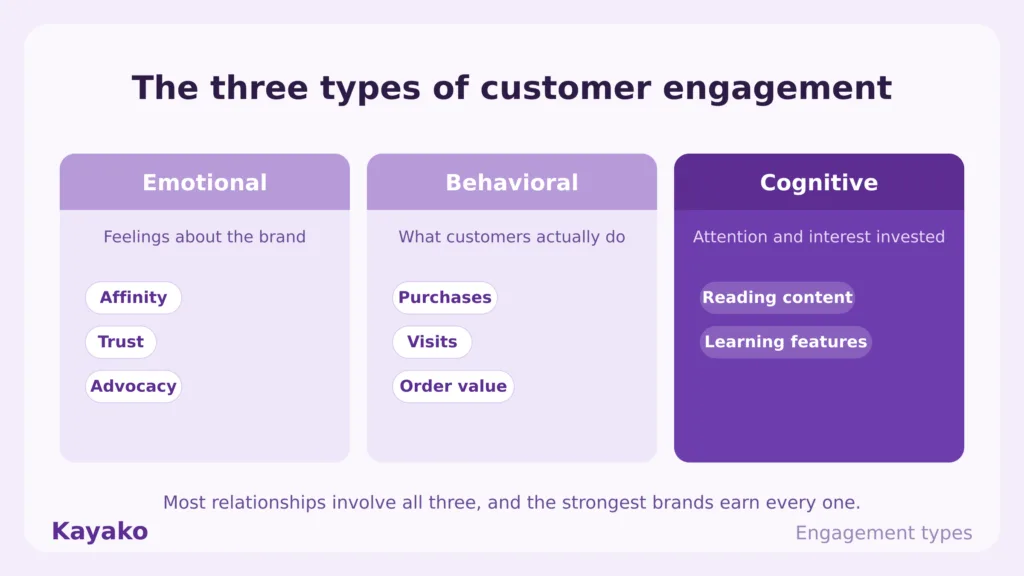
Engagement is not one thing you switch on. It shows up in three forms, and naming them helps because each one is measured in a different way later. These types of customer engagement build on each other.
Emotional engagement
The feelings and associations a customer holds about a brand. This is the hardest to manufacture, and the most durable once earned, because it survives a price increase or a competitor’s promotion. When people defend a brand to their friends, this is a form of doing the work.
Behavioral engagement
The observable actions, such as purchase frequency, time on site, average order value, and loyalty-program participation. Behavioral signals are the easiest to track, so they anchor most dashboards and give you the clearest early read on whether engagement is rising or slipping.
Cognitive engagement
The attention, interest, and mental investment a customer gives a brand, for example, reading your content or learning a new feature. Cognitive engagement often precedes the behavioral kind, so it is an early signal worth watching. Together, these three forms explain not just whether customers act, but why, which is exactly what the business case rests on.
Why customer engagement matters (the business case)
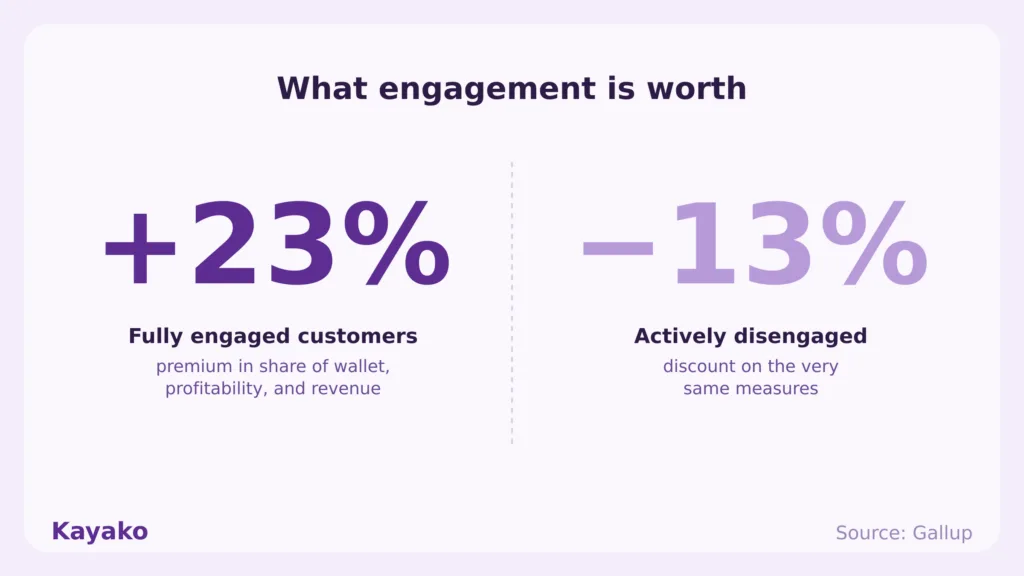
If you have ever had to defend an engagement budget, this is the section to bookmark. The case for why is customer engagement important rests on retention economics, and the numbers are strong. Gallup found that a fully engaged customer represents a 23% premium in share of wallet, profitability, revenue, and relationship growth compared with the average customer, while an actively disengaged one represents a 13% discount on the same measures.
The B2B picture is just as direct. Gallup reports that companies that successfully engage their B2B customers see 63% lower attrition, 55% higher share of wallet, and 50% higher productivity. Retention is the quiet multiplier here, because keeping a customer costs a fraction of winning a new one, and engaged customers stay. Treat engagement as a leading indicator of revenue, not a vanity metric, and the spending decision usually makes itself.
The short version. Engaged customers buy more, stay longer, and bring friends. Disengaged ones cost you on every measure. Engagement is where retention and revenue meet.
Turn support into an engagement engine Get Started ›
Customer engagement strategies (how to build it)
Knowing the definition is the easy part. Building engagement takes deliberate work across the relationship. These customer engagement strategy moves are the ones that compound, so start with the few that fit your team and add the rest over time.
- A consistent brand voice. Sounds like the same company in an email, a chat, and a help article. Consistency is what makes a relationship feel like a relationship.
- Be where customers are. Meet people on the channels they already use through omnichannel support, with one continuous conversation rather than separate silos.
- Personalization with data. Use history and context to make each interaction relevant. Generic outreach reads as noise, and customers tune it out.
- Loyalty programs. Reward repeat behavior so the easy choice is to come back. Points, tiers, and perks turn one purchase into a habit.
- Content and education. Teach customers to get more value from what they bought. Education deepens cognitive engagement and reduces support load at the same time.
- Active listening and closed-loop feedback. Ask for feedback, then visibly act on it. The loop is what turns a survey into a relationship.
- Proactive engagement. Reach out at key moments rather than only when something breaks, for example, a check-in at onboarding or a heads-up before a renewal.
- Community, UGC, and gamification. Give customers a stage. User-generated content and friendly competition turn buyers into participants.
Underpinning all of it is trust. Harvard Business School describes a trust triangle of authenticity, logic, and empathy, and engagement grows fastest when customers feel all three. AI helps you execute these strategies at scale, which is where tools like Kayako AI Customer Support and a strong NPS program come in. None of these works in isolation, so the brands that win usually run several at once, which is exactly what the examples below show.
Customer engagement examples
Definitions land better with names attached. Each of these customer engagement examples maps to a strategy above. The point is the mechanism each brand uses.
- Spotify, personalization. Personalized playlists and the annual Wrapped recap turn listening data into a shareable identity, which drives behavioral and emotional engagement at once.
- Starbucks, gamified loyalty. Starbucks Rewards uses stars, tiers, and challenges so everyday purchases feel like progress toward something.
- Nike, community. Workout apps, membership, and interactive campaigns build a direct relationship that goes well beyond the shoebox.
- Amazon, reviews, and UGC. Customer reviews and Q&A make shoppers active contributors, and that participation compounds trust for the next buyer.
- Airbnb, closed-loop feedback. Product changes driven by guest and host feedback, such as streamlined booking, show customers their input shapes the product.
- Whole Foods, education as engagement. In-store and online education turns a grocery run into a learning moment, which deepens cognitive engagement.
- Dropbox, usage-based upsell. Prompts tied to how people actually use the product nudge upgrades at the moment they are most relevant.
Engagement is also local. The same brand adapts by market, for example, Amazon tailors its last-mile delivery to each country, and Uber adapts its model to local payment habits, such as cash rides in some regions. The lesson is consistent: meet customers in their context, and verify each market’s specifics before you publish numbers about them. Inspiring as these are, none of them means much until you can measure your own engagement, which is where we turn next.
How to measure customer engagement (metrics)
You cannot manage what you do not measure, and engagement is measured differently by each team. The customer engagement metrics below map to where the relationship shows up, so pick the set that matches your goals rather than tracking all of them at once. This is also the answer to how to measure customer engagement in practice.
- Relationship and loyalty: Net Promoter Score, repeat-purchase frequency, loyalty-program participation, and churn rate. For the first one, see What Is Net Promoter Score (NPS)?.
- Satisfaction and effort: CSAT and Customer Effort Score, measured after specific interactions.
- Product and behavior: active users, feature adoption, and time on site or in app.
- Marketing signals: email open and click-through rates, social interactions, and audience growth.
- Revenue health: customer lifetime value and net revenue retention, the metrics that tie engagement back to money.
Here is the opportunity hiding in plain sight. Twilio notes that marketing, product, and support each measure engagement differently, so a shared definition matters. Tidio research suggests only about 44% of companies track engagement analytics at all, which means a team that measures well already has an edge over half the field.
Once you can measure engagement, you can improve it deliberately rather than by guesswork. That is also where 2026 changes the game, because AI is making personalized, proactive engagement possible at a scale no team could staff on its own.
How AI is changing customer engagement in 2026
AI is becoming the engine for engagement at scale, and 2026 is the year it moves from novelty to default. It personalizes outreach for each customer, predicts needs before they surface, and powers always-on conversational support that keeps the relationship two-way around the clock. IBM points to proactive engagement, reaching out at the right moment in the relationship, as a defining pattern, and Salesforce frames AI and unified data as the way to win every interaction.
Keep the honest caveat, though. AI augments engagement, yet human connection still drives the emotional kind, so the strongest approach pairs automation with people. Tools such as Kayako AI Customer Support and the Kayako AI Chatbot handle the repetitive, high-volume moments so your team can spend its time on the relationships that need a human touch.
Engage every customer at scale Talk to Expert ›
How Kayako helps
Engagement lives or dies in the support inbox, because that is where customers show up when they care enough to reach out. Kayako keeps those moments fast and personal. Its AI agent resolves the repetitive questions instantly, while SingleView gives agents a unified timeline so every conversation builds on the last one rather than starting over. The result is consistent, proactive, two-way engagement at scale, priced at $1 per AI-resolved ticket rather than per seat.
Start a 90-day Kayako pilot Get Started ›
So, to answer what is customer engagement in one line: it is the depth, quality, and continuity of a customer’s two-way relationship with your brand, and it predicts loyalty, retention, and revenue better than any single sale. It is not the same as experience or satisfaction; it shows up in emotional, behavioral, and cognitive forms, and the business case behind it is backed by hard numbers rather than hope.
From here, the path is practical. Define engagement clearly for your team, pick the few metrics that match your goals, and build it with a consistent voice, omnichannel presence, personalization, and proactive outreach. Then let AI carry the repetitive load so your people can spend their time where emotional engagement is actually won. Measure honestly, act on what you learn, and the relationship compounds, one good interaction at a time.
Frequently asked questions
What is customer engagement in simple terms?
It is how deeply and how often a customer interacts with and participates in a relationship with your brand, across every touchpoint, over time. Strong engagement shows up as repeat visits, feedback, referrals, and loyalty.
What is the difference between customer engagement and customer experience?
Experience is the customer’s total perception across every touchpoint. Engagement is the depth, continuity, and active participation in the relationship. Experience is the backdrop, and engagement is how actively the customer takes part in it.
Why is customer engagement important?
Because it predicts revenue and retention. Gallup found fully engaged customers represent a 23% premium in share of wallet, profitability, revenue, and relationship growth, while disengaged ones cost you on the same measures.
What are the types of customer engagement?
Emotional (feelings about the brand), behavioral (observable actions such as purchases and visits), and cognitive (attention and mental investment). Most relationships involve all three.
How do you measure customer engagement?
Match the metric to the goal: NPS, CSAT, and CES for sentiment and loyalty; active users, feature adoption, and repeat purchases for behavior; and customer lifetime value and net revenue retention for revenue health.
What are examples of customer engagement?
Spotify Wrapped, Starbucks Rewards, Nike membership, Amazon reviews, Airbnb feedback-driven changes, Whole Foods education, and Dropbox usage-based prompts. Each turns a customer into an active participant rather than a one-time buyer.
What is a customer engagement strategy?
A deliberate plan to deepen the relationship, typically combining a consistent brand voice, omnichannel presence, personalization, loyalty programs, education, closed-loop feedback, proactive outreach, and community, all supported by the right metrics.