Building customer relationships means earning trust across every interaction, before and after the sale, through proactive communication, real personalization, and fast problem-solving. This guide covers what relationship building is, why it pays off, the strategies that actually work, real-world examples, and how to keep relationships strong as you grow. The short version: retention is the cheapest growth you will ever buy, and it is built one resolved issue at a time.
Ask a founder where their next quarter of growth will come from, and most will point outward, at new customers. The math says they are looking in the wrong direction. A Bain & Company study, published in the Harvard Business Review, found that increasing customer retention by just 5% raises profits by anywhere from 25% to 95%. Very little in acquisition produces a return like that, which is why the companies that grow steadily tend to be the ones that treat existing customers as an asset rather than a finished transaction.
Knowing how to build customer relationships is what turns a one-time buyer into an asset. It is the ongoing work of earning trust across every touchpoint, so a customer chooses you again when they have every option to leave. This guide breaks down what relationship building actually involves, the business case behind it, the strategies that move the needle, and how support quietly decides whether a relationship survives its first problem.
What is customer relationship building?
Customer relationship building is the practice of earning and keeping a customer’s trust through every interaction they have with your business, from the first marketing touch to the fifth support ticket. It is not a single campaign or a loyalty program bolted on at the end. It is the accumulated effect of being consistent, responsive, and genuinely useful over time, so the customer feels known rather than processed.
One distinction clears up a lot of confusion. A CRM stores who the customer is and where they sit in the pipeline, whereas relationship building is what you do with that information. The data tells you a customer bought twice and opened a support ticket last week; the question is whether that ticket got resolved fast enough that they buy a third time. Strong, consistent service is the vehicle for all of it, and the practices that actually drive retention come back to exactly this. A relationship is really just the sum of the conversations you have had. Once you see it that way, the case for investing in it becomes hard to ignore.
Why building customer relationships matters
The business case rests on a simple asymmetry: keeping a customer is far cheaper than winning one, and a kept customer is worth more over time. Bain & Company puts the cost of acquiring a new customer at 5 to 25 times more than retaining an existing one, and that gap has widened as advertising has grown more expensive. Retention is not a softer alternative to growth. It is often the more profitable engine, which is why a growing number of teams now treat support as a revenue center rather than a cost.
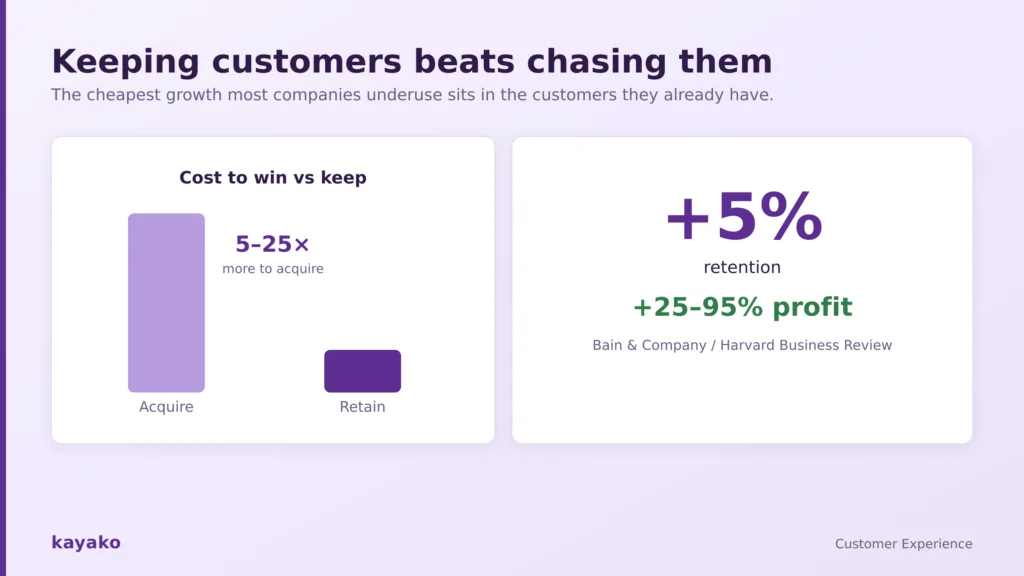
The economics of retention: small gains in keeping customers produce outsized profit.
The value compounds the longer a relationship lasts. Bain’s research shows returning customers spend around 67% more in their third year with a brand than in their first six months, and Forrester data has customer lifetime value rising by roughly 126% when buyers make repeat purchases. The pattern holds at the company level too: McKinsey has found that businesses with strong retention outperform their peers by as much as 85% in sales growth, the kind of result the right customer success metrics are meant to surface. Improving customer retention and lifting customer lifetime value are, in practice, the same project viewed from two angles.
There is a defensive case as well. Roughly 85% of customer churn is preventable through better service, which means most of the customers a business loses were not lost to a competitor’s better product but to its own slow or impersonal response. Relationship building is how you stop that leak before it starts.
There is a compounding upside on the other side of that number. A customer who feels genuinely looked after does not just stay; they spend more, forgive the occasional mistake, and tell other people. Word-of-mouth from a loyal customer arrives pre-trusted and costs nothing to generate, which means a strong relationship is quietly doing your marketing for you. Over a few years, the difference between a business that builds relationships and one that treats every sale as final is the difference between growth that compounds and growth you have to buy each quarter again. With the stakes clear, the question becomes how to actually do it.
How to build strong customer relationships
Relationship building is not mysterious, but it is deliberate. These five practices are where the trust actually gets built, and each one is something a team can start on this quarter.

The five practices that build customer relationships, none of which needs a budget.
Communicate proactively and consistently
The strongest relationships are maintained before anything goes wrong. Reaching out with a helpful update, a heads-up about a known issue, or a check-in the customer did not have to request signals that you are paying attention.
Proactive contact turns support from a complaint channel into a relationship channel, and the right support tools make it possible to do this at scale rather than one email at a time. Consistency matters as much as initiative, because a relationship built on unpredictable contact is no relationship at all.
Listen and act on feedback
Customers can tell the difference between being surveyed and being heard. Collecting feedback is only half the work; the half that builds trust is visibly acting on it and closing the loop with the person who raised it.
When a customer sees their suggestion turn into a change, or their complaint produce a fix, they stop being a user and start being an advocate. A feedback process that goes nowhere does the opposite, quietly teaching people that their input does not count, which is worse than never asking. The mechanics matter less than the follow-through: a quick reply acknowledging a suggestion, and a note when it ships, turns a passive user into someone who feels a small stake in the product. Feedback is one of the rare relationship-building moves that costs almost nothing and returns loyalty out of proportion to the effort.
Personalize every interaction
Personalization is not inserting a first name into an email. It is knowing the customer’s history well enough that they never have to repeat it, so a support agent opens a conversation already aware of the last three. That kind of context is what customers now expect: Salesforce reports that 88% of customers say the experience a company provides matters as much as its products.
Meeting that bar means every interaction should feel like a continuation of the relationship rather than a cold start. The practical test is simple: if a returning customer has to explain who they are or what they bought, the personalization has failed, no matter how their name appears in the greeting. Getting this right depends less on clever messaging and more on whether the whole team can see the same customer history at the moment they need it.
Resolve problems quickly
Nothing tests a relationship like a problem, and nothing builds one faster than solving it well. Speed is the variable customers feel most sharply, because a fast resolution respects their time while a slow one signals that their frustration is not your priority. Given that around 85% of churn traces back to preventable service failures, the ability to resolve issues quickly and completely, increasingly with the help of automation that clears the routine load, is not a support metric buried in a dashboard. It is one of the load-bearing pillars of the whole relationship.
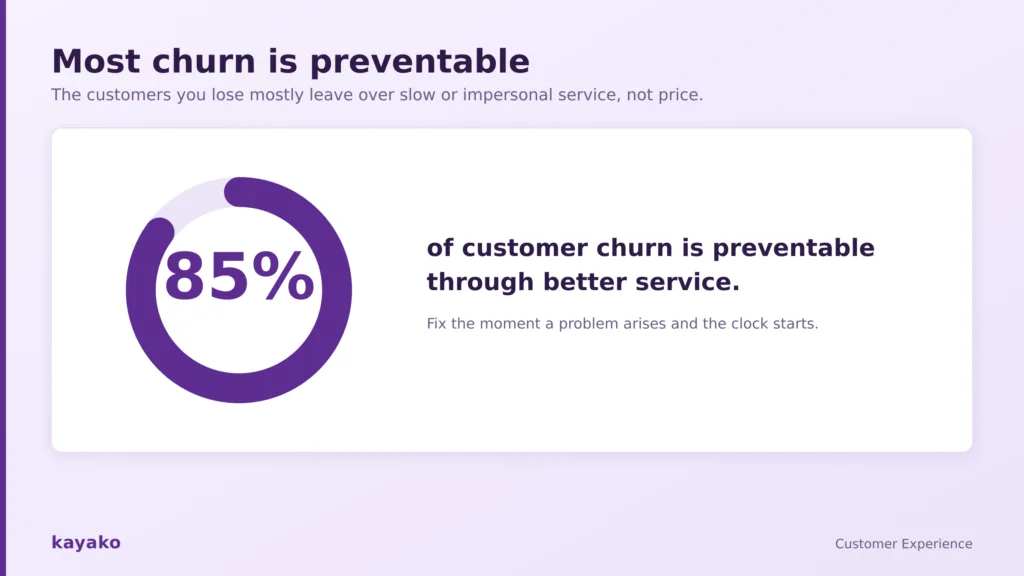
Most churn is preventable, which makes fast, personal service a retention lever.
Be reliable and follow through
Trust is built on kept promises, and it is spent on broken ones. If you commit to a callback by Friday, the callback happens by Friday. Reliability is unglamorous and compounding: each promise kept makes the next interaction start from a higher baseline of trust, until the customer simply assumes you will do what you say. T
That assumption is the quiet goal of every relationship strategy on this list. It is also the easiest to undermine, because a single missed commitment can undo months of accumulated trust, so the bar is not occasional excellence but boring consistency. Seeing these principles in action makes them concrete, so here are a few examples.
Customer relationship examples
The brands known for loyalty tend to build it in recognizable ways. A subscription software company that reaches out the moment a customer’s usage drops, offering help before the renewal date, is practicing proactive relationship building rather than waiting for a cancellation.
A retailer that remembers a shopper’s preferences across channels, so the recommendation in the app matches the conversation in the store, is turning personalization into a reason to stay. The same moves show up again and again in the strongest B2B customer service examples.
The pattern repeats across industries. A financial services firm that resolves a disputed charge in minutes rather than days converts a moment of anxiety into a demonstration of reliability.
A direct-to-consumer brand that acts on a wave of feedback about sizing, then emails the customers who complained to tell them what changed, turns critics into promoters. None of these moves is expensive or clever. They are simply the five practices above, applied consistently, by companies that decided the relationship was worth the effort.
It is worth noticing what these examples have in common beyond the individual tactic. In every case, the company acted on information it already had, a drop in usage, a stated preference, a disputed charge, a wave of feedback, and did something visible with it fast. That is the whole craft: not gathering more data about customers, but responding to what the data already says quickly enough that the customer feels the response. A business that reacts within minutes builds a relationship that a business reacting within weeks cannot, even with identical information. Building relationships is one thing; keeping them alive over the years is another.
How to maintain customer relationships over time
Winning a customer’s trust once is easier than keeping it. Maintenance is the discipline of staying consistent long after the novelty of a new relationship has worn off, and it is where many businesses quietly lose people they worked hard to earn. Regular, low-pressure contact keeps the relationship warm: a periodic check-in, a useful resource, an early look at something new, all of which remind the customer you exist without asking them for anything.
The mechanics of maintenance are measurable through your customer experience metrics. Tracking your churn rate tells you whether relationships are eroding, and watching your Net Promoter Score tells you whether the ones you keep are strong enough that customers would recommend you.
Both are early-warning systems: a rising churn rate or a falling NPS is a relationship problem showing up in the data before it shows up in revenue. Catching it there, while there is still time to reach out and repair the relationship, is the whole point of measuring. The same relationship logic applies wherever a customer meets your business, including sales and marketing.
Building customer relationships in sales and marketing
Relationship building does not belong to the support team alone. In sales, backed by real sales enablement, it is the difference between chasing a transaction and earning a long-term account, which means listening more than pitching and treating the close as the start of the relationship rather than the finish line. A rep who checks in after the deal, connects the customer to the right resources, and stays useful without always selling is building the trust that produces renewals, referrals, and natural cross-selling opportunities.
In marketing, relationship building shows up as content and communication that serves the customer rather than only promoting the product. Educational resources, honest guidance, and messaging that speaks to where the customer actually is all deepen the relationship before a support ticket is ever filed. Aligning sales, marketing, and support around one consistent experience is what makes a relationship feel coherent, and it is where a unified view of the customer becomes genuinely valuable rather than a nice-to-have.
The failure mode is a customer who is treated as three different people by three different teams: a prospect to marketing, a deal to sales, and a ticket number to support. Each interaction resets the relationship instead of building on it, and the customer feels the seams. When those three teams work from the same record, the relationship carries forward, so the support agent knows what the customer was promised in the sales call, and the marketing team knows not to pitch a feature the customer already struggles with. That continuity is what separates a company that has a relationship with a customer from one that merely has transactions with them.
Kayako in practice: relationships built on fast resolution
Everything above points to the same conclusion: relationships are won and lost in the details of everyday service, and speed of resolution is the detail customers feel most. This is where a support platform stops being back-office software and starts being a relationship tool. The teams that keep customers are the ones that resolve issues before frustration hardens into a decision to leave, and that is difficult to do by hand once volume grows.
Kayako is built around that insight. Its AI agent, Agent Kay, which is a genuine AI agent rather than a scripted chatbot, resolves routine questions on its own, so customers get answers in the moment rather than waiting in a queue, while SingleView keeps a customer’s full history, orders, and past conversations on one record. The effect on the relationship is direct: a customer never has to repeat themselves, and an agent never opens a conversation cold. Personalization stops being a slogan and becomes the default, because the context is simply there.
The pattern is visible in how customers use it. When the software company Trilogy moved its support onto Kayako, the change that mattered for customer relationships was speed: the average ticket age fell from 17.6 hours to under 2 minutes, and the AI agent reached a 76% autonomous resolution rate, handling most routine questions without a person involved.
The reason that protects relationships is straightforward. A customer whose problem is solved in two minutes rather than most of a day never reaches the point of frustration where they start looking at alternatives, so the resolution speed is doing quiet retention work on every ticket. What makes that possible is less the technology on its own than how it is set up.
Kayako pairs the platform with hands-on implementation support, so the AI is trained on a company’s own history and tone rather than left generic, and the team is guided through rollout rather than handed a login and left to configure it. That is the difference between an AI agent that customers trust and one they learn to route around, and it is why the resolution figures hold up in practice rather than only in a demo. You can see where this is heading in Kayako’s view of the future of AI in customer service. Fast, personal resolution is not the whole of a customer relationship, but it is the part most likely to break, and fixing it removes the most common reason customers walk away.
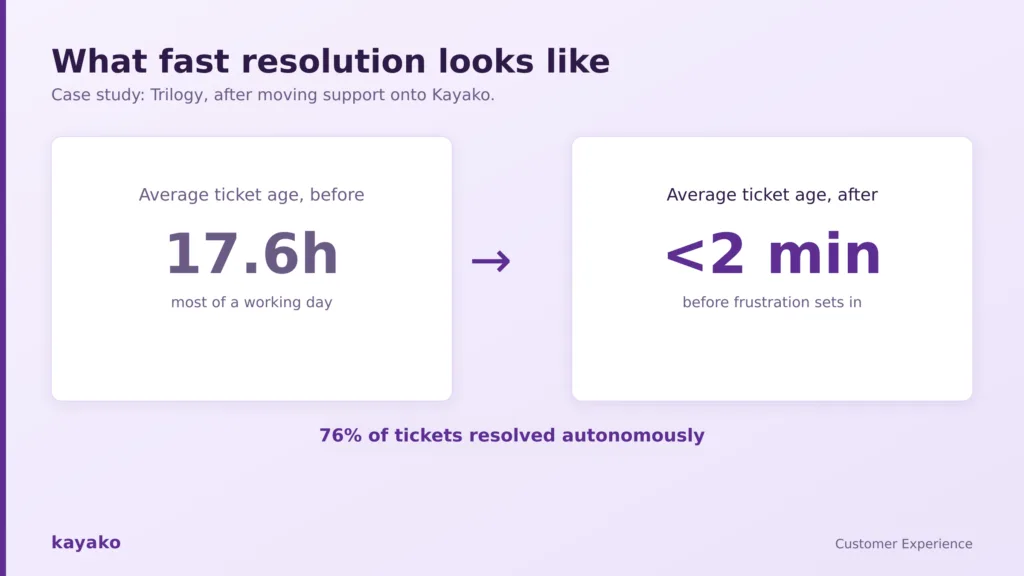
Case study: Trilogy cut average ticket age from 17.6 hours to under 2 minutes on Kayako.
Building customer relationships is the highest-return work most businesses underinvest in. The economics are settled: a small lift in retention produces an outsized lift in profit, returning customers spend more, and the majority of the customers you lose could have been kept with better service. None of it requires a grand strategy. It requires proactive communication, real listening, genuine personalization, fast resolution, and reliability, applied consistently until trust becomes the default.
Start where the relationship is most likely to break, which for most companies is the moment a problem arises, and the clock starts. Resolve those moments quickly and personally, measure whether your churn and loyalty numbers respond, and build outward from there. The customers you already have are the cheapest growth available, and every one you keep is one you do not have to spend to replace.
Frequently asked questions
What is customer relationship building?
Customer relationship building is the ongoing practice of earning and keeping a customer’s trust across every interaction with your business, from marketing and sales through to support. It is not a single campaign or loyalty program but the accumulated effect of being consistent, responsive, personalized, and reliable over time, so customers feel known and choose you again when they could easily leave.
Why is building customer relationships important?
Because retention is far cheaper and more profitable than acquisition. Bain & Company found that a 5% increase in retention raises profits by 25% to 95%, and that acquiring a customer costs 5 to 25 times more than keeping one. Returning customers also spend more over time, and roughly 85% of churn is preventable through better service, so strong relationships directly protect revenue that would otherwise leak away.
How do you build strong customer relationships?
Through five consistent practices: communicate proactively rather than only reacting to problems, listen and visibly act on feedback, personalize interactions using the customer’s full history, resolve problems quickly and completely, and follow through reliably on every promise. None of these requires a large budget. They require doing the ordinary things consistently until trust becomes the customer’s default expectation of you.
How do you maintain customer relationships over time?
Maintenance means staying consistent long after the relationship is new: regular low-pressure check-ins, useful resources, and early access that keep the relationship warm without always asking for a sale. Track your churn rate and Net Promoter Score as early-warning systems, because a rising churn rate or falling NPS signals a relationship problem in the data before it reaches revenue, while there is still time to reach out and repair it.
How do you build relationships with clients in sales?
Treat the close as the beginning of the relationship rather than the end. Listen more than you pitch, check in after the deal, connect the client to the right resources, and stay useful without always selling. A rep who builds genuine trust earns renewals and referrals that a transactional approach never will, because clients buy again from people who have proven they are invested beyond the first signature.