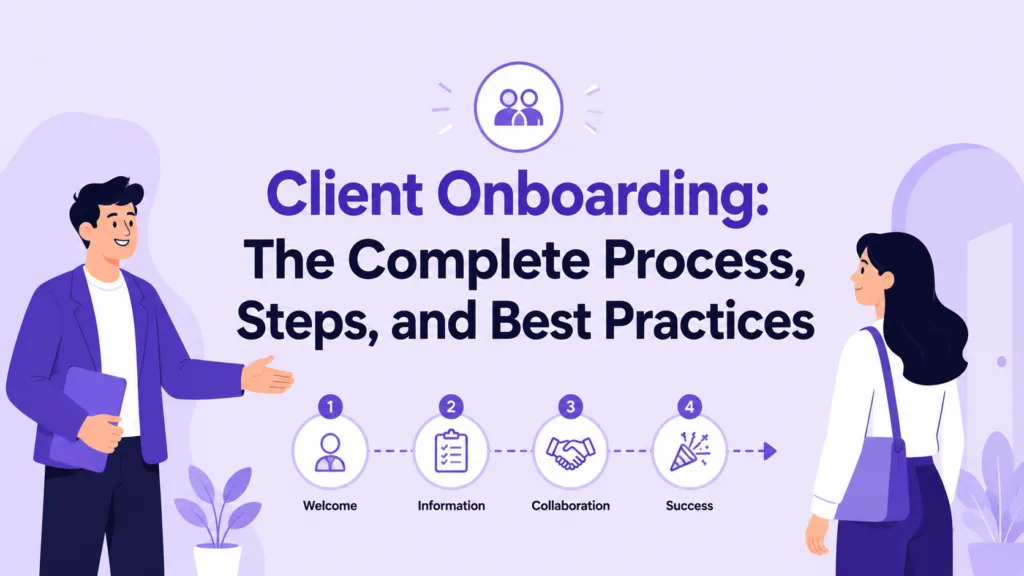
Quick summary: Client onboarding is the process of taking a new client from signed contract to first real value. It runs across three stages and a handful of core steps, from the welcome and kickoff through setup, training, and the first check-in. Done well, it is the single biggest lever on retention, since most early churn traces back to a weak start. Measure it on time to value, activation, and early churn, and automate the routine parts so your team can focus on the client.
Client onboarding is the make-or-break phase of every new customer relationship. It is the stretch between a signed contract and the moment a client first gets real value from what they bought, and it sets the tone for everything that follows. Get it right and you build a loyal, expanding account. Get it wrong and you lose a customer you already paid to win. Because acquisition is far more expensive than retention, that lost account is not just a churned logo; it is the wasted cost of every sales and marketing dollar spent to close it.
The stakes are easy to underestimate. Increasing customer retention by just 5% can lift profits by 25% to 95%, according to Bain research published in Harvard Business Review, and onboarding is where retention is won or lost. This guide covers what client onboarding is, the stages and steps, best practices, the mistakes to avoid, and how to measure it, so you can build a program that turns new clients into lasting ones.
What is client onboarding?
Client onboarding is the structured process of welcoming a new client, setting up their account, and guiding them to their first success with your product or service. It covers the handoff from sales, the kickoff, account and technical setup, training, and the early check-ins that confirm the client is on track. In practice it is the bridge between the promise made during the sale and the value the client actually experiences, and how well you build that bridge determines whether the account grows or quietly slips away.
It is worth separating two related ideas. Client onboarding is the B2B, relationship-level process of getting an account live and productive. User onboarding is the in-product experience that activates individual users. The two work together, but client onboarding is the broader arc, and it is where the commercial relationship is cemented. That relationship is fragile early, which is why onboarding carries so much weight, as the numbers make clear. The client has committed budget but has not yet seen the return, so confidence is high and patience is short. Onboarding is where you convert that commitment into proof.
Why client onboarding matters
Client onboarding matters because the first weeks decide whether a client stays for years or leaves within months, and the data on that is hard to argue with.
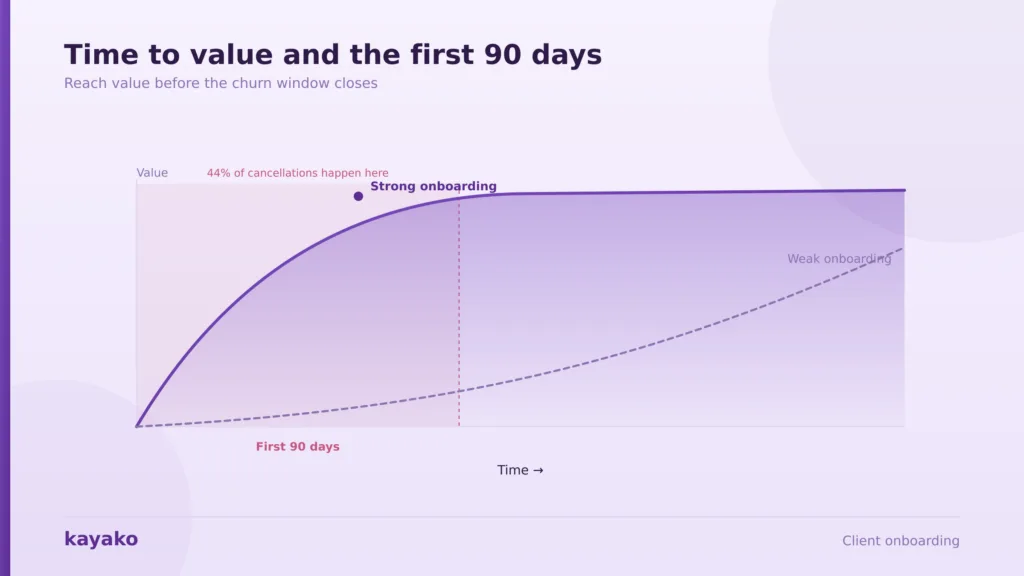
Start with churn. More than 20% of voluntary churn is linked to poor onboarding, according to Recurly’s analysis of subscription businesses, and 44% of subscription cancellations happen within the first 90 days, according to figures compiled by SundaySky. The first three months are both the most valuable and the most fragile part of the relationship. A client who stalls in week two rarely tells you; they simply disengage, and by the time the renewal comes up, the decision has effectively been made.
The upside is just as measurable. Every $1 invested in onboarding returns about $5 in revenue and cost savings, per Forrester research, and experience-driven businesses see 1.9x higher retention and 2.1x higher customer lifetime value than their peers, in Forrester data commissioned by Adobe. Clients notice the effort too: 86% say educational, welcoming onboarding content makes them more loyal, in OnRamp’s research roundup, and 63% weigh the onboarding period when they decide whether to subscribe in the first place, per Custify. Clients who come through a positive onboarding are also about 4x more likely to become brand advocates, and many will pay a premium of 12% to 21% over the average user, per OnRamp.
There is a cost angle as well. Acquiring a new customer costs five to twenty-five times more than keeping an existing one, so protecting a new account is far cheaper than replacing it. Strong onboarding is also a support-cost lever, since confused clients file more tickets. That link between onboarding, retention, and customer churn is why the process deserves real structure. There is also a silent-churn problem: most unhappy clients never complain; they simply leave, which means a weak onboarding rarely announces itself until the account is already gone. Building the process deliberately is the only reliable defense, starting with its stages.
The stages of client onboarding
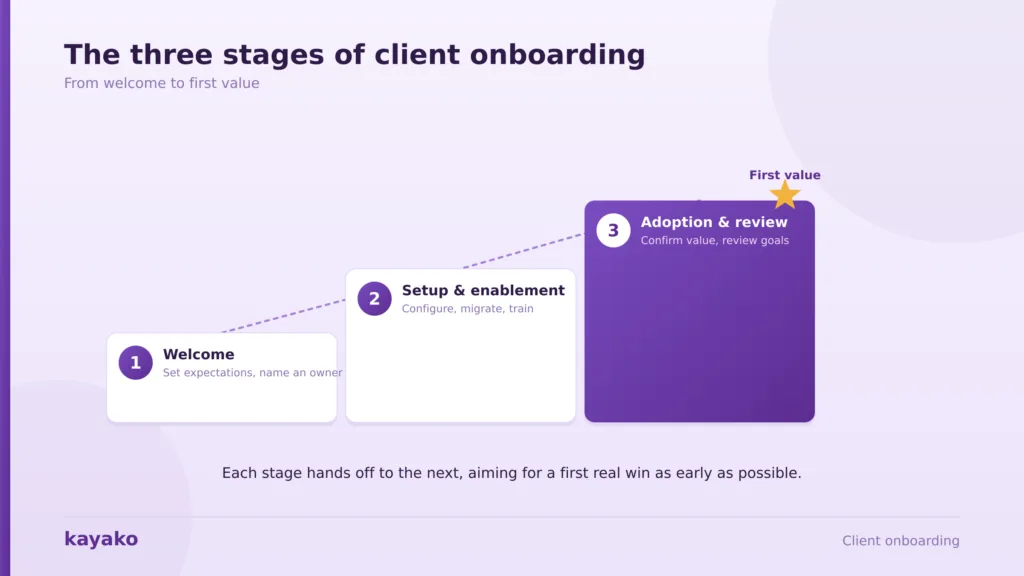
Client onboarding moves through three broad stages. Naming them helps you design each deliberately rather than improvising, and each one hands off to the next.
Stage 1: Welcome and expectations
The first stage covers the handoff from sales, a warm welcome, and a shared understanding of goals and timelines. It is where you confirm what success looks like for this client and set expectations for the weeks ahead. Being explicit here prevents most of the friction that shows up later, because a client who knows what to expect is far more patient when a step takes time. A strong welcome reassures a client who has just spent money, which sets up the practical setup work that follows. Small things carry weight here: a prompt, personal welcome that references the client by name and goal signals that the relationship did not end at the signature. This is also the moment to name a single owner, so the client always knows who to turn to.
Stage 2: Setup and enablement
The second stage is the hands-on work: account and technical configuration, data migration, integrations, and training. This is where time to value is won or lost, so the aim is to get the client to a first meaningful outcome quickly. The temptation is to show off everything the product can do; the discipline is to guide the client to one concrete win and let breadth come later. Every day of delay in this stage is a day the client is paying without yet seeing a return, which is exactly the feeling that breeds early doubt. A good knowledge base carries a lot of the load here, letting clients self-serve setup questions instead of waiting for an email. Once the client is set up and trained, the focus moves to adoption. The goal in this stage is a first tangible win, not a full feature tour; a client who achieves one real outcome quickly is far more likely to stay than one who is shown everything and does nothing.
Stage 3: Adoption and review
The third stage confirms the client is actually using the product and getting value, then reviews progress against the goals set in stage one. It closes the loop and transitions the account into ongoing success and expansion. A structured review against the original goals gives you a natural moment to demonstrate value, which is also the best possible setup for a renewal or an upsell conversation later. With the stages mapped, the practical question is what the day-to-day process looks like.
The client onboarding process step by step
Most effective onboarding programs follow a similar sequence. Adapt the details to your product, but the backbone looks like this.
- 1. Send a welcome email. Confirm the client is in good hands, set expectations, and share what happens next, ideally within minutes of the deal closing. This first message sets the emotional tone, so make it warm and specific rather than a generic template.
- 2. Share an intake questionnaire. Gather the details you need once, so the client never has to repeat themselves later.
- 3. Run a kickoff call. Align on goals, timelines, owners, and the definition of success for this account. A good kickoff is less a status meeting and more a commitment to a shared outcome, so leave it with a written summary everyone agrees on.
- 4. Set up the account. Handle configuration, data migration, and integrations, and remove as much of that burden from the client as you can.
- 5. Train the team. Deliver role-specific training and resources so every user knows how to get value.
- 6. Run the first check-in. Confirm the client hit a first win, surface blockers early, and adjust. This is the step teams most often skip when busy, and the one that most reliably catches a churn risk while it is still fixable.
- 7. Gather feedback. Ask how onboarding felt, and feed the answers back into the process, then act on what you hear so the next client benefits from the last one’s experience.
Speed matters throughout. Solving an issue on the first interaction can prevent 67% of the churn tied to it, per OnRamp, so fast, proactive communication during these steps pays off directly. That is easier when the process is standardized rather than reinvented for every client. A documented sequence means each new account gets the same strong start, and your team spends its energy on the client rather than on remembering what comes next. The right sequence also depends on the kind of client, which brings us to the types of onboarding.
Types of client onboarding
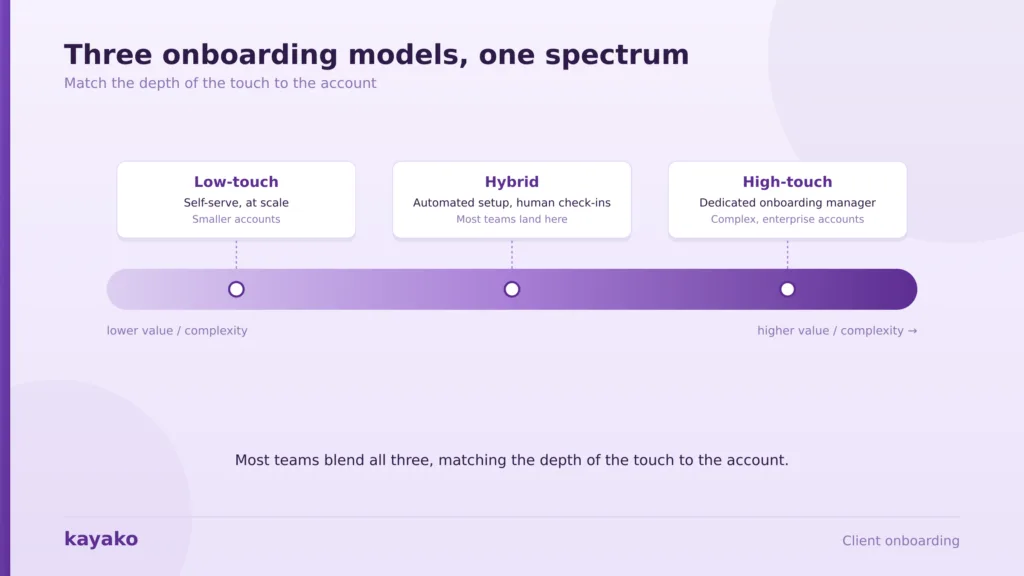
Not every client needs the same touch. Onboarding generally comes in three forms, and most companies mix them by segment, matching the depth of the touch to what the account is worth and how complex it is to set up.
- High-touch: a dedicated onboarding manager and live sessions, suited to enterprise or complex accounts.
- Low-touch: guided, mostly self-serve onboarding with light human support, suited to smaller accounts at scale.
- Hybrid: automated setup and resources plus human check-ins at key moments, which most teams land on.
The right mix depends on account value and complexity. Even high-touch onboarding benefits from automation behind the scenes, since a human touchpoint at the right moment yields up to 30% better 90-day retention, per figures compiled by Shno, while routine steps run themselves. Choosing the model is the setup; running it well is the practice, so here are the best practices that separate strong programs from weak ones.
Scale personal onboarding without scaling your team, with Kayako
Client onboarding best practices
The best onboarding programs share a set of habits. Adopt these, and you raise retention across every segment. None of them requires a big budget; they require discipline and a shared view of the client.
Standardize, then automate. Document the process once, then automate the repeatable parts. AI already handles a large share of routine onboarding questions, with chatbots answering about 75% of them instantly, per UserGuiding, which frees your team for the high-value moments. Pairing this with helpdesk automation keeps the setup moving without manual chasing. The point is not to remove the human touch, but to spend it where it matters, on the client, rather than on repetitive admin.
Personalize the experience. Tailor the kickoff and resources to the client’s goals and role. Clients who complete a strong onboarding carry about 21% higher lifetime value, per Shno’s roundup, and personalization is a big part of why. Tailoring the first week to a client’s stated goals, rather than a generic checklist, is what makes an account feel understood from the start.
Communicate proactively. Do not wait for the client to ask. Reach out at key milestones with updates and next steps. Building this into a wider B2B customer service strategy keeps the account moving and reassured. A single unprompted check-in at the right milestone often does more for confidence than a dozen reactive replies.
Give every rep full context. Nothing frustrates a new client faster than repeating themselves. A single view of the account across sales and support removes that friction. When support can see what sales promised and what the client has already told them, every interaction feels informed rather than cold, and the client never has to start over. These habits matter most when you see what happens without them, which is the next section.
Common client onboarding mistakes to avoid
Most onboarding failures come from a short list of avoidable mistakes. Watch for these.
- A slow or missing kickoff. Momentum fades fast after a signature. Delay the kickoff, and you risk the client cooling before they see value.
- Making the client repeat themselves. Scattered notes across sales and support force clients to re-explain, which erodes trust from day one.
- No clear owner. When no one owns onboarding, tasks slip, and the client feels it.
- No success metric. Without a defined first win, onboarding drifts, and no one knows if it worked.
These mistakes are expensive because early impressions stick. Given that 44% of cancellations land in the first 90 days, a stumble here often means losing the account entirely. Strong customer communication management fixes most of them, and the right tools make it easy, which is what we turn to next.
Client onboarding tools
The right stack turns a manual scramble into a smooth, repeatable process. The exact tools matter less than how well they share information, since gaps between systems are where clients fall through. A few categories cover most needs.
- CRM: tracks the account and the handoff from sales, so history follows the client.
- Onboarding and project tools: manage tasks, timelines, and owners across the onboarding plan.
- Knowledge base and self-service: lets clients answer setup questions on their own, at any hour.
- Shared inbox and support platform: keeps every onboarding conversation on one record with full context.
The through-line is a single, shared view of the client, available to everyone who touches the account. When a fragmented stack forces teams to hunt for context, onboarding slows and clients repeat themselves. A unified customer support platform with an AI shared inbox and a built-in knowledge base keeps the whole onboarding conversation in one place, so every rep picks up exactly where the last one left off. The fewer tools a client has to feel, the smoother the start. Tools only help if you know what good looks like, so define how you will measure success.
How to measure client onboarding success
You cannot improve what you do not measure. A handful of metrics tell you whether onboarding is working.
- Time to first value: how long until the client gets a first meaningful outcome. Shorter is better, and it is the metric most tied to retention.
- Activation rate: the share of clients who complete the core setup and reach a first win.
- Onboarding CSAT or NPS: how satisfied clients are with the onboarding experience itself.
- Early churn rate: the share of clients lost within the first 90 days, the clearest sign onboarding is failing. Watch it by cohort, since a spike in one month’s intake often points to a specific change in your process.
Track these from day one and review them often. Tying onboarding metrics to customer lifetime value makes the business case obvious, since a faster, smoother start compounds into years of retained revenue. Metrics point to where onboarding breaks; the next section shows how Kayako helps fix it.
How Kayako helps with client onboarding
Kayako strengthens the communication and self-service layer that most onboarding programs struggle with. Its SingleView gives every rep the full history of the account, so a new client never repeats themselves across sales and support. Its knowledge base deflects the routine setup questions that would otherwise slow things down, and Agent Kay resolves them autonomously, day or night. Proactive outreach powers the milestone check-ins that keep an account on track, all built on proactive customer service.
The payoff shows up in resolution speed, which is exactly what a new client feels first. Case study: Trilogy. After moving to Kayako, Trilogy eliminated 80% of its ticket volume, cut ticket age from 17.6 hours to under 2 minutes, and saved $5 million within a 90-day rollout. For a client in their first weeks, near-instant answers are the difference between confidence and second thoughts. That reliability is what turns a good onboarding into lasting retention. When a client can get an instant, accurate answer at any hour of their first week, the friction that usually drives early churn simply does not build up, and the account settles into the habit of success.
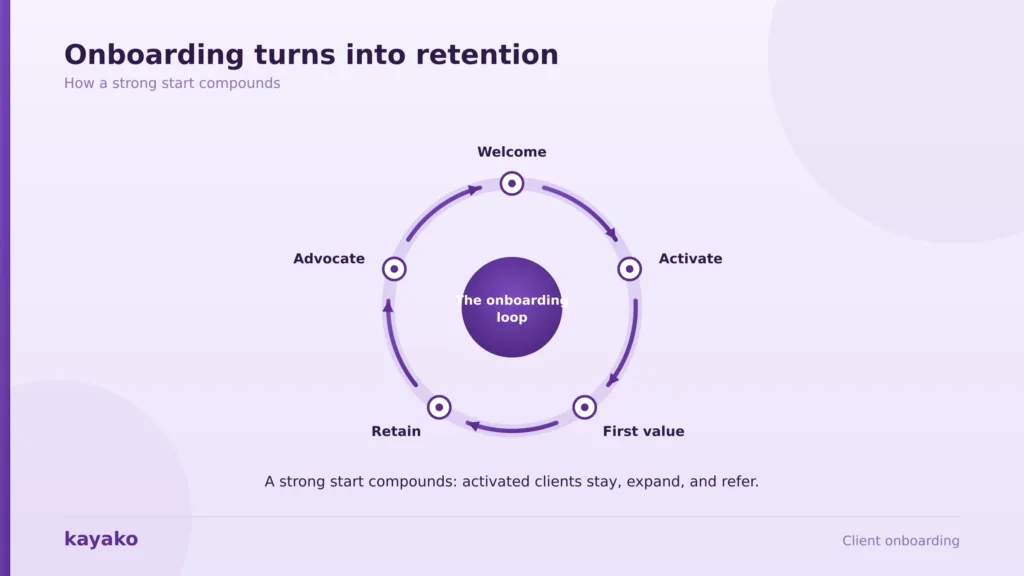
Client onboarding is the highest-value phase of the customer relationship. It runs through three stages and a clear sequence of steps, and it lives or dies on speed, personalization, and a single shared view of the client. The data is consistent: strong onboarding lifts retention, lifetime value, and referrals, while a weak start drives most early churn. Across every study, the pattern holds that the first weeks predict the whole relationship.
Build the process deliberately, automate the routine parts, measure time to value and early churn, and give every client fast, personal help from day one. Do that, and onboarding stops being a cost center and becomes the engine of retention that the numbers promise. The companies that treat the first 90 days as their most important product, not an afterthought, are the ones that keep the customers everyone else works so hard to win.
Frequently asked questions
What is the client onboarding process?
The client onboarding process is the sequence that takes a new client from a signed contract to the first value. It typically includes a welcome email, an intake questionnaire, a kickoff call, account and technical setup, training, a first check-in, and a feedback step. The goal is to get the client to a meaningful first outcome quickly, while removing friction and setting expectations for the relationship ahead.
How long should client onboarding take?
It depends on product complexity, from a few days for a simple tool to several weeks for an enterprise deployment. The metric that matters more than elapsed time is time to first value: how quickly the client gets a real outcome. Since 44% of subscription cancellations happen within the first 90 days, the aim is to deliver a first win as early as possible, then confirm adoption before that window closes. A useful rule of thumb is to map the shortest path to the client’s first real outcome and remove every step that does not lead to it.
What is the difference between client onboarding and user onboarding?
Client onboarding is the B2B, account-level process of getting a new client set up, trained, and productive, including the handoff from sales and the kickoff. User onboarding is the in-product experience that activates individual users. Client onboarding is the broader relationship arc, while user onboarding is one part of it. Strong programs align both the account and its individual users to reach value together.
What makes client onboarding effective?
Effective onboarding is fast, personalized, and consistent. It gets clients to a first value quickly, tailors the experience to their goals, communicates proactively at milestones, and gives every rep full context so clients never repeat themselves. It is standardized so nothing slips, and automated where possible, so the team focuses on high-value moments. Above all, it is measured by time to value and early churn.
How do you measure client onboarding success?
Track time to first value, activation rate, onboarding CSAT or NPS, and early churn within the first 90 days. Time to value and early churn are the clearest signals, since they connect directly to retention and lifetime value. Review the metrics often, and watch for drop-off points where clients stall, so you can fix the specific step that is costing you accounts. Aligning these onboarding metrics with